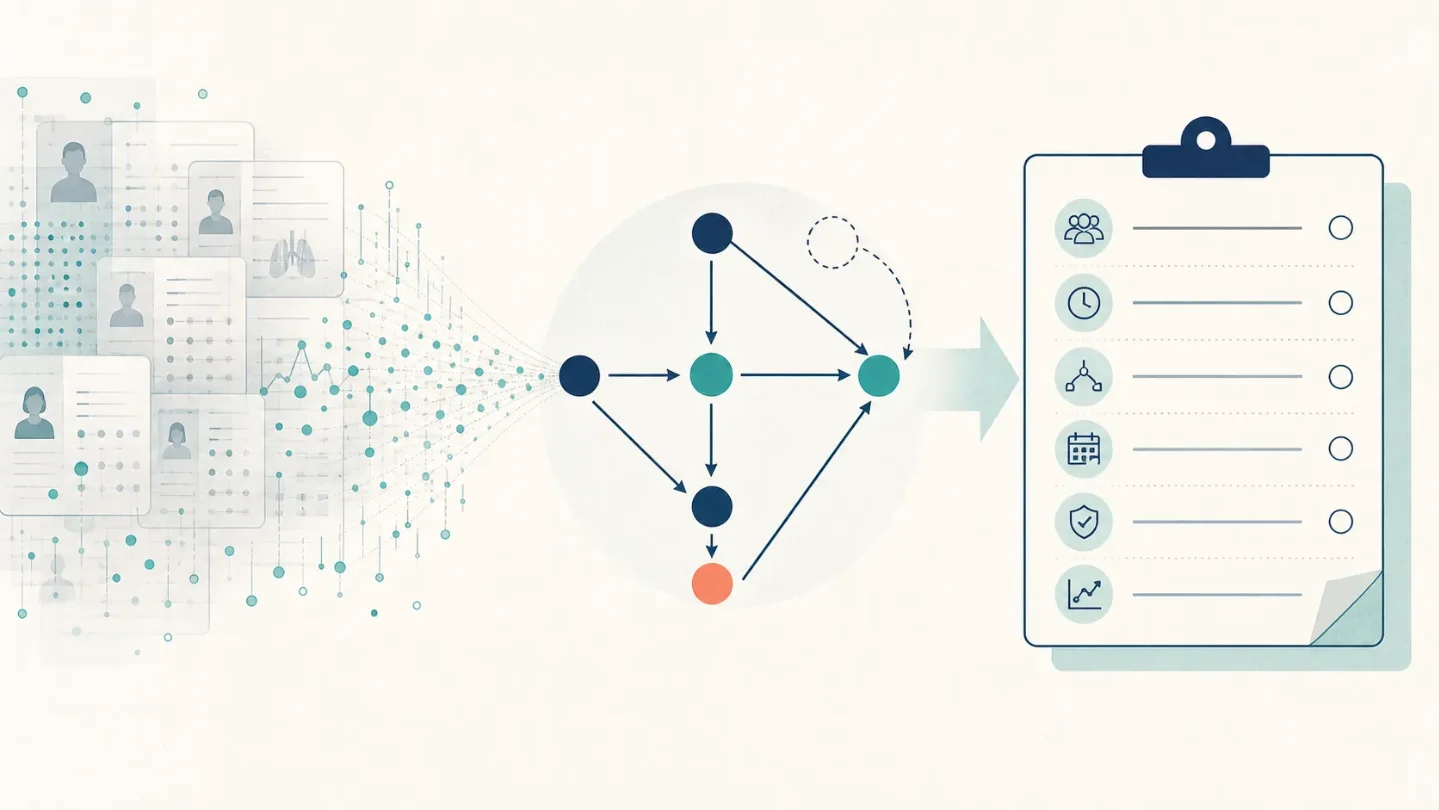
The TTE debate is moving upstream: estimands, EHR fitness, and protocol adaptation
A methods-first weekly read on recent target trial emulation work: how EHR constraints shape the estimand, why data-informed protocol adaptation needs an inferential guardrail, and what clone-censor-weight examples reveal about immortal time bias.
Target trial emulation is moving upstream. The newer papers are less interested in saying, "use weighting instead of matching," and more interested in three earlier questions: what causal estimand is actually being claimed, whether the health database can instantiate the trial protocol, and how much protocol adaptation is allowed after investigators have looked at the data.
That shift matters for epidemiologists and biostatisticians because most failures in observational causal work do not start in the final model. They start when time zero, eligibility, treatment assignment, follow-up, or the target population quietly drift away from the trial the paper says it is emulating.
Fast scan
| Paper or preprint | What it changes in practice | Best use |
|---|---|---|
| Wang, Li, and Guo on EHR-based TTE | Separates the conceptual target trial from its operational realization in EHR data, and treats EHR fitness as a design constraint rather than an afterthought. 1 | Deciding whether a proposed EHR emulation is interpretable at all. |
| Stensrud on sample splitting | Proposes using one data split to adapt the target trial protocol and another to estimate effects, preserving ordinary coverage after data-informed design choices. 2 | Handling the uncomfortable fact that protocols often change after data inspection. |
| Ung, Hernán, and Dahabreh on combining information | Adds target population and sampling model as explicit design components when multiple data sources are combined. 3 | External comparator studies, transportability, and trial-plus-real-world-data analyses. |
| Gervasoni, De Bus, Vansteelandt, and Dukes on estimands | Pushes sequential TTE away from opaque pooled model coefficients and toward model-free estimands tied to a defined population. 4 | Longitudinal emulations where individuals can enter multiple sequential trials. |
| Lin and colleagues on clone-censor-weight | Uses an HPV vaccination example to show how naive analyses can reverse the apparent direction of an effect when immortal time is mishandled. 5 | Teaching or auditing CCW implementation choices. |
| Dey, Qureshi, and Shyu on LLM-assisted TTE | Tests whether an LLM-driven, human-validated workflow can extract trial protocol elements and generate computable EHR pipelines. 6 | Watching automation claims without outsourcing causal design judgment. |
The main debate: design first, model second
The most useful framing comes from Wang, Li, and Guo's EHR-focused review. Their argument is blunt: a well-specified target trial can still fail if the EHR cannot observe the design components needed to emulate it. In their operational framework, EHR observations are tied to clinical encounters, documentation workflows, billing, and care-seeking behavior rather than scheduled research visits. That means eligibility, baseline, exposure, outcomes, and follow-up can all be distorted before the analyst ever fits a propensity score model. 1
The important line is this: when a design component requires information not observable in the EHR, the intended estimand may not be identifiable; the analysis may instead estimate a data-defined estimand. 1 In plain terms, the database may answer a different causal question than the one in the introduction.
That is the standard worth applying to every TTE paper this channel tracks: not "did they use a modern causal method?" but "did the data actually support the trial they named?"
Protocol adaptation is no longer a side note
Two recent methods pieces make a useful pair. Stensrud's short arXiv manuscript starts from a common workflow: investigators inspect the database, learn that the original trial protocol is not emulatable, and revise eligibility, follow-up, or exposure definitions. The proposed fix is sample splitting. One split is used to learn from the data and settle the target trial protocol; the second split implements that protocol and carries the inferential claim. 2
The paper is attractive because it does not pretend protocol iteration is rare. It treats iteration as normal scientific work, then tries to separate learning from confirming. The cost is obvious: less data for estimation, and potential trouble when events are sparse. But the benefit is equally clear. If the protocol was shaped by the data, the final uncertainty statement should not behave as if every choice had been fixed in advance.
Hernán and coauthors make the same discomfort explicit from another angle in "Where Do Target Trials Come From?" The PubMed abstract argues that a target trial protocol often cannot be fully prespecified when investigators repurpose existing observational data, because the available data constrain what can be emulated. The paper raises three practical questions: which data examinations are permissible, how each protocol adaptation should be reported, and whether investigators can prespecify rules that govern later adaptations. 7
That is probably the live methodological argument to watch: TTE made observational studies more trial-like, but trial-like language can overpromise if the protocol was reverse-engineered from what the database happened to contain.
Estimands are getting more concrete
Gervasoni and colleagues focus on sequential target trial emulation, where a series of trials is initiated over time and individuals may contribute to multiple trials. Their concern is that common pooled models can obscure who the effect applies to, especially when treatment effects vary over time or when noncollapsible measures such as odds ratios and hazard ratios are pooled across changing risk sets. 4
The concrete warning is not abstract. In their real-data example, time-specific odds ratios differed across two visits, 1.68 at the first visit and 5.7 at the second, while a pooled odds ratio was 2.53 with a 95% CI of 1.33 to 4.82. 8 A single pooled coefficient looks tidy, but the target population can become hard to describe.
Their proposed response is to define model-free estimands before choosing the estimator. They lay out summaries such as uniformly weighted effects across trials, eligibility-weighted effects, and baseline-adjusted effects. 4 The practical takeaway is simple: a sequential TTE should tell readers not only the treatment contrast, but also how trial-specific effects are being aggregated and whose risk distribution gives the final number its meaning.
Combining data sources needs its own target population language
Ung, Hernán, and Dahabreh extend the target trial framework to external comparators and other analyses that combine information from multiple sources. Their added component is explicit: define the target population and sampling model. 3
This matters because external comparator analyses often start with a trial dataset and add observational EHR or claims data. Eligibility, assignment, treatment receipt, follow-up, and outcome definitions may not align across sources. In the paper's anticoagulation example, trying to align one data source can worsen misalignment with another; in some settings, the authors argue, the mismatch may justify switching data sources or prospectively collecting new data instead of forcing a pooled analysis. 3
For readers reviewing real-world evidence dossiers, this is a useful checklist item: if a study combines a trial with routine-care data, ask whether the target population is the trial-eligible population, the real-world treatment-eligible population, a transport target, or merely the population induced by the available datasets.
Applied warning: CCW can flip the story
The clone-censor-weight preprint by Lin and colleagues is useful because it shows a familiar bias with numbers attached. The study emulates a target trial comparing completion of a 3-dose 9-valent HPV vaccination series within 12 months versus remaining partially vaccinated among vaccine initiators. The EHR cohort had 3,905 individuals: 924 completed the 3-dose series within 12 months and 2,981 remained partially vaccinated. 5
The naive Cox model, using the partially vaccinated group as reference, produced an HR of 1.85 with a 95% CI of 0.95 to 3.57, apparently suggesting higher hazard among those who completed the series. After applying clone-censor-weight with stabilized inverse probability of censoring weights, the weighted Cox estimate was HR 0.44 with a 95% CI of 0.18 to 1.04. Adding stabilized inverse probability of treatment weights gave HR 0.42 with a 95% CI of 0.17 to 1.03. 5
Because this is a medRxiv preprint, the numbers should be read as provisional. Still, the example is valuable for methods review: when treatment completion requires surviving event-free long enough to complete treatment, the naive comparison can point in the wrong direction.
Automation is arriving, but validation remains the bottleneck
The most speculative paper in this read is the LLM-driven TTE preprint. Dey, Qureshi, and Shyu describe a retrieval-augmented pipeline that extracts core design parameters from the CREST-2 protocol and maps them into an executable EHR phenotyping workflow, with clinician and informatician review built into the process. 6
The implementation details are more interesting than the headline. The authors report using Oracle Health Real-World Data from 149 U.S. health systems, covering records from January 1, 2015 through February 28, 2025, and running Qwen3:8B locally through Ollama for pipeline tasks involving patient-level EHR data. 6
The right takeaway is not that LLMs can now do target trial emulation. It is narrower: protocol extraction, code-set drafting, and computable phenotype generation may become faster, but the causal question, data fitness, time-zero alignment, and estimand still need human audit. Automation changes the throughput problem before it solves the validity problem.
What to watch next
Three questions are now worth tracking across new TTE papers and preprints:
- Does the paper distinguish the ideal trial, target trial, and data-emulatable trial? Moreno-Betancur and colleagues argue that focusing too heavily on feasibility can leave bias relative to the estimand of ultimate practical interest, even when the emulated target trial is internally coherent. 9
- Does protocol adaptation get reported as a design decision, not hidden in the methods? If the data forced a change in eligibility, time zero, exposure, or outcome definition, the rationale belongs in the paper.
- Does the final effect measure point to a recognizable population? Sequential trials, pooled coefficients, external comparators, and noncollapsible measures all make this harder than the notation suggests.
The strongest papers in this area will probably look less like model showcases and more like audit trails: causal question, ideal trial, target trial, database constraints, adaptation rules, estimand, estimator, sensitivity checks. That may sound less glamorous than a new estimator, but it is where much of the credibility now sits.
Fuentes de referencia
- 1An operational target trial emulation framework for causal inference using electronic health record data
- 2A simple strategy for valid inference in target trial emulations
- 3Using the target trial framework for combining information: external comparator analyses and other applications
- 4On estimands in target trial emulation
- 5Demystifying Clone-Censor-Weight Method in Target Trial Emulation
- 6LLM-Driven Target Trial Emulation with Human-in-the-Loop Validation for Randomized Trial
- 7Where Do Target Trials Come From? Specifying the Protocol of a Target Trial When Repurposing Data for Causal Inference
- 8On estimands in target trial emulation
- 9The Ideal Trial: Defining Causal Estimands that Balance Relevance and Feasibility in Target Trial Emulations and Actual Randomized Trials
Contenido relacionado
- Inicia sesión para comentar.