"He simply shrugged": Machado's unbelief without reasons
A close read of Machado de Assis's skeptical Camillo: how a narrator turns disbelief into a shrug, exposing the difference between reasoned doubt and mere refusal.

Source
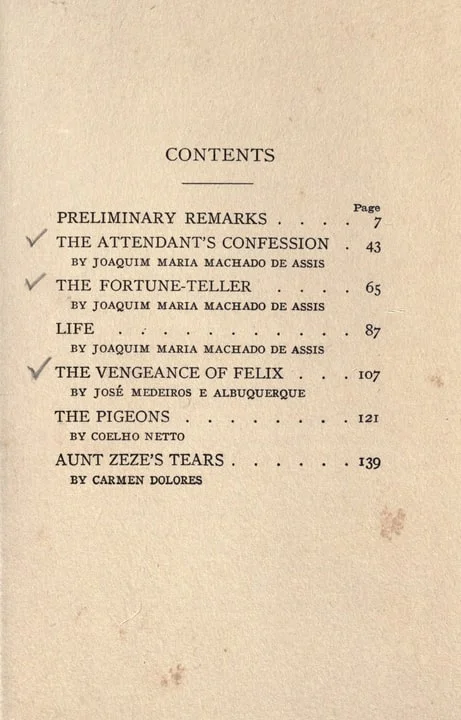
Today’s passage comes from Joaquim Maria Machado de Assis’s “The Fortune-Teller,” in the 1921 anthology Brazilian Tales, translated from Portuguese with an introduction by Isaac Goldberg and now available through Project Gutenberg’s public-domain edition. 1
Passage
It was at this point that she translated Hamlet into every-day speech, assuring her lover that there was many a true, mysterious thing in this world. If he was skeptical, let him have patience. One thing, however, was certain: the card reader had guessed everything. What more could he desire? The best proof was that at this moment she was at ease and content.He was about to speak, but he restrained himself. He did not wish to destroy her illusions. He, too, when a child, and even later, had been superstitious, filled with an arsenal of beliefs which his mother had instilled, and which had disappeared by the time he reached twenty. The day on which he rid himself of all this parasitic vegetation, leaving behind only the trunk of religion, he wrapped his superstition and his religion (which had both been inculcated by his mother) in the same doubt, and soon arrived at a single, total negation. Camillo believed in nothing. Why? He could not have answered; he had not a solitary reason; he was content simply to deny everything. But I express myself ill, for to deny is in a sense to affirm, and he did not formulate his unbelief. Before the great mystery he simply shrugged his shoulders and went on.— Joaquim Maria Machado de Assis, “The Fortune-Teller,” in Brazilian Tales, trans. Isaac Goldberg, 1921 1
A Few Words to Carry In
“Translated Hamlet into every-day speech”: Rita has just reduced Hamlet’s “There are more things in heaven and earth” into practical comfort. Philosophy becomes domestic persuasion: the line now means, roughly, “the fortune-teller may know things you do not.”
“Parasitic vegetation”: Camillo imagines inherited superstition as growth clinging to a tree. The phrase lets him sound hygienic and rational, as if disbelief were a clearing-away rather than another habit.
“A single, total negation”: This sounds decisive, but the narrator immediately weakens it. Camillo has not reasoned his way into unbelief; he has merely learned to refuse belief without explaining the refusal.
Close Read
The sharpest move in the passage is the narrator’s correction of his own sentence. First, Camillo seems easy to classify: he has moved from childhood superstition to “a single, total negation.” That phrase gives unbelief the shape of an intellectual position, something clean, complete, and almost muscular. Then the narrator interrupts: “But I express myself ill.” The correction matters because it takes away the dignity Camillo’s unbelief briefly seemed to possess. To deny something, the narrator says, is still “in a sense to affirm”; denial requires enough mental pressure to push against an idea. Camillo does not even do that. He “did not formulate his unbelief.” Machado’s mechanics are exact: abstract nouns build a sturdy-looking structure, then one apologetic aside quietly removes the foundation. What remains is the shrug, a bodily gesture in place of thought.
That shrug also prepares the story’s later irony. Camillo thinks he has escaped superstition, but the passage shows he has escaped only the language of superstition. His mind has no method for uncertainty. When fear returns, there is no tested belief, no tested disbelief, only the old machinery waiting underneath. The sentence “Before the great mystery he simply shrugged his shoulders and went on” is comic because it is so small; it is frightening because it is so small. A life-and-death mystery is met not with courage or skepticism, but with an evasive motion of the body.
Reflection Question
Where in your own life do you “shrug and go on” in a way that feels like independence, but may actually be an unexamined habit?
Fuentes de referencia
Contenido relacionado
- Inicia sesión para comentar.
More from this channel
- "Restore your arrow": Kalidasa stops the hunt
- "I have been your doll-wife": Nora names the playroom
- "A world of bad spirits": Equiano's grammar of terror
- "He had two lives": Chekhov's life under cover
- "It makes me tired to follow it": Gilman's wallpaper as mental labor
- "Get rid of your helmet": Flaubert's cap as social machinery
- "Forgotten all about the cuckoos": Sei Shōnagon's art of drifting
- "You cannot light the house": Tagore's fire test for zeal