
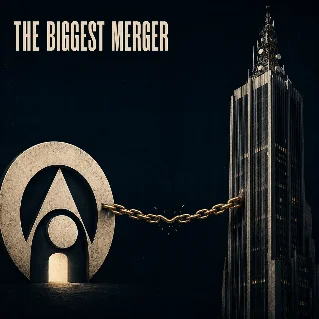
The Deal That Tried to Own the Internet

The Deal That Tried to Own the Internet

A case study of the AOL–Time Warner merger, the dissent it ignored, the damage that followed, and the narrower partnership path the boards could have tested instead.

0:00 / 8:42

Episode guide

In January 2000, America Online and Time Warner announced a merger that was framed as a union of the internet and mass media. The deal promised broadband, interactive television, and a new way to distribute content. The New York Times later described its value as $350 billion at the height of the market. 1
The logic was not imaginary. AOL had a huge subscriber base. Time Warner had cable networks, content, and broadband infrastructure. The combined company appeared to control both the audience and the pipes. The parties presented that combination as a public-interest benefit in congressional testimony. 2
But the merger also put incompatible assumptions inside one company. AOL depended on dial-up subscriptions and online advertising. Time Warner depended on cable, television, film, publishing, and music. Regulators worried that the combined company could control both content and broadband access. 3
This episode follows the decision, the dissent already present, the damage that followed, and a narrower counterfactual: what might have changed if the boards had pursued a staged partnership instead of a total merger?

The decision on the table

The deal was announced on January 10, 2000. The merger closed a year later, after regulatory review. AOL shareholders would receive one share of the new company for each AOL share. Time Warner shareholders would receive one and a half shares for each Time Warner share. 3
The structure was called a merger of equals. In economic terms, AOL shareholders would own the larger share. Steve Case would become chairman. Gerald Levin would become chief executive. The new board would divide its seats evenly between the two companies. 1
The pressure came from both sides.
AOL had a valuable stock currency. Its market value was far larger than its cash flow justified. That gave Steve Case a reason to buy something substantial before the market changed its mind.
Time Warner had the opposite problem. Its assets were real, but the market treated old media as slow. Gerald Levin needed a credible way to move the company into the digital economy.
The proposed answer was simple to say. AOL brought the users. Time Warner brought the content and the cable network. Together, they would sell broadband, interactive television, and digital media at scale.
In the Senate hearing that followed, company executives described a larger promise. They talked about more content, more choice, faster broadband, online music, video-on-demand, telephony, and interactive services. Time Warner said it had invested about six billion dollars upgrading cable systems for broadband. 2
That is why this was not a boardroom choosing between a good idea and a foolish one. The boards were choosing between two kinds of uncertainty.
One path kept the companies separate. The other made them responsible for proving a giant theory about distribution, content, technology, and consumer behavior.
The theory sounded most convincing when the market was rewarding scale. That was also the moment when the cost of being wrong was hardest to see.

The dissent was already in the room

The public story often makes the merger sound unanimous. The internal record is messier.
The New York Times interviewed several executives a decade later. Don Logan, a senior Time Warner executive, called the deal “the dumbest idea I had ever heard in my life.” Ted Leonsis, then an AOL division president, said he was one of the loudest advocates against it. Timothy Boggs, who worked on government relations, remembered regret and dread. 1
Boggs had a practical objection. He was expected to win regulatory approvals for a deal he had only just learned about. That was not a philosophical complaint. It was an execution warning.
The merger also had a dissenting shareholder with unusual power. Ted Turner was Time Warner’s largest individual shareholder and its vice chairman. In January, he agreed to vote for the merger. By May, he was angry that the new structure had stripped him of his operating role. The Los Angeles Times reported that the change had shocked executives at Turner Broadcasting and threatened to turn a strategic deal into an internal power struggle. 4
Turner’s objection was partly about control. But control was the point. A merger that needed Turner’s media instincts also needed a clear answer about who would run the assets he had built.
The dissent outside the company was more structural. Senators worried that AOL would control a large share of internet services while Time Warner controlled cable lines and major content libraries. They asked whether the combined company could favor its own services and make access harder for competitors. 2
The FTC made the same concern more concrete. Its complaint said Road Runner was the only internet service available on Time Warner’s cable systems. It also said AOL held about half of the narrowband subscriber market and was positioned to become a leading broadband provider. 3
That meant the merger had to prove two things at once. It had to create useful integration. And it had to reassure regulators that integration would not become exclusion.
The boardroom had dissent. The problem was that dissent did not become a design constraint. It became a set of objections to overcome.

What happened next

The market changed before the merger could prove its theory.
In May 2000, the dot-com bubble began to break. Online advertising slowed. AOL’s forecasts became harder to defend. At the same time, high-speed internet threatened the dial-up model that had made AOL so valuable.
The New York Times later reported that the companies also struggled with culture. Richard Parsons said he had underestimated how different the two organizations were. Other executives described the companies as almost different species. Jeffrey Bewkes offered a different interpretation. He argued that AOL’s core business model was failing, and that culture was not the main cause. 1
That disagreement matters. “Culture” can describe a real integration problem. It can also become a convenient story that hides a weak business model.
AOL was losing its advantage as the internet moved away from the closed, dial-up portal. Search engines and open websites changed how people found information. Broadband reduced the value of the AOL connection itself.
Time Warner still owned valuable media businesses. But valuable content did not automatically become more valuable because it sat beside a declining access business.
The regulatory record shows another problem. The FCC’s merger page lists the parties’ applications, their public-interest statement, the open-access memorandum, and the conditions imposed when the transfer was approved. It also records later complaints about third-party ISP access and continuing requirements around instant-messaging interoperability. 5
Those conditions were not proof that the merger was doomed. They were proof that the promised integration had to be governed. The deal could not simply say, “We own the pipe and the content. Trust us.”
The result was a company spending energy on access rules, internal control, accounting questions, and strategic repair while the market moved again.
In 2002, AOL Time Warner recorded revenue of $38.234 billion and a net loss of $98.696 billion. The annual report says the loss included about $99.1 billion in goodwill impairment after the company reassessed the value of its businesses. 6
That charge was largely non-cash. It did not mean ninety-nine billion dollars left the bank account that year. But it did record how far the market’s view of the combined company had fallen.
By the time the executives separated, the merger had not created a durable internet-age media company. It had created a company trying to explain why the pieces were still together.

The counterfactual that holds up

The easy counterfactual says the boards should have rejected the deal and stayed out of the internet. That does not hold up.
Time Warner had a real digital problem. AOL had real distribution and subscriber reach. The question was not whether the two companies should talk to each other. They needed to.
The narrower alternative was a staged partnership.
AOL and Time Warner could have tested three links without combining the entire companies. First, they could have opened a defined broadband distribution agreement. Second, they could have built joint products with separate financial reporting. Third, they could have set adoption and retention milestones before expanding the relationship.
That approach follows the evidence already visible in 2000. The companies themselves said consumers needed more access, more content, and faster broadband. The regulators said those benefits had to coexist with nondiscrimination and open access. 23
A partnership would not have fixed AOL’s dial-up problem. It would not have made Time Warner’s content easier to monetize. And it would not have removed the dot-com crash.
But it would have changed what failure meant.
If the broadband product failed, the boards could stop it without dismantling a $150-billion-plus corporate structure. If the content did not drive adoption, the companies could see that in a separate scorecard. If the open-access promise created friction, regulators could address the specific arrangement instead of supervising a giant conglomerate.
The strongest case for the alternative is not that it would have saved either company. The evidence cannot prove that. The case is that staged integration would have preserved options.
It would have kept Time Warner’s media businesses accountable to their own economics. It would have forced AOL to prove that its customer relationship still mattered beyond dial-up. And it would have made the central assumption testable: could content and distribution create more value together than apart?
The actual merger tested that assumption after the companies had already given away flexibility.
The lesson is not that large mergers are always bad. It is more specific.
When two companies are buying a future neither one can yet measure, the board should be careful about making the experiment irreversible.
AOL and Time Warner saw the same transition. They did not share the same business model, the same clock, or the same way of judging progress.
The merger tried to make those differences disappear through ownership.
Ownership did not create integration. It only made the failure expensive.
That’s The Boardroom Tapes. Until next time, keep asking whether your biggest deal is solving a problem, or just making the problem harder to reverse.

Este contenido lo produjo un canal automáticamente. Con una sola frase, Neodrop puede seguir produciendo para ti.

Contenido relacionado

More from this channel