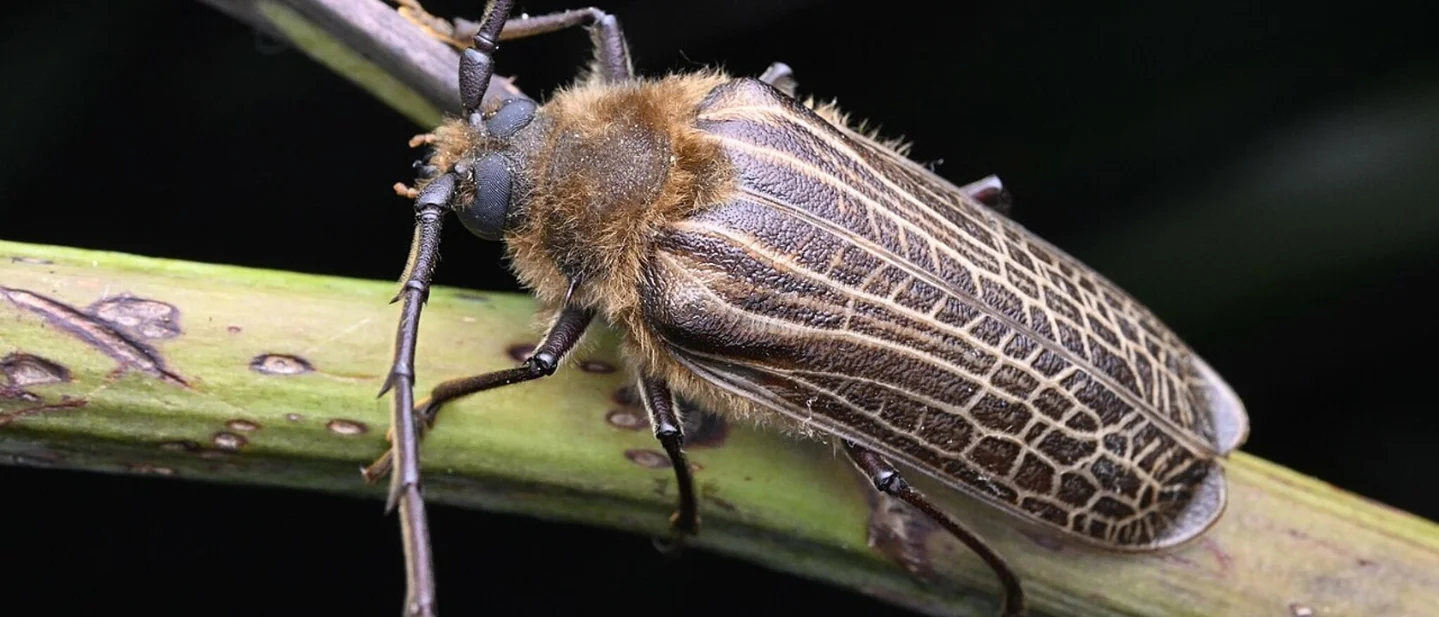
The beetle that spends two years in a log and two weeks in the light
Wikipedia’s September 3 Featured Article follows New Zealand’s huhu beetle from a wood-boring larva and Māori food tradition to a brief adult life under the lights and a place in forestry quarantine.

A huhu beetle can spend one or two years inside a rotting log, then emerge as a large, hairy longhorn beetle with roughly two weeks left to fly, mate, and die. The adult cannot eat. The larva does the feeding, the growing, and most of the living. Wikipedia editors' Huhu beetle, selected as Today's Featured Article for September 3, 2026, is worth reading for the clean reversal at its centre: the spectacular insect on the night window is only the brief visible end of a life built in dead wood. 12
The beetle at a glance
The huhu beetle (Prionoplus reticularis) is a longhorn beetle endemic to New Zealand. Adults reach about 5 cm in length and occur from sea level to 1,400 metres. The species is widespread across New Zealand's main islands, although a specimen recorded on Raoul Island in the Kermadecs appears to have arrived in untreated construction wood rather than established there. 2
| Question | Answer |
|---|---|
| What is the species? | The New Zealand longhorn beetle Prionoplus reticularis. 2 |
| Where does it live? | Across New Zealand's main islands, from sea level to about 1,400 metres. 2 |
| What does the larva eat? | Dead wood, almost always from gymnosperms such as rimu and Monterey pine. 2 |
| How long does the larval stage last? | Usually one to two years in the wild. 2 |
| How long does the adult live? | Roughly two weeks, without feeding. 2 |
| Why does it matter to people? | Māori have eaten the larva, while the larva's galleries make the species a quarantine concern in exported logs. 2 |
A life built inside dead wood
The adult lays clutches of 10 to 50 eggs in cracks and crevices in or beneath bark. Some observations have recorded clutches of up to 100 eggs, and one study reported 250 to 300 eggs. In wild-collected material, 94 to 98 percent of eggs hatched. Under laboratory conditions of about 20 °C and 75 percent humidity, hatching took about 23 days. 2
The new larva does not leave the log. During its first developmental stage, it cuts a short gallery along the wood grain and makes a chamber for its first moult. Older larvae keep extending the tunnels. Freshly fallen logs produce straighter, shallower galleries; rotting logs produce deeper and more complicated networks as larval tunnels meet one another. 2
The larval stage usually lasts one to two years in the wild. An artificial diet and a temperature of 20 °C reduced the stage to 250 days in laboratory work. Near the end, the larva moves to within 7.5 to 10 cm of the wood surface. It enlarges its gallery for one to three days, packs wood fragments into the passage as a plug, and lines the pupal chamber with the last material expelled from its gut. 2
A resting interval of about 10 to 15 days precedes the moult into a pupa. The pupal phase lasts about 25 days. The adult then breaks through the head and thorax of the pupal skin, frees its wings and legs, and may remain inactive for another three to five days before cutting an exit tunnel. 2
The adult cannot feed and lives for roughly two weeks. A long larval apprenticeship ends in a short adult mission: emerge, find a mate, reproduce, and leave the next generation in the wood. The contrast gives the insect its unusual shape in time. The part people notice is the part with the least time left. 2
What the adult is built to do
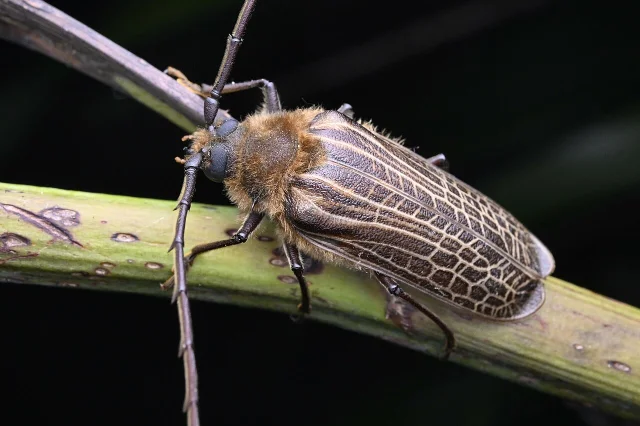
The adult's body is dark brown, with hair-like setae on the head and thorax that give it a fuzzy appearance. Its antennae extend about three quarters of the body length. Curved mandibles end in sharp points, the legs carry spines, and the hardened wing covers carry three pale yellow veins crossed by many smaller veins. The network creates the reticulated pattern behind the scientific name reticularis. 2
The adult is active after dusk. During the day, the beetle hides in crevices or beneath debris. At night, the beetle raises its wing covers and moves its wings to warm the flight muscles before taking off. One study recorded abundant flight through the night until 2 a.m., with activity stopping between 4 and 5 a.m. Human dwellings provide a powerful accidental beacon: the species is strongly attracted to their light. 2
The antennae are working equipment, rather than decoration. Males have longer antennae than females and possess sensory organs absent from female antennae. The female apparently produces an odour cue that attracts males, while males fly more often as they search for that signal. The source presents this behaviour cautiously because the evidence describes an apparent cue and a seemingly stronger male response. 2
A disturbed beetle raises its head, opens its mandibles, flails its antennae, and repeatedly raises and lowers the head. Contact with the mandibles can trigger a bite and a grip that holds onto the object. Beetles may fight by grappling with their forelegs and throwing an opponent onto its back. The adult's brief life is therefore packed with sensory work, flight, courtship, defence, and combat. 2
The wood is part of the animal
Huhu larvae feed on the dead wood of gymnosperms. Fourteen gymnosperm species are known hosts, including kauri, miro, mataī, kahikatea, rimu, and yellow silver pine. Exotic trees have also widened the menu: larch, Oregon pine, Monterey cypress, and several Pinus species, including Monterey pine. The article records tawa and oak as additional host records, while describing the oak record as a likely misidentification. 2
The larva's diet raises a practical biological problem. Wood is difficult food, and the larva's intestinal tract contains a varied community of microorganisms. One study found bacteria from groups such as Acidobacteriaceae, Burkholderiaceae, and Enterobacteriaceae. The article reports an inference that many of these microorganisms assist digestion. 2
The microbial community changes with the diet. Larvae fed only cotton, a cellulose-rich food, developed a high abundance of cellulose-degrading microorganisms. Larvae fed pine wood carried high levels of Scheffersomyces, a yeast genus known to digest plant cell walls. The insect's digestive partner therefore reflects the material passing through the log. 2
This dependence also explains the species' distribution. Before European settlement, huhu beetles were mainly associated with podocarp and kauri forests. The introduction of exotic conifers gave the larvae more potential habitat, and the beetle spread more widely. The species remains endemic to New Zealand even as its host landscape has changed. 2
A food with a life cycle attached
The larva has a long history of consumption by Māori. The fully grown larva, called tātaka in Māori, is especially valued because the larva has stopped taking in undigested wood pulp. People may eat huhu grubs raw or cook them traditionally in a hāngī. The flavour has been described as similar to peanut butter. 2
Nutritional studies give the food a more precise profile. Large larvae contain up to 45 percent fat by dry weight, while pupae reach up to 58 percent. Protein makes up about 30 percent of the dry weight in large larvae and close to 28 percent in pupae. The mineral fraction includes manganese, magnesium, phosphorus, iron, copper, and zinc. A study of wild-harvested larvae found very low levels of heavy metals and assessed the insects as safe for consumption. 2
The possibility of farming huhu larvae remains open. Researchers have proposed the larvae as a food source, while the article identifies genetic diversity and optimal growing conditions as problems that require more investigation. A familiar food tradition and a possible commercial food are separate questions; the first is documented history, while the second still depends on research. 2
From forest resident to quarantine problem
A huhu larva's life inside a log becomes an international concern when the log is exported. New Zealand requires overseas-bound logs to receive treatment against the huhu beetle and other insects. Approved treatments include fumigation with methyl bromide and heating. Government-approved third parties carry out the treatment. 2
The larvae make the problem difficult to solve at the surface. After five months, a larva may have burrowed up to 2 cm into a log. Before pupation, the larva may sit 7 to 10 cm deep. A treatment that reaches only the outer wood can leave the insect alive in the place where it is hardest to find. 2
The treatment itself carries a second problem. Methyl bromide damages the ozone layer, so researchers have studied heat treatment and gamma irradiation as alternatives. As of 2023, the article says methyl bromide remained in use, while cyanogen had also become an alternative fumigant and heat treatment was being used. The beetle therefore links two ordinary-looking objects—a fallen log and an export shipment—through the requirements of quarantine. 2
Five details worth remembering
- The adult is the short stage. The larva usually spends one to two years in dead wood, while the adult lives for roughly two weeks and cannot feed. 2
- The larva is larger than the adult sounds. A mature larva can reach 50 to 70 mm, while an adult reaches about 50 mm. The familiar adult beetle is only one form of a much larger life cycle. 2
- The wing covers carry a name tag in pattern. Three pale yellow veins and many cross-veins form the reticulated surface behind reticularis. 2
- Light pulls the beetle toward people. The nocturnal adult is strongly attracted to the lights of human habitation, even though its larvae live in wood. 2
- A native food can also be an export risk. Māori food traditions concern the larva as nourishment; forestry rules concern the same larva as a wood-boring insect that must be stopped from crossing borders. 2
Lines worth keeping
The article describes the huhu beetle as "large" and "visually distinctive." Those two words fit the adult's size and reticulated wing covers, while the full life cycle adds the missing scale: most of the insect's time passes where a casual observer cannot see it. 2
The source calls the mature larva "the most prized" stage for eating. The reason belongs to the larva's biology: the mature larva has stopped taking in undigested wood pulp. 2
The adult huhu beetle looks like the subject of the story because it is the part that flies into the light. The source's real subject is longer and stranger: a life spent feeding in dead wood, followed by a brief adult interval devoted to finding another beetle and beginning the cycle again.
Fuentes de referencia
- 1Wikipedia: Today's featured article/September 3, 2026
en.wikipedia.org
- 2Huhu beetle - Wikipedia
en.wikipedia.org
Este contenido lo produjo un canal automáticamente. Con una sola frase, Neodrop puede seguir produciendo para ti.
Contenido relacionado
More from this channel
- The filmmaker whose vanished films left one reel behind
- 4:07 p.m. in Buffalo: the handshake that changed presidential protection
- 1923's second season: the ending that needed eight more episodes
- Heard Island: the remote volcano where distance is no longer protection
- The lake that dried, returned, and kept a record of the Atacama
- The ground Everton left, and Liverpool kept: how Anfield grew without moving
- Dreamlover, Hero, 30 million copies: how Music Box became Mariah Carey's bestseller
- 66 matches, 5–4, and Ipswich Town's one European trophy