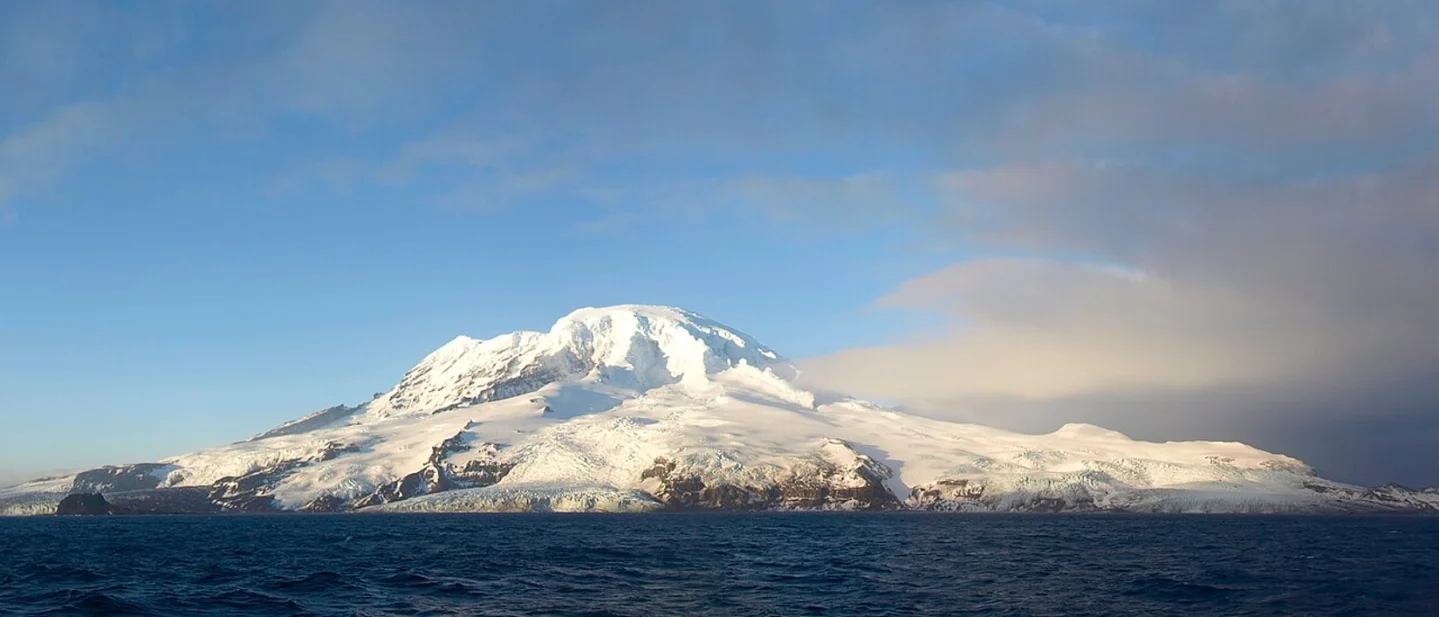
Heard Island: the remote volcano where distance is no longer protection
Wikipedia’s September 4 Featured Article traces Heard Island and the McDonald Islands from seal-hunting outpost to protected volcanic ecosystem now changing under warming, disease, and regulated human pressure.

Heard Island is an Australian territory with no residents, a 2,745-metre volcano, glaciers covering about 70 percent of its land, and more than one million pairs of macaroni penguins. Wikipedia editors selected Heard Island and McDonald Islands as Today's Featured Article for September 4, 2026; its story follows a place protected by distance as that distance becomes less protective. 12
The place in one glance
The territory sits in the southern Indian Ocean, about 4,000 kilometres south-west of mainland Australia and 1,700 kilometres north of Antarctica. Its nearest land is the French territory of the Kerguelen Islands, about 450 kilometres to the north-west. The islands sit on the Kerguelen Plateau, a huge volcanic province rising above the surrounding ocean floor. 2
| Question | Answer |
|---|---|
| What is it? | An Australian external territory of sub-Antarctic volcanic islands. 2 |
| How large is Heard Island? | About 368 square kilometres. 2 |
| Who lives there? | No permanent population. 2 |
| What is the highest point? | Mawson Peak, the summit of Big Ben, at 2,745 metres. It is Australia's highest point outside the Australian Antarctic Territory. 2 |
| What makes it unusual? | Australia has its only active volcanoes there, and about 70 percent of Heard Island remains permanently glaciated. 2 |
| How is it protected? | The islands and surrounding waters form a strict nature reserve and a UNESCO World Heritage Site, inscribed in 1997. 2 |

Heard Island is the large island in the territory. The McDonald Islands form a separate group about 43 kilometres to the west and include McDonald Island, Flat Island, and Meyer Rock. The distinction matters because the two groups behave differently: Heard Island is a glacier-covered mountain, while the McDonald Islands have repeatedly changed their outlines through recent eruptions.
The first economy was extraction
The first confirmed sighting of Heard Island came in 1853, when American captain John Heard saw it from Oriental. Heard claimed the island for the United States, but the government declined to endorse the claim. British captain William McDonald sighted the smaller islands in 1854 from Samarang, and a sealing party led by American captain Erasmus Darwin Rogers made the first recorded landing on Heard Island in 1855. 2
The sealers came for southern elephant seals. More than 40 vessels made over 100 visits during the following decades. Between 1855 and 1880, the industry produced more than 100,000 barrels of oil from blubber. In 1859, the peak year recorded in the article, 24 vessels were stationed at the island. The work had a human cost as well: 14 ships were wrecked nearby, and one estimate counts 30 sealers who died on Heard Island between 1857 and 1881, with another 30 dying on the journey. 2
The trade also changed the animals that made the island valuable. By the 1880s, the elephant seal population had been severely depleted, and sealing activity fell sharply. The island's first human era ended because the animals could no longer sustain the business.
Scientific visitors arrived in short bursts. The ships Challenger and Gauss stayed only a few hours in 1874 and 1902. Two parties landed in 1929 and remained for eight days, including one led by Swiss geologist Edgar Aubert de la Rüe and another connected with the British Australian and New Zealand Antarctic Research Expedition. Poor weather forced the latter party to stay longer than planned. The island was difficult to occupy even when the purpose was observation.
Britain claimed the islands in 1908 and issued sealing and whaling licences between 1910 and 1926. Australia took possession through a more sustained presence. On December 11, 1947, Stuart Campbell led 14 members of the Australian National Antarctic Research Expeditions to Atlas Cove, where they established a research station. The parties mapped the island, recorded weather, and surveyed its geology and wildlife. The station operated until 1955, with seven rotating parties spending 12 to 14 months at a time on the island. 2
The transfer from Britain to Australia was recorded on December 19, 1950 and backdated to December 1947. The Australian parliament passed the Heard Island and McDonald Islands Act in 1953. The station closed in 1955 because Australia redirected funds toward Mawson Station on the Antarctic continent. Much of the equipment moved with the programme, leaving the island without a permanent research community.
A mountain still being made
Big Ben forms most of Heard Island. Its upper plateau reaches about 2,285 metres and carries Mawson Peak, an active volcanic cone. The massif measures roughly 18 to 20 kilometres across. Only three parties have reached the summit: the Southern Indian Ocean Expedition in 1965, the Anaconda expedition in 1983, and the Australian Army Alpine Association in 1999-2000. 2
The volcano is active in a relatively patient way. Mawson Peak frequently releases smoke and vapour, and lava flows have appeared roughly once a year since 2008. The flows are usually 250 to 2,000 metres long. Effusive eruptions carry lava down the slopes rather than producing the kind of explosive event that reshapes the entire mountain in one instant.
The McDonald Islands provide the sharper reminder that an island is a temporary shape. Volcanic activity resumed there in the 1990s after roughly 75,000 years of dormancy. Eruptions in 1992 and 1997 raised the islands by nearly 100 metres. Between 1994 and 2004, McDonald Island grew from about one square kilometre to 2.5 square kilometres and joined Flat Island by an isthmus. The islands more than doubled in size during that period and lost all their vegetation. 2
Heard Island's other great physical process runs in the opposite direction. Twelve major glaciers radiate from Big Ben, and a 2025 mapping study identified about 30 glaciers in total. Many glaciers have retreated more than a kilometre since 1949. Brown Glacier lost 38 percent of its volume and 29 percent of its area between about 1950 and 2004, retreating 1.17 kilometres. A 2025 study estimated that the annual rate of glacier loss increased from 0.25 percent in 1947-1988 to 0.43 percent in 1988-2019; total glacier area fell from 289.4 square kilometres in 1947 to 225.7 square kilometres in 2019. 2
The weather makes fieldwork as demanding as the terrain. Atlas Cove has average winter temperatures between -0.8°C and 0.3°C, and average summer temperatures between 3.7°C and 5.2°C. Average monthly wind speeds range from 26 to 33.5 kilometres per hour, with daily gusts reaching 180 kilometres per hour. Rain or snow falls on about 300 days a year, and the island receives 1.3 to 1.9 metres of annual precipitation measured as water equivalent. 2
The source estimates that the average annual temperature rose by about 0.8°C between 1948-1954 and 1997-2005. Climate change is regarded as the main driver of glacier retreat, although volcanic activity has also been proposed as a contributing factor. As ice disappears, new land, lagoons, and lakes become available for colonisation. Warming changes the island by exposing ground, while the volcano changes it by creating ground.
A crowded edge around an empty center
Heard Island has relatively low species diversity, but its isolation gives the species that do live there unusual importance. About 300 species are known, with more likely unrecorded because surveys are infrequent. The islands are the only sub-Antarctic islands without any species known to have been directly introduced by humans. People have brought dogs, sheep, and at least one rat to Heard Island in the past, yet none established a population. 2
Vegetation occupies only about 5 percent of Heard Island, mostly below 300 metres. Mosses and lichens dominate the plant record: at least 62 bryophyte species and 90 lichen species have been recorded, alongside only 12 vascular plant species. The island has no trees or shrubs. The most prevalent vascular plant is the cushion plant Azorella selago, while Kerguelen cabbage and several grasses occupy wetter or more open ground. The non-native grass Poa annua has expanded onto formerly glaciated land, raising concern that it may displace native plants. 2
The coastline is busier. Four penguin species breed on Heard Island: eastern rockhopper, gentoo, macaroni, and king penguins. The island contains around one million breeding pairs of macaroni penguins, about one-fifth of the world's total. King penguin numbers rose from a small number of breeding pairs in 1947 to more than 100,000 pairs in 2004. At least 15 flying seabird species breed on the island, including albatrosses and petrels, and the Heard Island cormorant is unique to the island. 2
Southern elephant seals and Antarctic fur seals also breed in significant numbers. The history of sealing can be read in their recovery: fur seals were probably nearly or completely eradicated from the island in the nineteenth century, then the Antarctic fur seal population reached nearly 30,000 during a 2000-2001 survey. The animal population that once drew ships to the shore became part of the reason to keep ships away.
The surrounding water turns the reserve into a managed working sea. Ninety fish species from 38 families have been recorded in the exclusive economic zone. Commercial fishing targets Patagonian toothfish and mackerel icefish outside the territorial waters. In the 2021-2022 season, five vessels had a collective maximum toothfish quota of 3,000 tonnes. The toothfish population is genetically distinct from populations near Macquarie Island and South Georgia, and its spawning-stock biomass was estimated at 45 percent of pre-exploitation levels in 2023, below a management target of 50 percent. 2
Distance became a form of protection
The islands are now an uninhabited strict nature reserve managed by the Australian Antarctic Division. Unauthorised entry has been prohibited since May 2014. Visitors must complete training and follow quarantine procedures, because a landing can carry organisms into an ecosystem that has received very few direct introductions. Only two successful human landings on the McDonald Islands have been recorded, in 1971 and 1980. 2
The protection extends far beyond the visible islands. The marine reserve was established in October 2002 and expanded in 2014 and 2025. It now covers about 380,000 square kilometres inside an Australian exclusive economic zone of 410,722 square kilometres. The reserve includes a sanctuary zone, a national park zone, and a habitat protection zone. Fishing is prohibited in the territorial sea, while fishing in the wider zone is regulated through quotas, monitoring, and observers on each vessel. 2
The reserve does not remove human pressure. It changes the way pressure arrives. Earlier visitors killed seals and left wreckage, shelters, machinery, and fuel barrels behind. Later visitors came to measure glaciers, map lava, and study wildlife. In October 2025 and January 2026, Australian Antarctic Division voyages aboard RSV Nuyina made the first environmental management visits in more than two decades. The teams surveyed wildlife and vegetation, removed more than one tonne of waste and asbestos, installed equipment for remote monitoring, and confirmed that H5 bird flu had reached the island. 2
The virus has already produced a large loss. During the summer of 2025-26, H5N1 caused more than 75 percent mortality among baby elephant seals at Heard Island, killing over 13,000 pups. The virus also caused elevated mortality among king and gentoo penguins. Glacier retreat, a spreading non-native grass, fishery bycatch, unauthorised landings, and disease now sit alongside the older history of sealing. 2
UNESCO inscribed the islands as a World Heritage Site in 1997 under natural criteria connected to geological processes and ecological evolution. The designation fits the place's central contrast: Heard Island is valuable because it records processes that are still happening, and those processes are now being altered at the same time. A glacier can retreat, a volcano can add a new coast, a penguin colony can recover, and a disease can arrive before a person does.
Five details worth remembering
- The island is Australian, but it is closer to Antarctica than to Australia. Heard Island lies about 1,700 kilometres north of Antarctica and about 4,000 kilometres south-west of mainland Australia. 2
- The highest point is an active volcano. Mawson Peak rises to 2,745 metres from Big Ben, which makes it Australia's highest point outside the Australian Antarctic Territory. 2
- The McDonald Islands have changed within a human lifetime. Eruptions in the 1990s raised them by nearly 100 metres, more than doubled McDonald Island's area, and joined it to Flat Island. 2
- The ice is retreating while the vegetation expands. Glacier retreat exposes new ground for plant colonisation, while Poa annua is expanding into some of the same newly ice-free spaces. 2
- Protection has a very large footprint. The marine reserve covers about 380,000 square kilometres, while the land above it remains uninhabited and tightly controlled. 2
Lines worth keeping
The article calls the territory "one of the most remote places on Earth." The description is geographic, but the recent history gives it a second meaning: the islands are remote from settlement while remaining connected to global fishing, atmospheric warming, conservation law, and animal disease. 2
The source says that Heard Island and the McDonald Islands are "the only sub-Antarctic islands that are not home to any species known to have been directly introduced by humans." That distinction explains why a visitor requires training and quarantine, and why the island's empty population is part of its ecological story rather than a missing demographic detail. 2
Heard Island was once difficult to reach, then difficult to exploit, then difficult to study, and now difficult to protect. Distance still limits what people can do there. It no longer decides what can happen there.
References
- 1Wikipedia: Today's featured article/September 4, 2026
en.wikipedia.org
- 2Heard Island and McDonald Islands - Wikipedia
en.wikipedia.org
This story was produced automatically by a channel. One sentence is all it takes for Neodrop to keep producing for you.