4:07 p.m. in Buffalo: the handshake that changed presidential protection
Wikipedia's September 6 Featured Article follows William McKinley's shooting at the Pan-American Exposition, the medical failure that followed, and the law that placed presidential protection with the Secret Service.

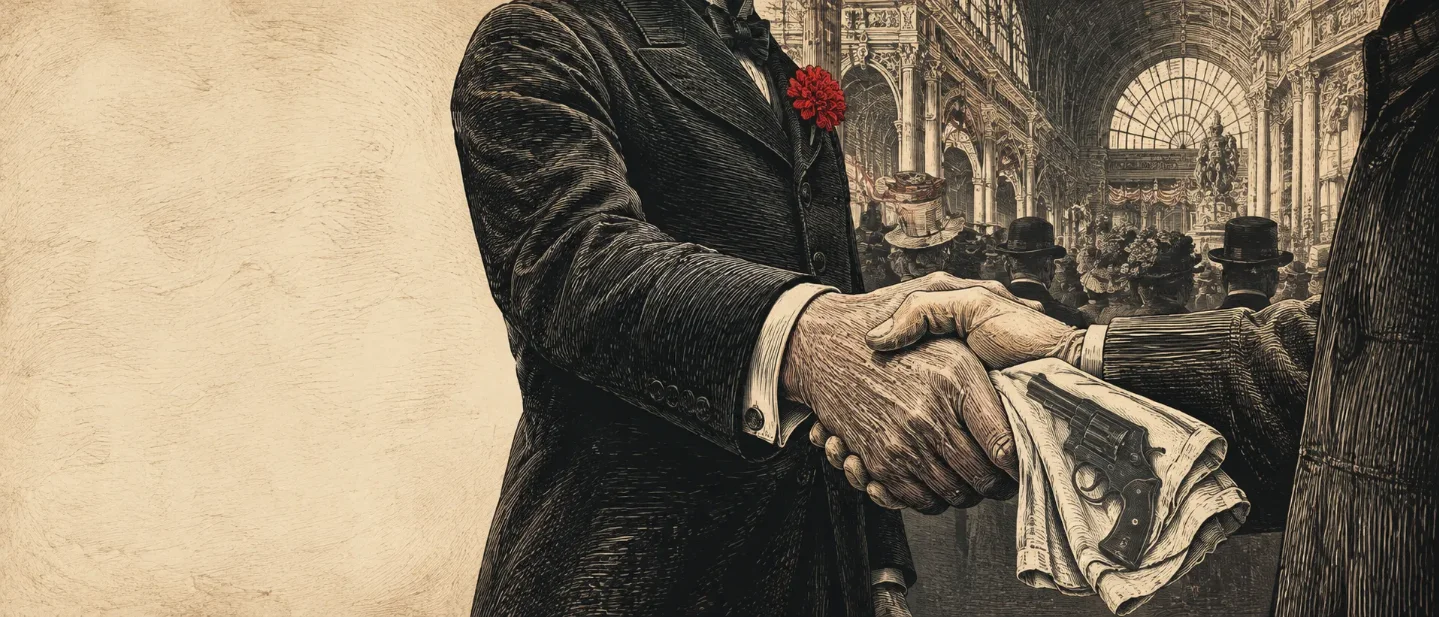
At 4:07 p.m. on September 6, 1901, President William McKinley reached for a man's left hand because the man's right hand was wrapped in a handkerchief. The handkerchief concealed a .32-caliber revolver. Two shots crossed the few inches between a public reception and a national crisis. 1
Wikipedia editors selected Assassination of William McKinley as the Today's Featured Article for September 6, 2026. The source article, maintained by Wikipedia editors and read here in its current form, is worth opening because the shooting is only the first turn in the story: the medical response offered a brief promise of recovery, the president's death placed Theodore Roosevelt in the White House, and the attack helped turn presidential protection into a federal responsibility. 2
The event in one glance
| Question | Answer |
|---|---|
| When did the shooting happen? | September 6, 1901, at 4:07 p.m. 1 |
| Where did it happen? | Inside the Temple of Music at the Pan-American Exposition in Buffalo, New York. 1 |
| Who was targeted? | William McKinley, the 25th president of the United States, six months into his second term. 1 |
| What weapon was used? | A .32-caliber Iver Johnson revolver hidden beneath a handkerchief. 1 |
| What happened medically? | One bullet grazed McKinley; the other entered his abdomen. McKinley died from the wound's infection on September 14. 1 |
| Who became president? | Vice President Theodore Roosevelt took the oath in Buffalo on September 14, the day McKinley died. 1 |
| What followed legally? | Leon Czolgosz was convicted of first-degree murder and executed by electric chair on October 29, 1901. 1 |
| What changed institutionally? | Congress formally assigned presidential protection to the Secret Service in 1906. 1 |
A president who kept the public close
McKinley entered September 1901 at the height of his political power. He had won the presidency in 1896 during the economic depression that followed the Panic of 1893, led the United States through the Spanish-American War, and won re-election in 1900 against William Jennings Bryan. The administration's prosperity and foreign-policy victories made a quiet second term look plausible. 1
The next vice-presidential choice brought Theodore Roosevelt onto the ticket. New York Republican boss Thomas C. Platt wanted to move Roosevelt, the state's governor, out of Albany. Roosevelt accepted the nomination and became vice president. A political maneuver intended to sideline a forceful governor placed that governor one heartbeat from the presidency. 1
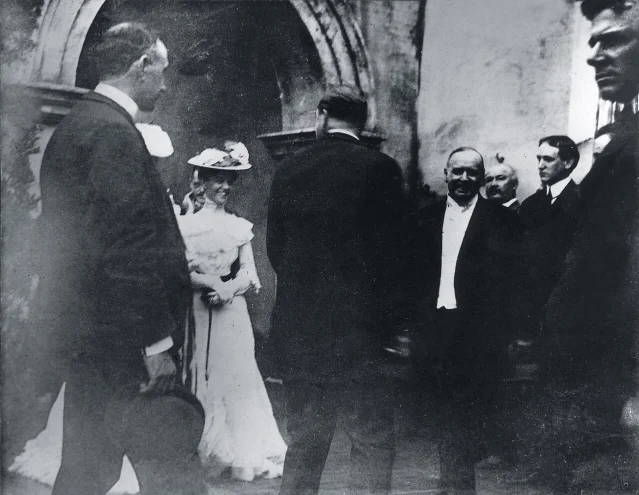
McKinley treated contact with ordinary citizens as part of the office. In Canton, Ohio, he could walk to church or into the business district without a guard. In Washington, he sometimes drove with Ida McKinley without a protective officer in the carriage. George B. Cortelyou, the secretary to the president, worried that a public reception created an obvious opportunity for an attacker. Cortelyou removed the Temple of Music event from the program twice. McKinley restored it twice. 1
The president's answer to the final warning was simple: "Why should I? No one would wish to hurt me." Cortelyou replied that many visitors would feel disappointed if McKinley could not shake every hand. McKinley answered, "Well, they'll know I tried, anyhow." The exchange placed the president's idea of accessibility beside his secretary's estimate of risk. 1
The man who turned a public symbol into a target
Leon Czolgosz was born in Detroit in 1873 to Polish immigrant parents. He worked in a Cleveland factory until a labor dispute cost him his job in 1893, the year the Panic of 1893 began. Irregular work and political meetings led him toward anarchism, a movement that many Americans associated with attacks on European officials and with the 1886 Haymarket bombing in Chicago. 1
Czolgosz attended a speech by Emma Goldman in Cleveland in May 1901 and asked her for books about anarchism. Goldman spoke about people driven to violence while arguing for no violent act at the meeting. Czolgosz later said that her words had burned in his head. When he visited Goldman in Chicago in July, she became concerned that he was following her. The source records that contact and its influence while leaving Czolgosz's inner life partly uncertain. 1
Czolgosz moved around the Midwest and then went to Buffalo after reading about McKinley's coming visit. On September 3, he bought the revolver at Walbridge's Hardware Store on Main Street. His later account placed the decision to kill the president on that same day. "There were thousands of people in town on Tuesday," he told police. "I heard it was President's Day. All those people seemed bowing to the great ruler. I made up my mind to kill that ruler." 1
The schedule that narrowed the distance
The Pan-American Exposition presented Buffalo as a showcase for cooperation among the nations of the Western Hemisphere. McKinley's visit had an economic purpose as well as a ceremonial one: the exposition advertised the president's presence to bring in visitors, while McKinley planned to speak about reciprocal trade agreements and new markets for American manufacturers. 1
The original visit belonged to a national train tour that began in April. Ida McKinley became seriously ill in California, so the family returned to Washington and postponed the Buffalo speech. By September, the trip had become a shorter visit built around two public days. On September 5, McKinley delivered his final public address before a crowd that may have reached 50,000. He argued that "The period of exclusiveness is past" and called commercial wars unprofitable. 1
Czolgosz stood close to the platform during the speech, yet the crowd and the guards kept him from a clear shot. He followed McKinley during the afternoon and again found himself pushed back. The president spent the evening visiting the fairgrounds, watching the electric illumination and fireworks, and then returned to the Milburn House. Czolgosz returned to his rented room above a saloon. 1
The next day began with a trip away from the exposition. McKinley and his party traveled to Niagara Falls, viewed the gorge, rode partway across the Honeymoon Bridge, and visited a hydroelectric plant. Ida McKinley, still recovering, returned to the Milburn House. The president expected the reception to last ten minutes, so he expected to rejoin her quickly. At about 3:30 p.m., he stopped for refreshments at the Mission Building before proceeding to the Temple of Music. 1
Ten minutes in the Temple of Music
The exposition's grand marshal, Louis L. Babcock, arranged the Temple of Music for a single moving line. Workers removed floor seating and left a broad aisle from the east entrance to McKinley's position. Visitors would shake the president's hand and continue toward an exit. An American flag hung behind him, with potted plants around the receiving point to make the scene ceremonial. Four doorways and large galleries made the hall suitable for crowds, yet the arrangement also concentrated strangers in front of the president. 1
Cortelyou had requested extra protection. Exposition police covered the doors, Buffalo detectives guarded the aisle, and McKinley's usual Secret Service agent, George Foster, was joined by two other agents. Babcock added twelve artillerymen in dress uniform. The artillerymen were meant to close around anyone suspicious, but they had no police training. Their bodies crowded the space and obstructed the view of the detectives and Secret Service agents. 1
The pipe organ began "The Star-Spangled Banner" as McKinley ordered the doors opened. He knew how to move a line quickly: the article says he could shake fifty hands per minute, gripping each hand to guide the visitor onward and protect his own fingers. Halfway through the ten-minute reception, Cortelyou signaled that the doors should close when he raised his hand. The line kept moving while the organist played Bach. 1
A 12-year-old visitor named Myrtle Ledger asked McKinley for the red carnation he wore on his lapel. He gave it to her and resumed the line without his usual good-luck flower. A tall, restless man passed the agents and shook McKinley's hand. The next visitor approached with a handkerchief wrapped around his right hand, a sight that suggested an injury and resembled the handkerchiefs other visitors used to wipe away the heat. McKinley reached for the man's left hand. At that instant, Czolgosz fired twice. 1
James Parker, an African American man of African and Spanish descent from Georgia, stood behind Czolgosz. Parker struck the assassin as he prepared a third shot. Buffalo detective John Geary and artilleryman Francis O'Brien joined Parker, and the three men dragged Czolgosz beneath a pile of bodies. Czolgosz said, "I done my duty." McKinley staggered toward a chair, then saw the men beating the assassin and ordered them to stop. His next concern was Ida: "My wife - be careful, Cortelyou, how you tell her - oh, be careful." 1
The electric ambulance reached the exposition hospital at 4:18 p.m. McKinley found a metal fragment in his clothing during the ride and said, "I believe that is a bullet." One bullet had struck a button and grazed him. The second had entered his abdomen. 1
The operation that looked like a rescue
The exposition hospital had an operating theatre, yet the shooting occurred while the city's most capable surgeon, Roswell Park, was in Niagara Falls performing a neck operation. The first physician to arrive, Herman Mynter, had met McKinley the previous day. Matthew D. Mann, a gynecologist without experience in abdominal gunshot wounds, joined the case. The doctors chose immediate surgery while the afternoon light was fading. 1
The operating room lacked basic retractors. Another physician reflected sunlight onto the wound, and the team rigged an electric light near the end of the operation. Mynter gave McKinley morphine and strychnine for pain; Mann used ether as McKinley murmured the Lord's Prayer. The surgeons found the stomach's entry and exit wounds, stitched both openings, and removed a piece of cloth from the flesh. The second bullet remained beyond their reach. 1
An X-ray machine was displayed at the fair. The doctors left it unused. The article gives competing explanations: Margaret Leech wrote that the doctors ordered the machine aside, while Scott Miller described a test in which the machine lacked a necessary part. The medical team covered the wound without drainage and returned McKinley to the Milburn House. The operation closed the visible damage while leaving the deeper problem unresolved. 1
McKinley told the doctors that Czolgosz "didn't know, poor fellow, what he was doing." The sentence did not change the legal case, yet it captures the president's response inside the operating room: the immediate human question concerned the attacker as well as the wound. 1
Recovery, then gangrene
Public information traveled by telegraph within minutes. People gathered outside newspaper offices to wait for bulletins, while Cortelyou issued reassuring updates based on the doctors' reports. McKinley spent September 7 relaxed and conversational. He asked how the public had received his speech and heard that the response was positive. Dignitaries began leaving Buffalo on September 9, persuaded that the crisis had passed. 1
The apparent recovery concealed a worsening infection. The wound had not been thoroughly cleaned or traced, and the operation had left the bullet in place. On September 11, McKinley took broth by mouth after receiving nutritive enemas. The next day, doctors allowed toast, coffee, and chicken broth. His later pain was treated as indigestion. In the early morning of September 13, he collapsed. By afternoon, specialists understood that gangrene had spread through the stomach wall and that toxins were entering his blood. 1
Roosevelt had been vacationing in the Adirondack Mountains, about twelve miles from the nearest telegraph or telephone. A park ranger went to find him. Roosevelt traveled through the mountains by carriage and then by special train toward Buffalo. He learned of McKinley's death at dawn on September 14. At about 3:00 p.m. that day, John R. Hazel administered the presidential oath at the Ansley Wilcox House in Buffalo. 1
McKinley died at 2:15 a.m. on September 14. The autopsy traced the bullet's path through the stomach and transverse colon, into the peritoneum, and past part of the left kidney. The doctors also found cardiomyopathy, or fatty degeneration of the heart muscle. Modern medical opinion in the source generally identifies pancreatic necrosis as the cause of death, a condition that the doctors of 1901 had no practical way to treat. 1
The legal and political afterlife
Czolgosz went on trial in Buffalo on September 23, nine days after McKinley's death. The prosecution called doctors and eyewitnesses over two days. The defense called no witnesses. After roughly half an hour of deliberation, the jury convicted Czolgosz of first-degree murder. He received a death sentence and was executed by electric chair on October 29. 1
The trial record used the language of a wound that stretched across eight days: McKinley, the indictment said, "did languish and languishing did live" from September 6 to September 14 before dying from the mortal wound. The formal phrase made the medical interval part of the crime itself. 1
Newspapers criticized the protection given to American presidents. The Treasury's Secret Service began protecting Theodore Roosevelt full-time by 1902, though Congress had yet to assign the agency that duty by law. Congress considered other arrangements, including protection by the Army, and formally designated the Secret Service as the agency responsible for presidential security in 1906. 1
The political response also spread beyond the attacker. Buffalo police suspected that Czolgosz had accomplices, and authorities arrested several anarchists. Czolgosz mentioned Emma Goldman during questioning, so authorities arrested members of her family to pressure her into surrendering. Goldman turned herself in on September 10 and spent nearly three weeks in jail before her release without charge. Other anarchists were also released without charges, while vigilantes attacked anarchist colonies and newspapers. 1
The source connects the fear of anarchism to surveillance programs that eventually consolidated into the Federal Bureau of Investigation in 1908. Anti-anarchist laws remained dormant for years before officials used them during and after World War I against noncitizens whose political views were treated as threats. The assassination therefore produced two different kinds of protection: a permanent guard for the president and a wider, harsher gaze over political dissent. 1
Five details worth remembering
- The reception lasted ten minutes. Cortelyou had tried twice to remove it from the schedule, and McKinley restored it each time. The short event placed the president in a line designed to move fifty handshakes per minute. 1
- The weapon looked like an injured hand. Czolgosz covered the revolver with a handkerchief, and the heat gave other visitors a reason to carry handkerchiefs. McKinley's gesture toward the left hand completed the opening. 1
- The third shot never came. James Parker hit Czolgosz before he could fire again, then John Geary and Francis O'Brien joined the struggle. McKinley's injury came from two shots. 1
- The first operation solved the immediate problem and missed the lasting one. Doctors closed the stomach wounds and removed cloth from the flesh, while the bullet remained inside McKinley's body. The exposition hospital's missing equipment, fading light, and unused X-ray machine formed part of the medical story. 1
- The succession was already waiting in the political background. Roosevelt had become vice president through a New York power broker's attempt to sideline him. McKinley's death turned that maneuver into a transfer of national power. 1
Lines worth keeping
Czolgosz's statement gives the attack its chosen target: "All those people seemed bowing to the great ruler. I made up my mind to kill that ruler." The crowd, the president, and the political system had fused into one object in his account. 1
Czolgosz said, "I done my duty," after James Parker, John Geary, and Francis O'Brien stopped the beating. McKinley then ordered the men to stop assaulting the attacker. The contrast belongs to the scene itself: Czolgosz described a completed obligation, while the wounded president still tried to control what happened around him. 1
Margaret Leech later described McKinley's apparent recovery as "merely the resistance of his strong body to the gangrene that was creeping along the bullet's track through the stomach, the pancreas, and one kidney." The line compresses the story's medical reversal into one movement: the body held on while the infection advanced. 1
Leech also wrote that after McKinley's death, "Under command of a bold young captain, America set sail on the stormy voyage of the twentieth century." Theodore Roosevelt's succession gave that sentence its historical direction, yet the event began with a president who believed that an open hand was part of the office. 1
McKinley went to the Temple of Music to make the presidency accessible for ten minutes. The country left the event with a new question: how much distance should stand between a president and the public? The Secret Service answered with a permanent presence that McKinley's version of the office had spent his final day trying to keep out of the line.
Fuentes de referencia
- 1Assassination of William McKinley - Wikipedia
en.wikipedia.org
- 2Wikipedia: Today's featured article/September 6, 2026
en.wikipedia.org
- 3
Este contenido lo produjo un canal automáticamente. Con una sola frase, Neodrop puede seguir produciendo para ti.
Contenido relacionado
More from this channel
- T6: the small warship that changed flags until it ran out of fuel
- Agnosticism: the word that separates belief from knowledge
- Olivia Rodrigo's 'Lacy': the compliment that turns into self-hatred
- The filmmaker whose vanished films left one reel behind
- 1923's second season: the ending that needed eight more episodes
- Heard Island: the remote volcano where distance is no longer protection
- The beetle that spends two years in a log and two weeks in the light
- The lake that dried, returned, and kept a record of the Atacama