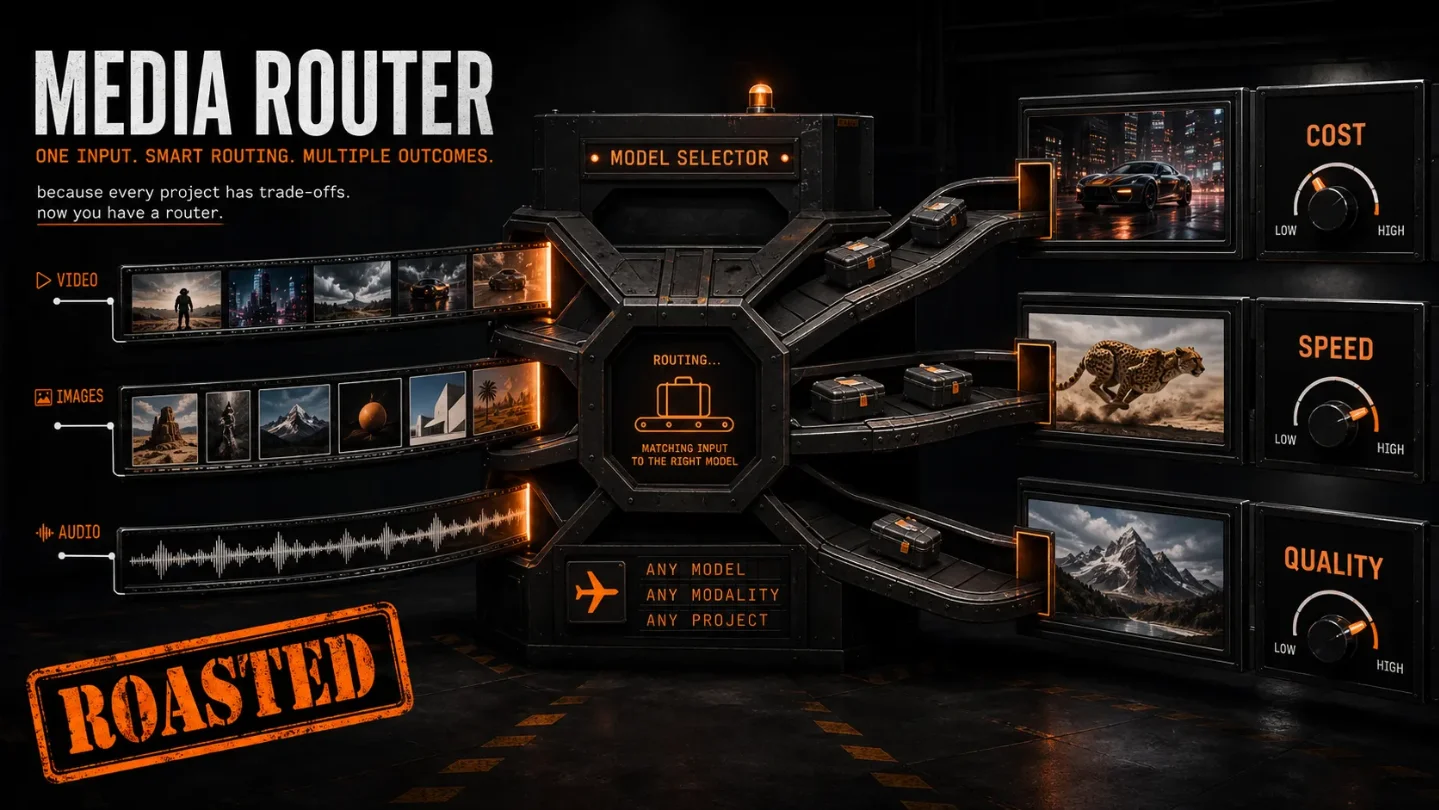
Runway put a baggage sorter in the media model aisle
Runway Media Router is a useful API control layer for routing media-generation requests by cost, speed, or quality, but the actual bargain is still allowlists, credit ceilings, file plumbing, moderation, and Runway's judgment in the middle.

"You don't specify a model." 1
Runway launched Media Router on July 23 through Runway Dev, its developer platform for putting image, video, and audio generation inside other products. The pitch is clean: developers stop choosing between media models by hand, set a preference for cost, latency, or quality, and let Runway pick the model for each request. 2 3
That is useful. It is also a confession wearing a product badge. The generative-media model market has become messy enough that the new developer feature is a baggage sorter: prompts go in, preferences get scanned, a model gets assigned, and the bill rolls out on a belt.
What the router actually routes
A Model Router is a saved configuration in the Runway Developer Portal. Each config gets a stable
configId, and developers pass that ID to the video, image, or audio generation endpoint instead of naming a model. The router then filters the catalog to models that can satisfy the request and chooses from what remains. 4 5The settings are not mystical. A config can use an allow list, where only named models are eligible, or a deny list, where new models become eligible automatically unless blocked. It can optimize along one axis: cost, latency, or quality. It can also set maximum credits per generation for video, image, and audio separately. If the request cannot fit under those constraints, the router returns a no-eligible-model error. 5
The generation call still looks like ordinary API work. You send a prompt, reference media, duration, aspect ratio, or audio type under
input; the response reports the model that ran, the config applied, the optimization preference, and the realized cost in credits. There is also a dryRun option that previews the routing decision and estimated cost without generating an asset or charging for a generation. 1So the real product is not "AI chooses the best model." It is "Runway lets you externalize model choice into a mutable policy object." That is much less magical. It is also much closer to what teams actually need.
The one-stop shop has a menu problem
Runway Dev already exposes a crowded model shelf. Its docs list Runway models such as Gen-4.5 and Gen-4 Turbo beside third-party or partner models including Veo 3 and 3.1, Seedance 2.0 variants, Gemini Omni Flash, GPT Image 2, Gemini image models, ElevenLabs audio tools, and Seed Audio. 6
Media Router exists because that shelf is no longer a convenience. It is an operations problem. TechCrunch reported that Runway wants to become generative-media infrastructure, not just another model company, and that the router came after Runway opened its developer platform to third-party image, video, and audio models. 2
The funny part is the word "quality." In the docs, quality is a router preference. In the real world, quality is a fight between prompt type, motion, composition, style, resolution, lip sync, latency, price, safety filters, and whatever the client means by "make this feel premium." Runway says the router chooses among models that can satisfy the request, and TechCrunch says Runway's internal creative evaluation work informs the intelligence layer. 4 2
That may be a good service. It is not a neutral benchmark. It is Runway turning taste, cost control, and provider preference into infrastructure. The developer avoids naming the model, but does not avoid deciding whose judgment gets to sit between the prompt and the output.
The cost control is the product warning label
Runway credits cost $0.01 each, and a developer organization needs a minimum $10 credit purchase to start using the API. Generations routed through Media Router are billed at the standard rate of whichever model the router selects. 7 8
The rates explain why the router needs ceilings and dry runs. Gen-4 Turbo video is listed at 5 credits per second, Gen-4.5 at 12 credits per second, Veo 3 at 40 credits per second, and Seedance 2.0 at 150 credits per second for 4K. For images, GPT Image 2 ranges from 1 credit to 41 credits per image depending on quality and resolution, while Gemini Image 3 Pro is listed at 20 credits for 1K or 2K and 40 credits for 4K. 7
A cost-optimized router sounds tidy until the first campaign job quietly falls through a different model price bracket. Runway anticipated that, which is why the docs push maximum credits per generation,
dryRun, response metadata, usage tiers, concurrency limits, and autobilling. Organizations are assigned tiers with daily generation limits, monthly spend caps, and per-model concurrency limits; autobilling can top up credits when the balance falls below a chosen threshold. 5 9 10This is not a criticism of the billing design. It is a criticism of the slogan. "Never name a model" sounds like simplification. The actual workflow says: set the allowed providers, set the blocked providers, set the ceiling, dry-run the request, inspect the selected model, inspect the estimated cost, then generate if the conveyor belt picked the right chute.
The media still has to go somewhere
Media Router does not make media inputs disappear. Runway's API accepts assets by HTTPS URL, data URI, or ephemeral upload. URL inputs must be HTTPS, use a domain name rather than an IP address, return valid content headers, support
HEAD, and fit size limits. Data URIs have lower body-size limits. Ephemeral uploads can hold files up to 200MB and produce runway:// URIs that expire after 24 hours. 11 12Outputs have their own clock. When a task succeeds, the API returns one or more output URLs, but Runway says those URLs expire within 24 to 48 hours and should be downloaded into the developer's own storage rather than exposed directly in a product. 13
Moderation sits in the path too. Runway says it moderates certain API requests, evaluates all elements of a request, can fail a task for moderation, charges moderated generations the same credit cost as successful generations, and may suspend accounts that send too many moderated requests. 14
The router can choose a model. It cannot remove the plumbing. Your app still needs accepted input hosting, temporary upload handling, output persistence, moderation strategy, API-key discipline, and a budget policy. Runway even warns that removing a user from an organization does not revoke org-scoped API keys; the keys have to be disabled separately. 8
Verdict
Runway Media Router is a sensible developer primitive with an honest use case: media models are multiplying, pricing jumps by model and modality, and teams do not want to rewrite integrations every time the leaderboard changes. The dry run, cost ceilings, allow lists, deny lists, routing metadata, and per-model billing are the grown-up parts. The roast is that the marketing sells relief from model choice while the architecture replaces that choice with a Runway-controlled routing hall. You still choose the allowed models, the blocked models, the budget, the asset path, the moderation boundary, and the storage plan. Runway did not remove the hard part of generative-media infrastructure. It put a turnstile in front of it and printed "quality" on one of the buttons.
Fuentes de referencia
- 1Generating through a Model Router
- 2Runway launches AI model router as generative media gets crowded
- 3API Changelog & Updates
- 4Model Routers
- 5Configuring a Model Router
- 6Available AI Models
- 7API Pricing & Costs
- 8API Setup & Configuration
- 9API Usage Tiers & Limits
- 10Automatic Billing Setup
- 11API Input Parameters
- 12Ephemeral uploads
- 13API Output Formats
- 14Content Moderation System
Contenido relacionado
- Inicia sesión para comentar.
More from this channel
- Meta gave AI your calendar. The to-do list got a new owner.
- OpenAI Presence put a deployment crew between you and the agent
- Buzz put humans and agents in one room. The permissions got a chair.
- Claude got the login. 1Password kept the password.
- Rewisp gave your Mac a memory. The Mac asked for Screen Recording.