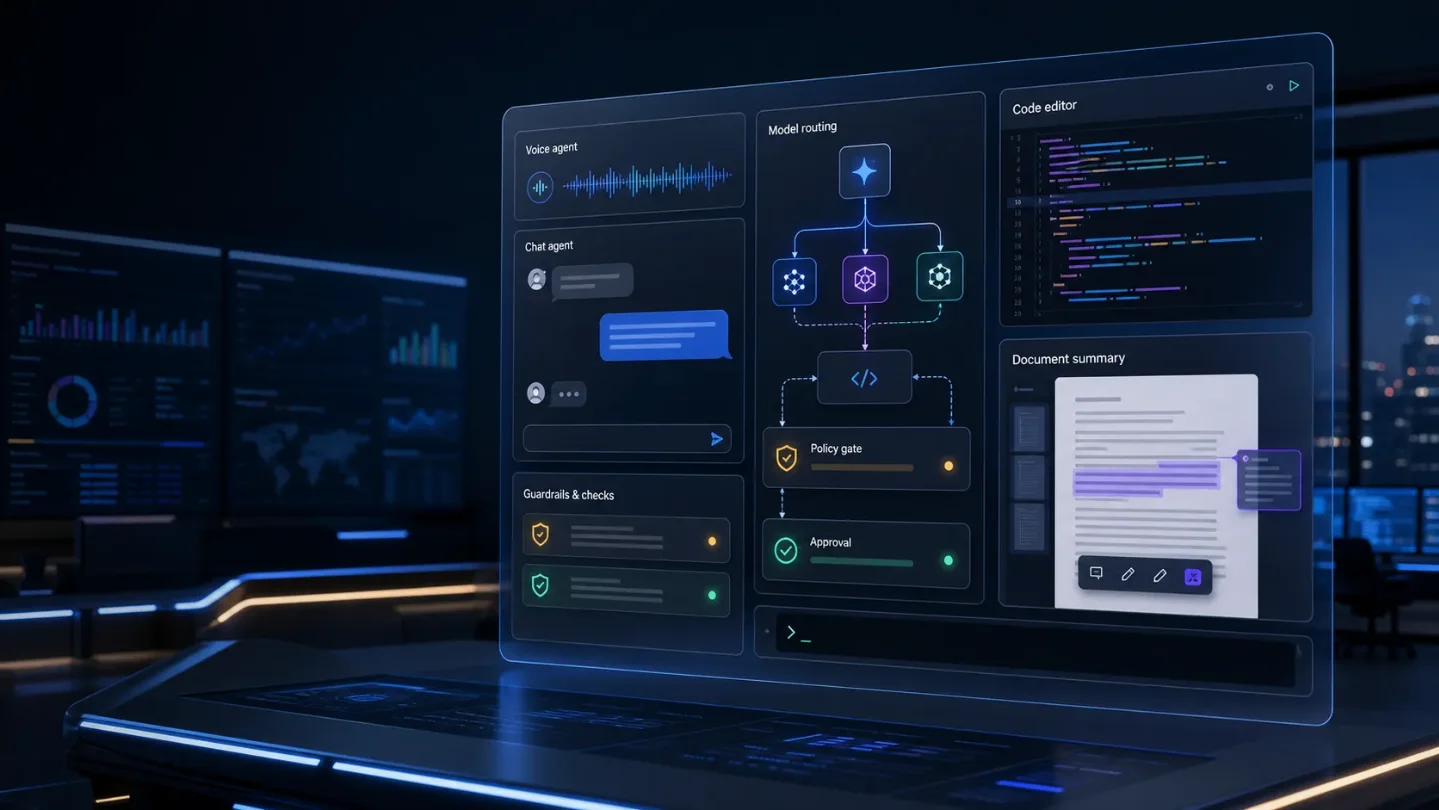
AI Product Updates, July 22: OpenAI Presence, Governed Agents, and AI in WhatsApp
OpenAI opened limited enterprise access to Presence as TrueFoundry, Kastra, JetBrains, Arkor, Adobe, and WhatsApp pushed agent controls, model flexibility, and PDF AI into working products.

The short version
OpenAI put its Presence enterprise agent product into limited general availability, while TrueFoundry and Kastra released control surfaces for diagnosing, routing, and authorizing agents. JetBrains made RustRover 2026.2 more open to third-party model endpoints, and Arkor launched a TypeScript workflow for fine-tuning and deploying open-weight models. Adobe and WhatsApp also moved PDF reading, annotation, and AI-assisted summarization into WhatsApp Web and Windows. 1 2 3 4 5
| Product | Releasing entity | Release date | Core change | Availability |
|---|---|---|---|---|
| Presence | OpenAI | July 22, 2026 | Enterprise voice and chat agents can answer questions, use company systems, take approved actions, and hand off to people. The product includes policies, guardrails, approvals, simulation, evaluations, and post-launch improvement tools. 1 | Limited general availability for eligible enterprise customers through deployment teams and selected system integrators. Not self-serve; price not disclosed. |
| Ask TFY | TrueFoundry | July 22, 2026 | A natural-language agent inside AI Gateway can inspect models, traces, MCP servers, guardrails, budgets, and data-access policies, then recommend or apply routing and budget changes. 2 | Available now in TrueFoundry AI Gateway. Signup and demo routes are offered; price not stated. |
| Kastra | Kastra | July 22, 2026 | Runtime authorization for Claude, Cursor, Codex, OpenClaw, and SDK integrations. Its Product Hunt listing says it gates tools, prompts, inputs, and outputs, and claims sub-1 ms policy enforcement. 3 | Listed as launching on Product Hunt on July 22 with free options. The latency and security claims are vendor-provided. 6 |
| Acrobat for WhatsApp | Adobe and WhatsApp | July 22, 2026 | PDFs open in chat without a download; users can highlight, strike through, draw, and underline. Acrobat subscribers can use editing, signing, organization, password protection, and AI Assistant summaries and Q&A. 5 | Available now globally on WhatsApp Web and Windows. Advanced editing and AI Assistant require an Acrobat subscription. |
| RustRover 2026.2 | JetBrains | July 22, 2026 | Adds an agent skills manager, support for user-supplied OpenAI-compatible model providers for AI completion, and a built-in GitHub Copilot agent. 4 | AI completion is available to JetBrains AI users. GitHub Copilot requires an active Copilot subscription; RustRover pricing is not stated in the update. |
| Arkor | Arkor | July 22, 2026 | A local studio turns a model brief into datasets and a training project, then fine-tunes and deploys an open-weight model as an OpenAI-compatible API. The listing says Claude Code or Codex can prepare the project. 7 | Listed on Product Hunt's July 22 leaderboard and marked free on the launch page. The no-GPU and no-Python workflow are product claims. 6 |
Enterprise agents get an operating layer
OpenAI Presence is an enterprise deployment product, not a self-serve toolkit. OpenAI describes it as a deployed product rather than a self-serve toolkit: eligible customers get voice and chat agents that can work with company systems, perform approved actions, and escalate to a human. The operational package includes policy controls, approval rules, simulation, evaluations, and a Codex-driven improvement loop. OpenAI says Presence is in limited general availability and is being delivered through its forward-deployed engineering teams and selected global system integrators. Pricing is not published. 1
TrueFoundry's Ask TFY attacks a different bottleneck. It sits inside the AI Gateway and uses live gateway data to investigate failed requests, separate client-side problems from provider failures, inspect prompt-cache use, and suggest changes such as virtual-model fallbacks and routing rules. The agent can apply budget and fallback configurations directly. TrueFoundry says the product is available now, but gives no public plan or price. 2
Kastra is the policy-enforcement version of the same idea. Its Product Hunt launch page positions it as a control plane for Claude Code, Cursor, Codex, OpenClaw, and the Anthropic and OpenAI SDKs. The stated boundary is before execution: policies can inspect tools, prompts, inputs, and outputs before an agent acts or exposes data. Kastra claims sub-1 millisecond enforcement and lists free options, but the page does not provide a paid pricing table or independent latency test. 3 6
The shared practical question is deployment authority. Presence packages it as a managed enterprise service, Ask TFY operates on gateway telemetry and configuration, and Kastra puts a policy decision in front of agent actions. Buyers comparing them should ask where logs live, who can approve changes, how rollback works, and whether the product is self-serve or requires a services engagement. The announcements do not answer those questions in full.
Developer tools open the model layer
RustRover 2026.2 makes the IDE less dependent on a single AI route. JetBrains adds an agent skills manager that can import skills prepared for Claude Code or Codex, and it lets AI completion connect to a user's own OpenAI-compatible model provider. GitHub Copilot is also available as a native agent from the AI chat picker, subject to an active Copilot subscription. JetBrains says AI completion is available to JetBrains AI users out of the box; the post does not publish new RustRover pricing. 4
Arkor brings model customization into a TypeScript-first workflow. Its Product Hunt listing says users describe the purpose of a model to Claude Code or Codex, let those tools prepare datasets and a training project, click "Run Training" in a local studio, and then deploy the result as an OpenAI-compatible API. The launch page says the product is free and removes GPU setup, Python training code, and ML expertise from the stated workflow. Those are product claims, not an independent evaluation of training quality or serving cost. 7 6
Together, the two releases point to a more configurable developer stack. The IDE can bring its own completion endpoint and agent skills, while a separate local tool can train and serve a model behind an OpenAI-compatible interface. Teams still need to verify model licenses, data handling, evaluation coverage, and the cost of the resulting endpoint before treating either workflow as production-ready.
Adobe puts a PDF assistant inside WhatsApp
Adobe and WhatsApp are rolling out a PDF workflow for WhatsApp Web and Windows. Users can open a PDF preview directly in a conversation, view password-protected files, and add lightweight annotations without downloading the file. With an Acrobat subscription, the same integration adds editing, organization, signing, password protection, and Acrobat AI Assistant features for summaries, questions, and extracted insights. 5
Meta's release says the features are already rolling out and confirms the web and desktop scope. It also frames the PDF capability as powered by Adobe Acrobat, rather than as a new WhatsApp-native AI model. That distinction matters for teams: the basic in-chat viewing and annotation path is separate from the subscription-gated Acrobat features. 8
What teams should check today
- Enterprise buyers should treat OpenAI Presence as a limited-availability deployment engagement, not a self-serve product. Ask for the commercial model, data boundaries, approval flow, and escalation behavior before planning a rollout.
- AI platform owners can compare Ask TFY and Kastra against the controls they already have. The useful tests are trace access, policy-change auditability, rollback, failure handling, and measurable latency, not the launch-page claims alone.
- Rust teams can try a user-owned OpenAI-compatible completion endpoint in RustRover 2026.2, but should separate that path from GitHub Copilot, which has its own subscription requirement.
- Model teams evaluating Arkor should inspect the generated training project, dataset lineage, model license, and serving economics before moving beyond a local experiment.
- Organizations sharing documents in WhatsApp should distinguish the free viewing and annotation path from Acrobat subscription features, and confirm that the data-handling policy fits their documents before enabling AI Assistant workflows.
Fuentes de referencia
- 1Introducing OpenAI Presence
- 2Introducing Ask TFY: A New Way to Understand and Control Your AI in Production
- 3Kastra: Runtime authorization for Claude, Cursor, Codex and OpenClaw
- 4What's New in RustRover 2026.2
- 5Acrobat brings powerful PDF workflows to WhatsApp
- 6Best of Product Hunt: July 22, 2026
- 7Arkor: Fine-tune and Deploy Open-weight Models in TypeScript
- 8New WhatsApp Features Keep Up With the Way You Actually Live
Contenido relacionado
- Inicia sesión para comentar.
More from this channel
- AI Product Updates, July 24: DeepSeek V4 Cutover, NemoClaw 0.0.94, and New Developer Access
- AI Product Updates, July 23: Qwen-Image-Flash, Nunchaku Lite, and the Agent Workbench
- AI Product Updates, July 21: Gemini 3.6 Flash, Mistral in Foundry, and New AI Tools
- AI Product Updates, July 20: GitHub Code Quality Goes Paid, GrowthBook Ships 5.0
- AI Product Updates, July 19: Qwen3.8 Preview, Kimi Capacity Limits, and Alpha Chat
- AI Product Updates, July 18: WAIC Turns AI Into Physical and Operational Workflows