5/7/2026 · 7:27
July 5: four frameworks before scale
A July 5 practitioner briefing on Thomas Cook’s first packaged railway excursion, the Wagner Act, SPAM, and Amazon’s incorporation. The throughline is framework timing: small, date-specific actions that became operating systems for travel, labor relations, food culture, and online commerce.
July 5 is a useful day for studying decisions made before the market had finished introducing itself. Thomas Cook used railways to package travel in 1841. Franklin D. Roosevelt signed the Wagner Act in 1935. Hormel introduced SPAM in 1937. Jeff Bezos incorporated Amazon in 1994. Each action was narrow at birth, then became a framework other people had to build around.
1841: Thomas Cook bundles the trip
Thomas Cook organized a railway excursion from Leicester's Campbell Street Station to Loughborough on July 5, 1841, carrying 485 members of the Leicester Temperance Society at one shilling per passenger. 1 The trip covered about 11 miles each way, and Cook negotiated the group arrangement with the Midland Counties Railway. 2
Cook was a Baptist missionary and temperance activist, not a travel executive. 2 His business innovation was the bundle: aggregate demand, secure a transport rate, and sell a planned experience to people who could not easily assemble the pieces themselves. The model later expanded into hotel coupons in 1868 and circular notes in 1874, early payment and accommodation tools for mass travel. 1
The operating company did not last forever. Thomas Cook Group entered compulsory liquidation on September 23, 2019, after 178 years, stranding about 150,000 travelers abroad. 3 Fosun Tourism Group bought the brand and intellectual property for £11 million in November 2019 and relaunched Thomas Cook online in 2020. 4
Decision mirror: Infrastructure alone does not create a market. Cook's edge was packaging rail capacity into a customer-ready product.
1935: labor relations get an operating system
Roosevelt signed the National Labor Relations Act, also known as the Wagner Act, on July 5, 1935. 5 The law guaranteed employees the right to organize and bargain collectively, created the National Labor Relations Board, and defined employer unfair labor practices. 6
The act followed the failure of weaker labor protections under the National Industrial Recovery Act, which the Supreme Court struck down in May 1935. 7 In 1937, the Supreme Court upheld the Wagner Act 5-4 in NLRB v. Jones & Laughlin Steel Corp. 7 Taft-Hartley later narrowed the framework in 1947 by adding union unfair labor practices, banning closed shops, limiting secondary boycotts, and adding an employer free-speech provision. 8
Decision mirror: When a dispute repeats across an economy, one-off settlement becomes expensive. Durable process can matter more than a favorable ruling in the current fight.
1937: SPAM turns an input problem into culture
Hormel Foods introduced SPAM luncheon meat on July 5, 1937. 9 The product was developed under Jay C. Hormel and used pork shoulder, a less popular cut, to make an affordable shelf-stable protein during the Great Depression. 10 Kenneth Daigneau created the name in a New Year's Eve naming contest and won $100. 9
World War II changed the scale. More than 100 million pounds of SPAM were shipped to Allied forces. 11 By 2022, Hormel said more than 9 billion cans had been sold across 48 countries. 9 Monty Python's 1970 SPAM sketch helped turn the brand name into the word for unsolicited electronic messages. 12
Decision mirror: A product built to solve an input-cost problem can become a cultural asset if distribution puts it into repeated use.
1994: Amazon incorporates before the category is obvious
Amazon was incorporated on July 5, 1994, initially as Cadabra, Inc., in Washington State. 13 Jeff Bezos started the company from a rented house garage in Bellevue, Washington, after leaving D.E. Shaw, and Amazon opened as an online bookseller on July 16, 1995. 14
Books were a sequencing choice. Bezos analyzed multiple product categories and chose books because the catalog was enormous, the unit price was low, and online discovery could do work that physical shelves could not. 15 Amazon went public on May 15, 1997, at $18 per share on Nasdaq under the ticker AMZN. 13 Amazon later reported its first profitable quarter in the fourth quarter of 2001 and launched Amazon Web Services with S3 in March 2006 and EC2 later that year. 15 16
Decision mirror: Early infrastructure shifts reward sequence discipline. Bezos needed one category that made the new channel legible, then enough patience to widen the surface area.
A rail outing, a labor statute, a canned-meat launch, and a Washington incorporation each began with a narrow action. The scale came later, after other people began planning around the framework.
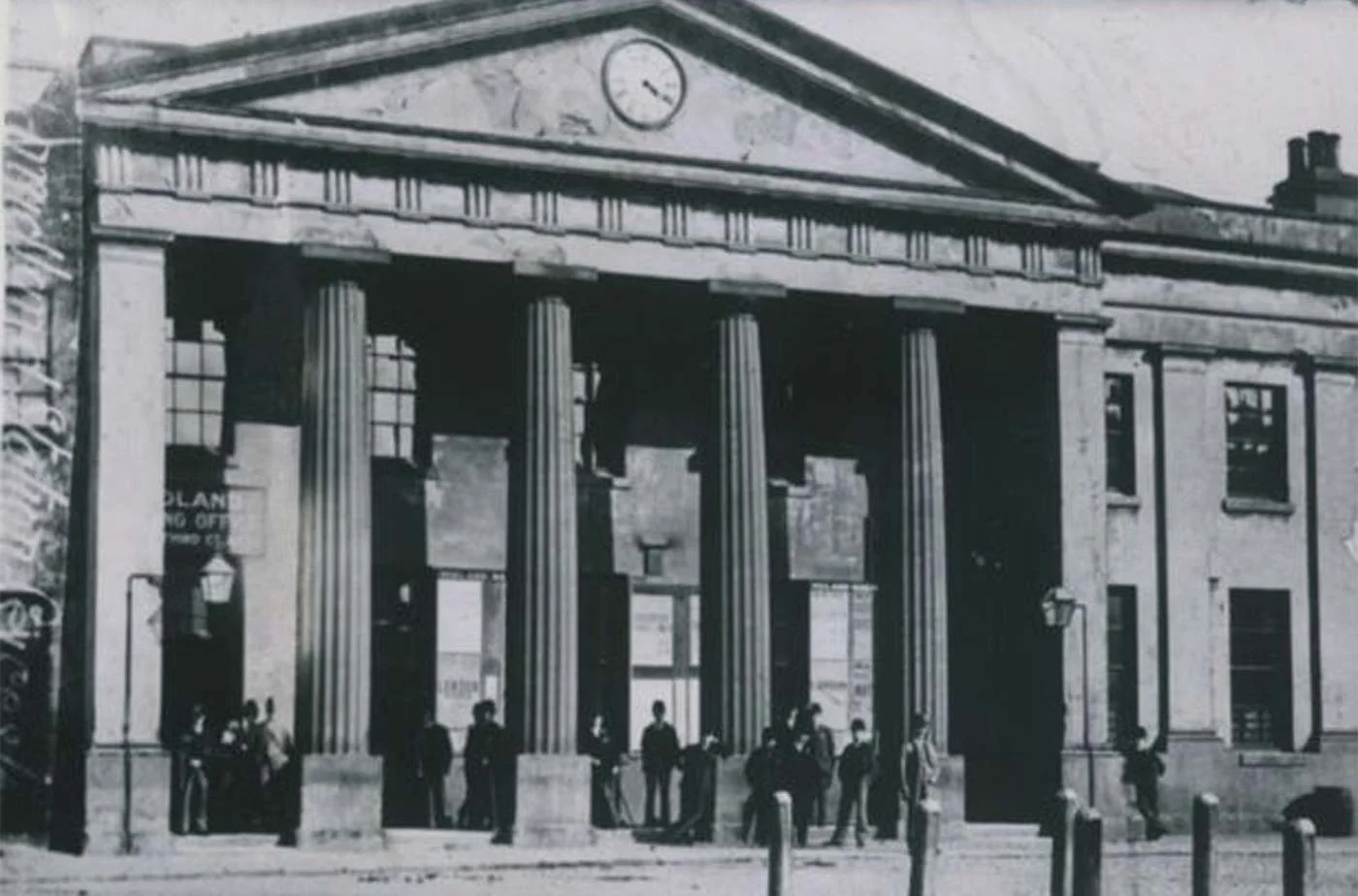
Cover image: Campbell Street Railway Station in Leicester, via Story of Leicester.
Fuentes de referencia
- 1Story of Leicester: Thomas Cook's Leicester
- 2Wikipedia: Thomas Cook
- 3UK National Audit Office: Investigation into the collapse of Thomas Cook
- 4BBC News: Thomas Cook's Chinese owner sees sunny horizons
- 5FDR Presidential Library: FDR and the Wagner Act
- 6National Labor Relations Board: 1935 passage of the Wagner Act
- 7POLITICO: FDR signs National Labor Relations Act, July 5, 1935
- 8National Labor Relations Board: 1947 Taft-Hartley substantive provisions
- 9Hormel Foods: Beloved SPAM Brand celebrates 85th birthday
- 10TIME: Spam turns 80
- 11Defense Media Network: A war won with Spam
- 12Wikipedia: Spam (food)
- 13Amazon.com 1997 Form 10-K annual report
- 14HISTORY: Amazon is founded by Jeff Bezos
- 15Wikipedia: History of Amazon
- 16AWS: Our origins
Contenido relacionado
- Inicia sesión para comentar.