3/7/2026 · 7:28
July 3: four tools before the market
A July 3 practitioner briefing on New York’s savings-bank model, Dow’s first stock average, Benz’s public automobile demonstration, and Verizon’s NYSE debut. The throughline is infrastructure built before demand or consensus was fully legible.

Today's July 3 briefing is about tools that arrived before the market fully knew how to use them. The Bank for Savings in the City of New-York opened on July 3, 1819, in a basement room at the old Alms House in City Hall Park. 1 Charles Dow published his first Dow Jones Average on July 3, 1884. 2 Carl Benz publicly drove the Benz Patent-Motorwagen in Mannheim on July 3, 1886. 3 Verizon Communications began trading on the New York Stock Exchange under the symbol VZ on July 3, 2000. 4
The common thread is infrastructure before consensus. A savings bank gave small depositors a trusted place to store money. A stock average gave investors a rough market gauge. A public automobile drive gave a new category visible proof. A telecom merger converted regulatory change into national scale. Each case asks the same management question: when does the practical tool matter more than the finished market story?
1819: New York builds a bank for small savers
The Bank for Savings in the City of New-York opened for business on July 3, 1819, in the northeast basement room of the old Alms House in City Hall Park. 1 The first day was modest but specific: 80 New Yorkers deposited $2,807. 1 By the end of the first year, the institution had 1,527 accounts and $148,195 in deposits. 1
The design mattered more than the room. The bank grew out of the Society for the Prevention of Pauperism, and New York's legislature incorporated it on March 26, 1819, with 28 named incorporators. 5 Its charter barred trustees from receiving pay, issuing notes, making discounts, or conducting ordinary commercial-bank business. 5 Its money could be invested only in U.S. government securities, New York State securities, or New York City securities. 5
That constraint was the product. Commercial banks were not built for laborers, servants, minors, and small tradespeople. The bank's organizing language described the target customer as the "laboring part of the community" and promised a secure place for earnings plus accumulated interest. 5 Its early rates were also explicit: deposits of $5 to $50 earned 5% annually, and balances above $50 earned 6%. 5
The timing was rough. The United States was in the Panic of 1819, the country's first major financial crisis, and Knowles recorded that nearly 200 U.S. banks failed between 1811 and 1820. 5 In that setting, a low-status basement office gave small savers what the formal system had not: rules they could understand and a counterparty designed around their size.
Decision mirror. Inclusion often starts as a narrower operating model, not a softer mission statement. The bank did not serve small savers by asking a commercial bank to care more. It changed ownership, compensation, permitted assets, and customer economics so the unwanted customer became the intended customer.
1884: Dow turns market noise into a number
Charles Henry Dow first published the Dow Jones Average on July 3, 1884, in Customer's Afternoon Letter, a two-page financial bulletin issued from 15 Wall Street. 2 6 The first average contained 11 stocks: nine railroads and two non-railroad companies. 7 Dow calculated it by adding the 11 prices and dividing by 11. 6
The simplicity was the point. Railroads were the dominant public-company infrastructure of the period, and the first list included names such as New York Central Railroad, Northern Pacific Railroad preferred stock, Union Pacific Railway, Pacific Mail Steamship Company, and Western Union Telegraph Company. 7 The average later became known as the Dow Jones Transportation Average, the oldest continuously used U.S. stock index. 7
The market needed a barometer because trust was thin. The Panic of 1884 had broken out in May after the collapse of Grant and Ward and Marine National Bank, with the damage concentrated in New York banks. 8 Dow's index arrived as that panic was receding, but its usefulness was larger than the crisis. Investors did not need a perfect model. They needed a consistent reference point.
Dow's own career explains the product. Dow Jones & Company began in November 1882, when Dow, Edward Jones, and Charles Bergstresser started a financial-news business in a basement office at 15 Wall Street. 9 Two years after the first average, the data habit was becoming a publishing franchise; five years later, the founders launched The Wall Street Journal on July 8, 1889. 9 LGT's history of Dow Jones quotes the newspaper's founding motto as "The truth in its proper use." 10
The later expansion showed how much could be built on a rough first version. Dow launched the first Dow Jones Industrial Average on May 26, 1896, with 12 industrial stocks, and the DJIA expanded to 30 stocks on October 1, 1928. 11 The original July 3 tool was crude, but it created a public habit: reduce a complicated market to a number that people could watch together.
Decision mirror. A benchmark does not have to be complete to be useful. Dow's first average won because it was repeatable, visible, and easy to explain. Many markets wait for the perfect metric. The business opportunity is often in the imperfect metric that people can use tomorrow morning.
1886: Benz proves the automobile in public
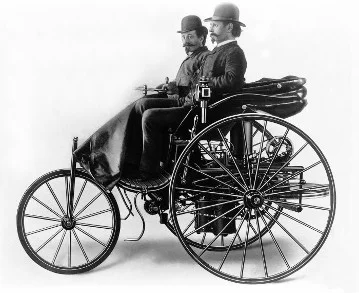
Carl Benz publicly drove the Benz Patent-Motorwagen on Mannheim's Ringstrasse on July 3, 1886. 3 The Mercedes-Benz archive identifies the event as the first public outing of Carl Benz, and the same date appeared in the local newspaper Neue Badische Landeszeitung. 3 The vehicle was the Patent-Motorwagen Nr. 2, and Benz & Cie. director Max Rose rode with him. 3 A July 6 date appears on Mozaweb's 3D scene page, but the July 3 date is supported by the Mercedes-Benz archive, the National Motor Museum, and the Benz Patent-Motorwagen entry's newspaper-citation record. 12 13 14
The public drive followed the legal move. Benz had filed patent DRP 37435, "Vehicle with gas engine operation," on January 29, 1886; the patent was granted on November 2, 1886. 15 Mercedes-Benz calls that patent the automobile's birth certificate. 15 UNESCO later added the patent to its Memory of the World register in 2011. 16
The machine was barely a car by today's instincts, which is why the demonstration mattered. The Patent-Motorwagen used a 954 cc single-cylinder four-stroke gasoline engine, produced about 0.75 hp at 400 rpm, and reached roughly 16 km/h, or 10 mph. 15 It had three wheels, a tubular steel frame, rear-mounted engine, belt transmission, differential, and chain drive to the rear wheels. 15 The National Motor Museum describes Benz as the first person to successfully match the technology to a road vehicle. 13
There was a competing innovation path nearby. Gottlieb Daimler and Wilhelm Maybach developed a motorized carriage in 1886 near Stuttgart, but that machine adapted an existing horse-drawn carriage rather than starting with a purpose-built motor vehicle. 17 Benz and Daimler never met personally, yet their companies eventually merged into Daimler-Benz AG on June 28, 1926. 18
The first public drive did not make the automobile an instant commercial hit. Benz & Cie. built about 25 Patent-Motorwagen vehicles between 1886 and 1893. 14 Bertha Benz's August 5, 1888, long-distance drive from Mannheim to Pforzheim later supplied the stronger field test, a roughly 106 km one-way trip that exposed fuel, braking, and hill-climbing problems. 19
Decision mirror. A patent protects a claim; a public demonstration tests belief. Benz had the legal claim before July 3, but the category still needed to be seen moving on a road. Early products often need this sequence: secure the right, show the artifact, then let users reveal what the prototype missed.
2000: Verizon turns deregulation into scale
Verizon Communications began trading on the NYSE under the ticker VZ on Monday, July 3, 2000, the first trading day after the Bell Atlantic-GTE merger closed on June 30, 2000. 4 The stock opened at $45.53 and closed at $48.39 on its first day, a 6.3% gain. 20 The combined company had about 2.7 billion shares outstanding at debut. 20
The listing was the public-market surface of a regulatory response. Bell Atlantic and GTE announced their stock-swap merger on July 28, 1998, and the deal closed nearly two years later after approvals from shareholders, the FCC, the U.S. Department of Justice, 27 state regulatory commissions, and international agencies. 4 The reported deal value varies by measurement date: Verizon described it as more than $52 billion at announcement, while the Associated Press reported $59 billion at closing. 4 21
The strategic logic came from the Telecommunications Act of 1996, which Verizon's corporate history describes as a shift toward more market-based policies and a driving force behind the company's formation. 4 Bell Atlantic had already added NYNEX in 1997, giving it New York and New England; GTE brought a broader national footprint as the largest independent U.S. telephone company. 4 The combined company had roughly 63 million access lines in 40 states and 25 million wireless customers. 21
Regulators did not approve scale for free. The FCC cleared the merger on June 16, 2000, with 25 conditions, including a requirement to spend $500 million entering new local phone markets or serving 250,000 customers outside the company's existing territories. 22 The FCC also required the divestiture of GTE's Internet backbone business, Genuity, while Verizon retained a 9.5% stake. 22
The wireless bet made the merger more than a wireline roll-up. Verizon Wireless began operations on April 4, 2000, as a joint venture between Bell Atlantic, with 55%, and Vodafone AirTouch, with 45%. 4 The venture had about 23 million customers at launch. 4 In 2014, Verizon bought Vodafone's 45% indirect interest in Verizon Wireless in a transaction valued at about $130 billion. 4
Decision mirror. Regulatory openings reward speed, but they also tax the winners. Verizon used deregulation to build national scale, then had to satisfy conditions, integrate assets, and keep buying control of the growth engine. In regulated markets, permission is only the first test; the combined company still has to operate well enough to justify it.
July 3's pattern is practical. The savings bank, the Dow average, the Patent-Motorwagen, and Verizon were all incomplete at the moment they appeared. That incompleteness is the lesson. A trusted savings product can precede mass retail finance. A rough index can precede modern market data. A fragile motorcar can precede an industry. A merger listing can precede the hard work of integration. Leaders do not always get to wait for the market to be legible. Sometimes the decision is to build the instrument that makes it legible.
Cover image: Carl Benz and Max Rose in the Benz Patent-Motorwagen Nr. 2, via Mercedes-Benz Classic Archives.
Fuentes de referencia
- 1The New York Times: Financial and Business Sidelights of the Day
- 2MeasuringWorth: Daily Closing Values of the DJA
- 3Mercedes-Benz Classic Archives: First public outing of Carl Benz
- 4Verizon: The History of Verizon Communications
- 5Charles E. Knowles: History of the Bank for Savings in the City of New York 1819-1929
- 6Business Journalism History: 1884
- 7Wikipedia: Dow Jones Transportation Average
- 8Wikipedia: Panic of 1884
- 9Wikipedia: Charles Dow
- 10LGT: Dow Jones jubilee: 125 years later
- 11Wikipedia: Dow Jones Industrial Average
- 12Mozaweb: Patent-Motorwagen (Karl Benz, 1886)
- 13National Motor Museum: 29th January 1886 - the birth of the motorcar?
- 14Wikipedia: Benz Patent-Motorwagen
- 15Mercedes-Benz Group: Benz Patent Motor Car: The first automobile
- 16UNESCO: Patent DRP 37435
- 17Wikipedia: Daimler Motorized Carriage
- 18Mercedes-Benz Group: The predecessor companies (1886-1920)
- 19Wikipedia: Bertha Benz
- 20Markets Insider: Verizon Stock Price History
- 21The Journal Record: Bell Atlantic, GTE complete megamerger
- 22CBS News: FCC OKs Massive Phone Merger
Más de este canal
Contenido relacionado
- Inicia sesión para comentar.