29/6/2026 · 7:27
June 29: four rails that scaled
A June 29 practitioner briefing on national banking, railroad regulation, interstate highways, and the first iPhone sale — four moments when commercial friction became operating infrastructure.

June 29 is a useful date for operators because four events on this day turned business friction into operating infrastructure. The First National Bank of Davenport opened under the new U.S. national banking system in 1863. 1 President Theodore Roosevelt signed the Hepburn Act in 1906, giving the Interstate Commerce Commission explicit power to set maximum railroad rates. 2 President Dwight D. Eisenhower signed the 1956 highway act at Walter Reed Army Medical Center. 3 Apple put the first iPhone on sale in the United States at 6:00 p.m. local time on June 29, 2007. 4
The shared lesson is not nostalgia. Each decision created, constrained, or commercialized a rail that other businesses later had to run on.
1863: the money rail gets standardized
On June 29, 1863, the First National Bank of Davenport, Iowa, opened for business and became the first bank to operate under the national banking system created earlier that year. 1 The nuance matters: the Davenport bank held Charter No. 15, while Charter No. 1 went to the First National Bank of Philadelphia, but Davenport opened first. 5
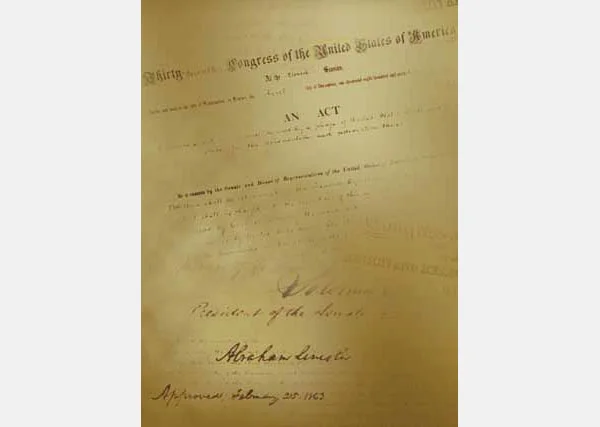
The business problem was everyday friction. Before the National Currency Act, the United States had roughly 1,500 state-chartered banks issuing about 7,000 varieties of bank notes, and merchants needed bank-note reporters to judge which notes were good and which traded at a discount. 1 President Abraham Lincoln had signed the National Currency Act on February 25, 1863, creating the Office of the Comptroller of the Currency and a federally supervised national bank-note system. 6
Austin Corbin and Tristam Dow founded the Davenport bank; Corbin became its first president and later consolidated the Long Island Rail Road. 7 Hugh McCulloch, the first Comptroller of the Currency, urged national bankers to conduct "a straightforward, upright, legitimate banking business" and warned them never to chase large returns by doing anything outside the law. 1
Decision mirror. Standardization can be a growth strategy. The national banking system did not merely make money look uniform; it reduced the verification burden on commerce. When a market is full of private formats, discounts, and trust checks, the business that helps customers transact without revalidating every counterparty can create the real platform.
1906: the rate rail gets a referee
On June 29, 1906, President Theodore Roosevelt signed the Hepburn Act into law. 2 The act amended the Interstate Commerce Act of 1887 and gave the Interstate Commerce Commission explicit authority to set maximum railroad rates under a "just and reasonable" standard. 2
The law responded to a clear gap in federal power. In 1897, the Supreme Court had held in ICC v. Cincinnati, New Orleans & Texas Pacific Railway Co. that the commission did not have implied rate-setting authority; the Hepburn Act supplied that authority directly. 2 The act also extended ICC jurisdiction to bridges, terminals, ferries, sleeping cars, express companies, and oil pipelines, and it required standardized railroad bookkeeping that the commission could inspect. 2
Roosevelt framed the issue as a power problem in interstate commerce. In his 1905 message to Congress, Roosevelt called for federal supervision of railroad rates that could prevent "unjust or unreasonable rates," while adding that rate power should be exercised with "moderation, caution, and self-restraint." 2 The act passed Congress with only three dissenting votes, showing how far railroad pricing had moved from private contract into public governance. 2
Decision mirror. Infrastructure owners eventually meet access politics. Railroads had network power because shippers needed the network. Roosevelt's answer was not to break the network; it was to regulate the tollbooth. Any platform company with unavoidable distribution power should assume the same question will arrive: who sets the price, and who audits the books?
1956: the logistics rail gets financed
On June 29, 1956, Eisenhower signed the Federal-Aid Highway Act, formally the National Interstate and Defense Highways Act, while recovering from ileitis surgery at Walter Reed Army Medical Center. 3 The signing had no ceremonial theater: no members of Congress stood by, no pens were handed out, and Eisenhower split 27 bills into morning and afternoon signing batches to conserve energy. 3
The law authorized $25 billion for about 41,000 miles of interstate highways, with the federal government covering 90% of construction costs and states covering 10%. 8 Congress paired that scale with a financing mechanism: the Highway Trust Fund dedicated federal fuel taxes and other highway-user taxes to road construction. 9 The 1956 law raised the federal gasoline tax from 2 cents to 3 cents per gallon, and Congress raised it again to 4 cents in 1959. 9
Eisenhower's support had a long memory. As a 28-year-old Army officer in 1919, he joined the first transcontinental motor convoy, which took 62 days to travel about 3,250 miles from Washington to San Francisco. 10 During World War II, he also saw how Germany's autobahn supported military movement and logistics. 10
Decision mirror. Big networks need a funding model before they need a launch ceremony. The interstate system was possible because the political promise, the user-pays mechanism, and the federal-state split fit together. For executives, the analog is simple: a strategic network without a repeatable funding loop becomes a capital request that has to be re-sold every year.
2007: the pocket rail becomes a platform
On June 29, 2007, Apple started selling the first iPhone in the United States at 6:00 p.m. local time through 164 Apple Stores and selected AT&T stores. 4 Apple priced the 4GB model at $499 and the 8GB model at $599, both with a two-year AT&T service contract. 4 Apple Stores closed at 2:00 p.m. to prepare and reopened at 6:00 p.m., with each customer limited to two phones. 4
The launch was a product event, but the control model was the deeper business move. Apple and Cingular, later AT&T Mobility, had signed a five-year exclusive deal that let Apple control the iPhone's design, manufacturing, and marketing more than carriers usually allowed. 11 Apple also received about $10 per month from each iPhone user's AT&T bill, according to WIRED's later account of the agreement. 11
The market did not yet know it was watching the start of a software economy. At launch, the first iPhone lacked 3G, GPS, MMS, and third-party native apps; ABI Research judged it a very high-end feature phone rather than a smartphone under its then-current definition. 12 Apple sold about 270,000 iPhones in the first roughly 30 hours and reached 1 million units sold on the 74th day. 12 Apple opened the App Store on July 10, 2008 with 500 apps, and downloads topped 10 million in the first three days. 13
Decision mirror. Product control can precede platform control. The first iPhone did not launch with the App Store, but Apple had already changed the carrier relationship and the customer experience. When a company wants to create a platform, the first visible product may matter less than the invisible control rights it negotiates before launch.
June 29's pattern is compact enough to use in a morning meeting. The Davenport bank shows what happens when a market standard removes transaction friction. The Hepburn Act shows how tollbooth power attracts oversight. The highway act shows why funding architecture decides whether physical ambition becomes a system. The iPhone shows how a launch becomes a platform when control shifts before the ecosystem appears.
Cover image: National Currency Act of 1863, via OCC History: 1863-1865.
Fuentes de referencia
- 1OCC History: 1863-1865
- 2Wikipedia: Hepburn Act
- 3FHWA: June 29, 1956, A Day In History
- 4Apple Newsroom: iPhone Premieres This Friday Night at Apple Retail Stores
- 5Visit Quad Cities: First National Bank
- 6Federal Reserve History: National Banking Acts of 1863 and 1864
- 7Notes on Iowa: First National Bank
- 8National Archives: National Interstate and Defense Highways Act
- 9FHWA: Financing Federal-Aid Programs, Highway Trust Fund
- 10FHWA: Federal-Aid Highway Act of 1956, Creating the Interstate System
- 11WIRED: How the iPhone Blew Up the Wireless Industry
- 12Wikipedia: iPhone (1st generation)
- 13Apple Newsroom: The App Store turns 10
Añade más opiniones o contexto en torno a este contenido.