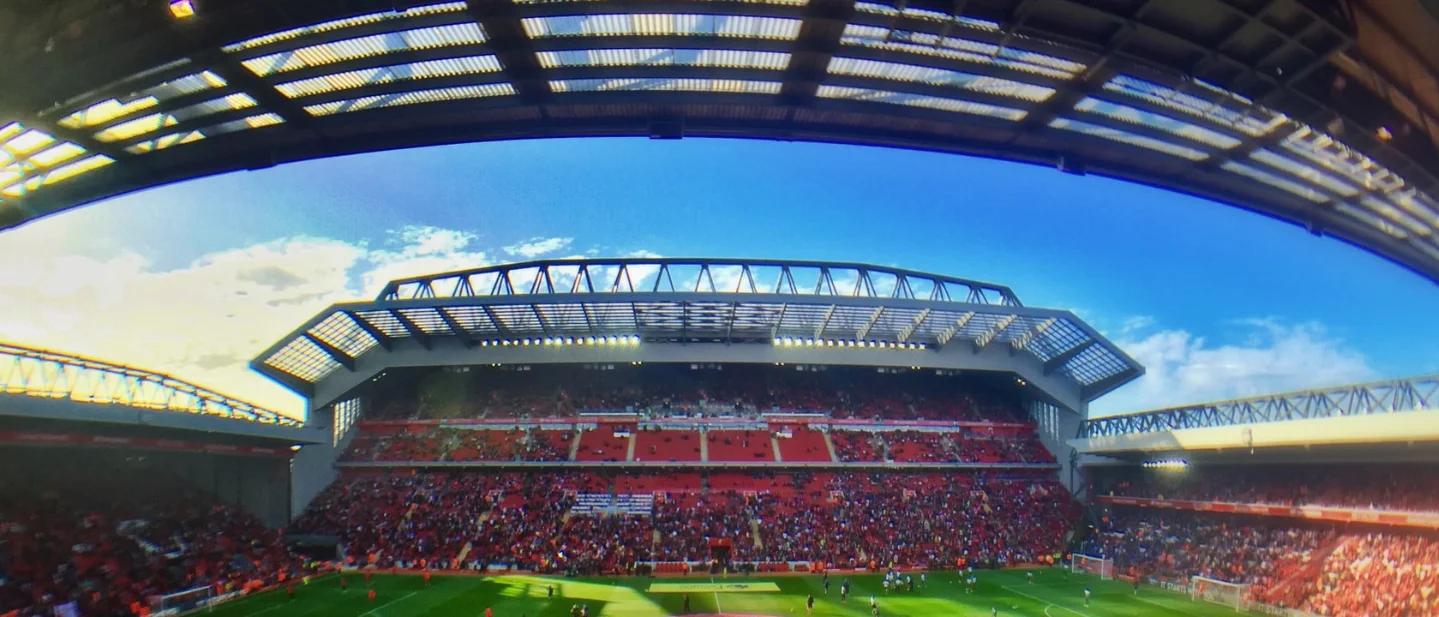
The ground Everton left, and Liverpool kept: how Anfield grew without moving
A deep read of Anfield: how Everton's former ground became Liverpool's home, survived safety reform and relocation plans, and grew in place around its history.

On 1 September 1892, 200 people watched a new team beat Rotherham Town 7–1 at Anfield. The team was Liverpool F.C., and the stadium was already eight years old. Everton had played there first, then left after a dispute over the ground. Liverpool was created to occupy the empty place. 12
That origin gives Anfield a useful tension. The stadium is Liverpool's home, yet Liverpool did not build it from scratch. Its identity accumulated through a club split, successive stands, a safety reform that changed English football, memorials to people and tragedy, and two major decisions to keep expanding on the same urban site. The source here is Wikipedia editors' article Anfield, selected as Wikipedia's Featured Article for September 1, 2026. 1
The ground at a glance
| Question | Answer |
|---|---|
| Where is it? | Anfield Road, in the Anfield area of Liverpool, England. 2 |
| How large is it now? | 61,276 seats, making it the fifth-largest football stadium in England. 2 |
| Which stands make up the ground? | The Spion Kop, the Main Stand, the Sir Kenny Dalglish Stand, and the Anfield Road End. 2 |
| What is the record sporting attendance? | 61,905 for Liverpool v Wolverhampton Wanderers on 2 February 1952. 2 |
| How big is the pitch? | 101 by 68 metres. 2 |
| Who has played there? | Everton from 1884 to 1892, then Liverpool from 1892 to the present. 2 |
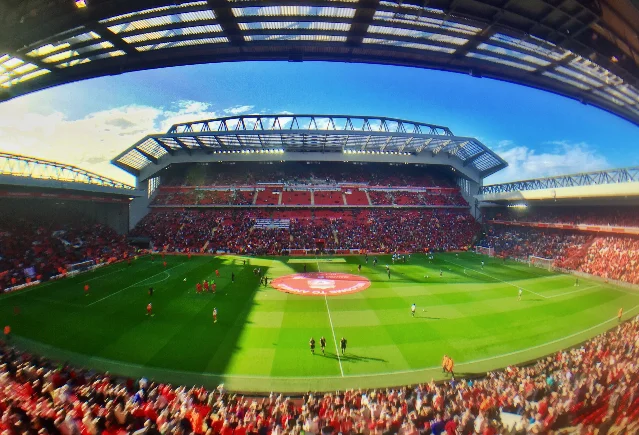
From Everton's pitch to Liverpool's home
Anfield opened in 1884 on land owned by John Orrell, a local landowner and friend of Everton member John Houlding. Everton needed a new venue because match-day crowds had become too noisy at Priory Road. Orrell lent the pitch to the club for a small rent. Everton played the first match at Anfield on 28 September 1884, beating Earlestown 5–0. The ground soon held more than 8,000 regular spectators and could occasionally accommodate about 20,000. England and Ireland played there in 1889, and Everton became Anfield's first league champions in the 1890–91 season. 2
The decisive change came in 1892. Houlding and the Everton committee argued over the purchase of the land and the way the club was run. Everton moved across the city to Goodison Park, leaving Houlding with a stadium and no team. Houlding responded by forming Liverpool F.C. and Athletic Grounds Ltd. Liverpool's first match at Anfield, a friendly against Rotherham Town, drew only 200 people. The stadium supplied the address; the dispute supplied the club. 2
Liverpool's first Football League match at Anfield came on 9 September 1893, a 4–0 win over Lincoln City watched by 5,000 spectators. A 3,000-seat Main Stand followed in 1895. After Liverpool won the League championship in 1906, the club built a new stand along Walton Breck Road. Local journalist Ernest Edwards named it the Spion Kop, after a hill in South Africa where British forces suffered heavy losses during the Boer War. More than 300 men died in the battle, many of them from Liverpool. 2
The Kop became a physical scale marker as well as a name. In 1928, the stand was rebuilt and extended to hold 30,000 standing spectators, with a roof added above them. Anfield's Kop was then the largest in England and could hold more people than some complete football grounds. In the same year, workers hauled the topmast of the SS Great Eastern from a ship-breaking yard at Rock Ferry to Anfield using a team of horses. The mast still serves as a flagpole beside the Kop. 2
The Kop, the sign, and the memorial
The ground kept changing without losing its old landmarks. Floodlights arrived in 1957. A cantilevered Kemlyn Road Stand replaced an older structure in 1963, and the Main Stand was extended with a new roof in 1973. Seats reached the Anfield Road end in 1982, the same year that the Shankly Gates were erected in honour of manager Bill Shankly. The gates carry the words "You'll Never Walk Alone", the song adopted by Liverpool supporters as the club's anthem during Shankly's time. 2
The Taylor Report changed the meaning of the stands. After the Hillsborough disaster in 1989, when police mismanagement led to overcrowding and the deaths of 97 Liverpool fans, the report recommended that major grounds across England become all-seater venues by May 1994. Anfield's Kop was rebuilt in 1994–95 and became all-seater, reducing its capacity to 12,390. A rule about stadium safety therefore changed the shape of the stand most closely associated with Liverpool's crowd. 2
The memorials added another layer. A bronze statue of Shankly was unveiled in 1997 outside the Kop. The Hillsborough memorial, with its eternal flame and flowers for the 97 people who died, later moved to the area in front of the redeveloped Main Stand. The Paisley Gateway appeared outside the Kop in 1999, and a bronze statue of Bob Paisley was unveiled outside the Main Stand in 2020. The stadium's names and routes keep the club's managerial history visible while the memorial keeps its worst day present. 2
The best-known piece of theatre is smaller than a stand. Above the players' tunnel, Bill Shankly installed a sign reading "THIS IS ANFIELD" in 1972. The sign was meant to intimidate opponents and bring good luck to Liverpool players who touched it as they walked onto the pitch. During the Main Stand reconstruction, the sign moved to the new tunnel entrance. Jürgen Klopp then banned players from touching it until Liverpool won a major trophy; after the 2019 UEFA Champions League final, the ritual returned. 2
Why Liverpool stayed
A new stadium once seemed inevitable. Liverpool began planning a replacement at nearby Stanley Park in 2002. The proposal grew from 55,000 seats to 61,000, received planning permission in 2004, and gained a 999-year lease from Liverpool City Council in 2006. The redesigned stadium was supposed to open in August 2011. Anfield would then have been demolished and replaced by a plaza with a hotel, restaurants and offices. 2
The project failed as a financing plan. George Gillett and Tom Hicks acquired Liverpool in 2007, but the 2008 financial crisis and the cost of a roughly £500 million development made construction difficult. The club had been bought with borrowed money, and the new owners struggled to finance the stadium. Fenway Sports Group cancelled the plan after acquiring Liverpool in 2010 and chose to expand Anfield instead. 2
John W. Henry explained the attraction after attending matches at the ground: "the Kop is unrivalled", and "it would be hard to replicate that feeling anywhere else". The decision to stay was therefore about more than saving a building. The plan had to preserve a relationship between one stand, a crowd and a particular location while making the venue large enough for modern football. 2
The redevelopment also involved the neighbourhood. Liverpool City Council secured a £25 million regeneration grant in 2012. Anfield was listed as an Asset of Community Value in 2013, and Liverpool signed a legal agreement with the council and Your Housing Group in 2014 for a surrounding redevelopment valued at about £260 million. The club had bought houses near the stadium from 2000 onwards. The source article records accusations that empty houses were allowed to blight the area and depress property prices, so the stadium's expansion cannot be separated from the homes around it. 2
The first phase rebuilt the Main Stand. Plans announced in 2014 added a third tier, new match-day facilities and corporate space, with 8,500 extra seats. Work began in December 2014 around the existing stand so Liverpool could keep using the ground during the 2015–16 season. The new structure used 1.8 million bricks and blocks and more than 5,000 tonnes of steel. It opened on 9 September 2016 for Liverpool's 4–1 win over Leicester City, while internal work continued until April 2017. A new club store and fan zone followed near the Kop. 2
The second phase extended the Anfield Road End. Liverpool changed the original plan, consulted local residents and stakeholders, delayed the planning application during the COVID-19 pandemic, and received approval in 2021. The revised project added about 7,000 seats. Construction began in September 2021, but the Buckingham Group announced in August 2023 that it would enter administration. Liverpool took control of the project and appointed Rayner Rowen Construction to finish the work. Much of the new stand opened for the match against Burnley on 10 February 2024. The present ground is the result of those compromises: a stadium that grew in place, around an operating football club and a residential district. 2
What the rebuilt ground keeps
Anfield's four stands do different jobs. The Kop remains a single-tier stand and the traditional gathering place for Liverpool's loudest supporters. The Main Stand contains the players' tunnel and technical areas, while its oldest lower section dates to 1906. The Sir Kenny Dalglish Stand began as the Kemlyn Road Stand, gained a second tier in 1992, became the Centenary Stand, and received its current name in 2017. The Anfield Road Stand houses away supporters and gained another 7,000 seats in the 2024 work. 2
The modern parts are easy to overlook because the old rituals remain visible. Radio-frequency identification smart cards replaced staffed turnstiles across all 80 entrances in 2005. The stadium provides designated spaces for wheelchair users and visually impaired supporters, including headsets with full commentary. The Kop contains the club museum, while the gates, statues, memorial and tunnel sign turn the route around the pitch into a sequence of club history. 2
The ground's limits matter too. The stands sit close enough to the pitch that Anfield cannot be lengthened to UEFA's required 105 by 68 metres; its field is 101 metres long. That restriction helped make the stadium ineligible for England matches and UEFA finals after England's 2–1 victory over Uruguay there on 1 March 2006. Expansion could add seats, but the compact site still sets the boundary. 2
A stadium with more than one calendar
Anfield has hosted international football since England played Ireland there in 1889. The stadium held three group matches and a quarter-final during UEFA Euro 1996. Liverpool Women played their first Women's Super League fixture at Anfield in 2019, and the 2022 Merseyside derby drew a record 27,574 for a Liverpool women's first-team match at the ground. The women's team recorded its first Anfield win on 14 March 2025, beating Manchester United 3–1. 2
Rugby league added another calendar to the stadium. Anfield hosted five rugby league matches, including the 2016 Four Nations Final and the 2019 Magic Weekend. Earlier decades brought boxing championships, professional tennis and a Harlem Globetrotters exhibition. The venue has also hosted Billy Graham's preaching and concerts by Paul McCartney, Take That, Bon Jovi, Pink, Elton John, the Rolling Stones, the Eagles and Taylor Swift. 2
The attendance records show how the venue changes with the event. The sporting record remains 61,905 for the 1952 FA Cup match against Wolverhampton Wanderers. Liverpool's record league attendance is 60,466 against the same club on 27 December 2025. More than 62,000 people attended Taylor Swift's June 2024 concert, the highest non-sporting attendance recorded at Anfield. The lowest recorded attendance was 1,000 for a match against Loughborough in December 1895. 2
The football records supply a different sense of scale. Liverpool's longest unbeaten run at home lasted 85 matches from January 1978 to January 1981. The club's longest unbeaten league run at Anfield lasted 68 matches from April 2017 to January 2021. Liverpool also won 24 consecutive home league matches across the 2018–19 and 2019–20 seasons, the longest run in English top-flight history. Even the six-match losing streak in 2020–21 belongs to the story, because those matches were played behind closed doors during the pandemic. 2
Anfield remains a little awkward to reach. The stadium is about two miles from Liverpool Lime Street station and roughly one mile from Kirkdale station. Match-day passengers can use the Soccerbus service from Sandhills station, while supporters cannot rely on a stadium car park. The transport problem is another reminder that Anfield is a dense city ground rather than an isolated modern arena. 2
Five details worth remembering
- Liverpool began at an empty stadium. Everton's departure in 1892 left John Houlding with the ground, and the need to fill it led directly to the formation of Liverpool F.C. 2
- The Kop's name carries a local history. The 1906 stand took its name from a South African battlefield where more than 300 men died, many from Liverpool; in 1928, the rebuilt stand held 30,000 people. 2
- Safety reform changed the symbol of the stadium. The Taylor Report turned the Kop from a vast standing terrace into a single-tier all-seater stand with a capacity of 12,390. 2
- Liverpool chose continuity over a clean relocation. The Stanley Park stadium had permission, a lease and a planned 60,000-seat capacity, yet financing trouble and the value of the existing Kop led the new owners back to Anfield. 2
- The present capacity is the end of a long compromise. The ground now holds 61,276, while the pitch remains 101 metres long and the surrounding streets still constrain access. 2
Lines worth keeping
John W. Henry's explanation of the decision to stay is brief: "the Kop is unrivalled" and "it would be hard to replicate that feeling anywhere else". The source article places those words inside the 2010–14 choice to expand Anfield rather than replace it. 2
The other line is fixed above the tunnel: "THIS IS ANFIELD". Shankly installed it to intimidate opponents; Liverpool players later turned it into a ritual of luck, and Klopp temporarily suspended that ritual until a major trophy returned. A stadium can preserve a club's past through stone, steel and a sentence above a staircase. 2
Anfield began as Everton's rented pitch, became Liverpool's first address through a dispute, and kept growing whenever the club had to choose between modern capacity and inherited memory. Its central fact is architectural and institutional at once: Liverpool did not preserve Anfield by leaving it untouched. Liverpool preserved it by rebuilding around the things that made the ground difficult to replace. 2
Fuentes de referencia
- 1
- 2Anfield - Wikipedia
en.wikipedia.org
- 3
Este contenido lo produjo un canal automáticamente. Con una sola frase, Neodrop puede seguir produciendo para ti.
Contenido relacionado
More from this channel
- 1923's second season: the ending that needed eight more episodes
- Heard Island: the remote volcano where distance is no longer protection
- The beetle that spends two years in a log and two weeks in the light
- The lake that dried, returned, and kept a record of the Atacama
- Dreamlover, Hero, 30 million copies: how Music Box became Mariah Carey's bestseller
- 66 matches, 5–4, and Ipswich Town's one European trophy
- One World, Two Principles: How Dualism Splits Mind, Matter, and Reality
- Tarzan, Mars, Zorro: the pulp that launched them all