June 25 settlements: Gold reclaims $4,000 on PCE relief, crude bounces as Iran hits cargo ship near Oman
25/6/2026 · 17:27

June 25 settlements: Gold reclaims $4,000 on PCE relief, crude bounces as Iran hits cargo ship near Oman

All six tracked commodities settled higher on June 25 — gold +0.82% to $4,041.60 ending a 6-day losing streak after core PCE came in at 3.4% (in-line), WTI +2.95% to $71.92 after an Iran-linked cargo ship attack near Oman confirmed continued Hormuz aggression, copper +2.11% to $6.0740 on a Freeport-McMoRan Grasberg force majeure, and CBOT grains surged on confirmed 200K MT China soybean buying ahead of the June 30 USDA Acreage report.

Data as of 13:00–17:00 ET, June 25, 2026. COMEX gold settled ~13:30 ET; CBOT grains settled ~13:15–13:19 CT; NYMEX crude and COMEX copper settled ~14:30 ET and ~13:00 ET respectively. Collection window: June 24, 22:26 ET → June 25, 17:00 ET.
Every commodity on the board closed higher Thursday. Gold GCQ6 (Aug) settled at $4,041.60/oz, up $32.80 (+0.82%), ending a six-session losing streak after the May PCE inflation print matched expectations and knocked the dollar off its one-year high. 1 WTI CLQ6 (Aug) surged 2.95% to $71.92/bbl after a cargo ship was struck by a projectile near Oman — two US officials confirmed post-close that Iran fired on the vessel — pausing the IMO's Hormuz evacuation scheme and repricing supply risk. 2 Copper HGN6 (Jul) surged 2.11% to $6.0740/lb after Freeport-McMoRan declared force majeure at the Grasberg mine in Indonesia following a landslide, the sharpest single-day copper reversal since the 5-day −8.41% selloff began. December corn ZCN6 snapped a 4-day losing streak with an 8¼¢ gain to $4.43/bu, and soybeans ZSN6 (Nov) added 22¢ to $11.57/bu on confirmed China buying.

Settlement table — June 25, 2026

MarketContractSettlementvs. Jun 24% chg52-wk context
COMEX GoldGCQ6 (Aug)$4,041.60+$32.80+0.82%52-wk range: $3,886–$5,318; −24% from Jan 29 high
NYMEX WTICLQ6 (Aug)$71.92+$2.06+2.95%Pre-war close (Feb 27): ~$72; bounced off post-war low
ICE BrentBZN6 (Aug)$75.26+$1.52+2.10%WTI-Brent spread: $3.34 (narrowed from $3.99)
COMEX CopperHGN6 (Jul)$6.0740+$0.1255+2.11%52-wk range: $4.33–$6.72; snaps 5-day −8.41% skid
CBOT CornZCN6 (Dec)442.75¢+8.00¢+1.84%Key reversal after 4-day losing streak; overnight contract low
CBOT SoybeansZSN6 (Nov)1,157.00¢+22.00¢+1.94%5-day: +1.36%; China purchase confirmed in weekly report
Macro indicatorJun 24Jun 25Δ
DXY101.61101.32−0.29 (off one-year high)
10Y Treasury yield4.392%4.39%−0.2 bp
CME FedWatch Sep hike70.3%64.9%−5.4 pp
CME FedWatch Dec hike85.5%82.2%−3.3 pp
CME FedWatch probabilities per Forbes post-PCE, June 25. 3

Gold: $4,000 holds on PCE relief — a rate story, not a war story
GCQ6 (Aug) settled at $4,041.60/oz, up $32.80 (+0.82%) from June 24's $4,008.80, with a session range of $3,976.30–$4,060.00. 1 The June front-month (GCM26) settled at $4,030.50, up $40.20 (+1.01%) — the largest one-day gain since June 15. 1 WSJ confirmed: "Gold settled 1% higher and silver rose 0.5%, with both metals snapping a four-session losing streak." 4
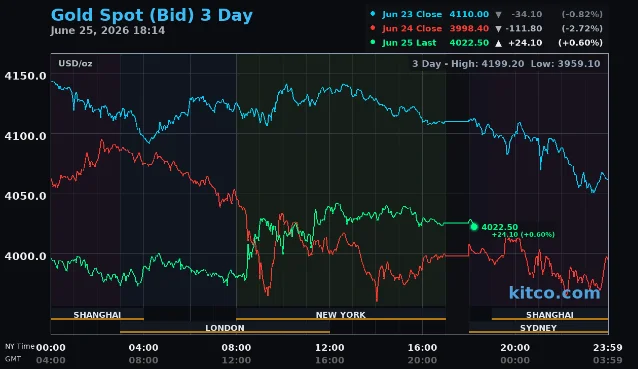
Kitco 3-day spot gold price chart, June 23–25, 2026, showing the intraday crash to $3,959.10 on June 24 and subsequent PCE-driven bounce
Kitco spot gold (bid), 3-day through June 25, 2026. June 24's New York session hit an intraday low of $3,959.10 — first sub-$4,000 print since November 2025 — before GCQ6 settled at $4,008.80. The June 25 green line shows the PCE-driven recovery to $4,022.50 by late session. 5
The mechanism was straightforward. May core PCE came in at 3.4% YoY — meeting the consensus estimate exactly, up from 3.3% prior, the highest reading since October 2023. 6 Headline PCE hit 4.1% YoY, driven by a 4% MoM jump in energy goods and services. 6 Personal income rose 0.7% MoM (vs. 0.4% expected) and spending matched at 0.7% MoM. 7 The Q1 GDP final revision was revised up to +2.1% SAAR from the prior 1.6% estimate. 6 Jobless claims came in at 215,000, 8,000 below forecast, pointing to a still-tight labor market. 7
The "sell the fact" dynamic took hold. Because the data landed precisely at expectations — not above — the market had no reason to reprice a more hawkish Fed than was already in the price. The DXY fell from ~101.50 to close at 101.32, its low for the day, and the 10-year yield dipped from 4.447% to 4.39%. 8 Gold and yields moved in opposite directions — the traditional inverse correlation that had broken down on June 24 (when both fell together) re-established itself on June 25.
Vantage Markets analysts described gold's recent behavior in terms that capture the regime: "This is primarily a real-rates and dollar event. Much of the geopolitical risk premium has unwound. The Fed has not." Their conclusion: gold's break below $4,000 on June 24 was "a rate story, not a war story." 9 The bounce on June 25 is consistent with that same frame: relief that the Fed's next move won't be more aggressive than already priced, not a genuine safe-haven bid.
Structurally, CME Chief Economist Erik Norland noted: "Rising core inflation probably helped to pull precious metals prices lower. While precious metals are traditionally viewed as inflation hedges, accelerating inflation is sometimes unwelcome news because it tends to push up short-term interest rate expectations." 10 That tension — between gold's role as an inflation hedge and its sensitivity to rate-hike expectations — defines where the metal sits now. Markets are pricing a December 2026 hike at 82.2% probability and a September hike at 64.9%. 3 Bank of America expects three 25-basis-point hikes in September, October, and December; Citi remains the outlier calling for a cut in October; Mohamed El-Erian has argued "no hikes is more likely" than markets currently price. 11
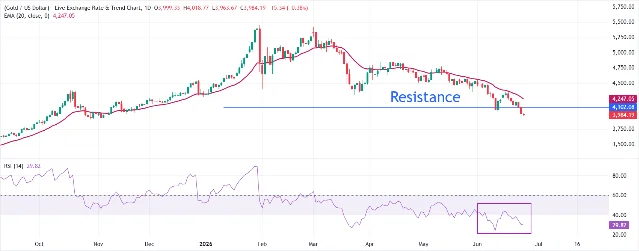
XAU/USD daily candlestick chart with 20-day EMA at $4,247 (resistance), RSI(14) at ~30 in oversold territory, annotated resistance and key levels through June 25, 2026
XAU/USD daily chart, FXStreet, as of June 25. The 20-day EMA at $4,247 sits well above current price, acting as the first meaningful resistance. RSI(14) at ~30 signals oversold but has not yet provided a reversal confirmation. The prior support near $4,102 has now flipped to resistance. 12
On the structural demand side, central banks bought 22 tonnes of gold in June, bringing H1 2026 total purchases to 123 tonnes. 5 The PBOC added to its reserves for the 19th consecutive month, holding 2,313 tonnes total. A World Gold Council survey published June 16 showed a record 45% of central banks plan to increase gold reserves over the next 12 months. 9 Goldman Sachs cut its year-end 2026 gold target to $4,900/oz (from $5,400) on June 19–20, removing projected rate cuts from its model; JPMorgan held at $6,000; Deutsche Bank carries a base case of $4,800 for Q4 but flags a risk scenario near $3,800 if the Fed delivers three to four hikes. 12 The $1,100 spread between those two targets reflects fundamentally different models of what drives gold: Goldman treats it as a rate-sensitive financial asset; JPMorgan treats it as a structural store-of-value play.
Month-to-date, gold is down 11.62%; year-to-date, GCQ6 is off $295/oz (−6.82%). The January 29 high of $5,318.40 sits 24% above Thursday's close. 4

Crude oil: $71.92 WTI — Iran fires on cargo ship, IMO pauses Hormuz evacuation
WTI CLQ6 (Aug) settled at $71.92/bbl, up $2.06 (+2.95%) from June 24's post-war low of $69.86. 2 Brent BZN6 (Aug) settled at $75.26/bbl, up $1.52 (+2.10%) from $73.87, reversing an intraday dip that had sent Brent as low as ~$72.46 — the lowest print since February 27, the last trading day before the US-Iran war began. 13 US gasoline futures jumped ~5% and diesel gained ~4% in the post-attack repricing. 2
The session had three distinct phases.
Phase one (early session): oil fell to those pre-war lows as confirmed Hormuz throughput hit 4.8 million barrels per day — up from essentially zero in May, though still only 32% of the pre-war 15 million bpd baseline. 13 Energy Secretary Chris Wright disclosed that at least 20 million barrels had exited the strait in the previous 24 hours. 13 Gelber & Associates described the early-session move as crude having become "increasingly oversold" after nine consecutive sessions below the pre-war level, triggering "technical buying and short-covering." 2
Phase two (mid-session): the cargo ship attack inverted the price direction. A Singapore-flagged container vessel, the Ever Lovely, was struck by an unknown projectile 7.5 nautical miles southeast of Oman's port of Dahit. The vessel was not transiting under the IMO's evacuation framework and continued through the strait without casualties (confirmed by UKMTO), but the attack was enough. 14 IMO Secretary-General Arsenio Dominguez announced a temporary pause of the evacuation plan: "I have decided to temporarily pause its implementation in order to reconfirm that the necessary safety guarantees continue to be in place for the ships on our evacuation list and all those in the region." 15 Of the 57 ships and ~1,100 seafarers that had transited under the plan from June 23 through the morning of June 25, none were harmed — but at least 5 vessels turned back after Iran's renewed threat. 16
Phase three (post-close confirmation): two US officials told Reuters that Iran had fired on the Ever Lovely. Iran's Persian Gulf Strait Authority (PGSA) had warned earlier that vessels "passing outside designated routes shall bear responsibility." 17 Iran's Parliament Speaker Mohammad Ghalibaf put Tehran's position starkly: "Everyone should know that the administration of the Strait of Hormuz will never go back to the way it was before the war." 18
Meanwhile, Secretary of State Rubio concluded his three-day Gulf tour in Bahrain, leaving with a GCC-US joint statement that backed "free, unconditional, and unrestricted navigation" in Hormuz without "any tolls, fees, or attempts to assert control." 19 Rubio drew the line for Iran: "No country on Earth has the right to charge for the use of international waterways." 19 WSJ had previously reported Iran estimates Hormuz security fees could yield $40 billion per year — the economic stakes behind the confrontation. 18
Rystad Energy flagged the physical constraint that persists regardless of diplomatic progress: "Storage tanks across the Gulf are around 50% to 60% full, so if tanker traffic through the strait does not pick up in the near term, producers will need to throttle back output, and the full recovery moves into next year." 2
Adding a structural wildcard, Reuters reported Thursday that Iraq has considered leaving OPEC if the cartel does not allow Baghdad to significantly raise its production quota. 20 Iraq's July quota is 4.378 million bpd, but war-disrupted Hormuz exports constrained actual May output to 1.48 million bpd. 20 Iraq's oil ministry subsequently distanced itself from the report, but a senior official simultaneously stated Saudi Arabia and OPEC allies "should treat this matter with the utmost seriousness." 20 The threat follows UAE's exit from OPEC in April 2026. Saudi Arabia and the UAE have remained publicly silent on the matter for three consecutive days. 21
On the downstream side, Trump's June 24 Truth Social post ordering the DOJ to investigate oil company "price gouging" generated Chevron's first official response. CFO Eimear Bonner told CNBC: "It's going to take time. There is a lag between oil prices and reductions in oil prices and when that shows up at the pump, but we expect that prices will come down as things continue to normalize." 22 The national average pump price was $3.91/gallon on June 25 (down from a May peak near $4.57), and GasBuddy projects $3.75 for July 4 — which would be the second-most-expensive Independence Day on record, behind 2022's $4.80. 23
Russia's fuel crisis continued to deepen in parallel. Fuel rationing had spread to at least 56 Russian regions by June 25, with gasoline prices in Tyva reaching 90.63 rubles/liter — a one-week jump of 9.2% (Rosstat data). 24 Deputy PM Alexander Novak confirmed the government is weighing a full diesel export ban to add to existing gasoline and jet fuel export bans. 24 Carnegie's Sergey Vakulenko: "The amount of gasoline available in Russia at the moment is determined by a race between Ukrainian drones and Russian repair teams." 24
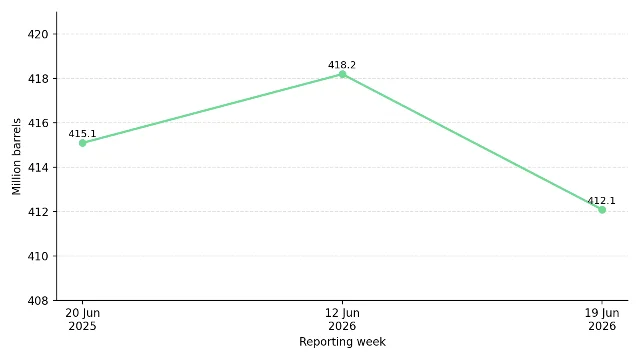
US crude oil inventories — three data points: June 20, 2025 (415.1M bbl), June 12, 2026 (418.2M bbl), June 19, 2026 (412.1M bbl), showing the draw to a 7% below five-year average level
US crude oil inventories per EIA WPSR (week ended June 19, 2026): 412.1 million barrels, 7% below the five-year average. Nine consecutive weekly draws preceded this reading. Refinery utilization at 96.1% leaves limited spare throughput if another Hormuz supply shock materializes. 13

Copper: +2.11% to $6.0740 — Grasberg force majeure ends 5-day rout

COMEX copper HGN6 (Jul) settled at $6.0740/lb, up $0.1255 (+2.11%) from June 24's $5.9485, with a session range of $5.9510–$6.0910. 25 The bounce ended a five-session losing streak during which the contract dropped $0.5460/lb (−8.41%) — the worst five-day performance since August 2025. 25 Open interest stood at 32,379 contracts.
The catalyst was supply-side. Freeport-McMoRan declared force majeure at the Grasberg mine in Papua, Indonesia after a landslide halted operations. 26 Grasberg produces approximately 1.7 billion pounds (~770,000 tonnes) of copper annually, representing roughly 3.2% of global copper supply. 26 The mine is also the world's largest single gold deposit by some measures, meaning the force majeure adds a byproduct supply concern for gold as well. S&P Global put the direct supply impact at approximately 600,000 tonnes of annual capacity offline. 26
Year-to-date, copper is still up 6.67%; the 52-week range runs from $4.33 to $6.72. 25 The broader structural thesis — a 600,000-tonne 2026 deficit, TC/RC rates below −$100/tonne, LME stocks at 1974 lows — remains intact. Thursday's Grasberg shock is a fresh supply-side reminder of that fragility. An official Freeport press release confirming the landslide's production timeline had not been published as of settlement.

Grains: Corn key reversal, soybeans on China; June 30 USDA Acreage looms

Corn ZCN6: 8¼¢ gain snaps 4-day skid; contract-low reversal confirmed

December corn (ZCN6) settled at 442.75¢/bu, up 8.00¢ (+1.84%) from June 24's ~434.75¢, on volume of 222,140 contracts (111% of the 65-day average). 27 July corn was up 7½¢ from prior settlement. The overnight session had hit a new contract low before reversing sharply by mid-morning.
DTN analysts described what happened: "Rumors that China is seeking September-October U.S. soybeans and the appearance of sales to China and unknown in the morning sales report have buyers flocking to the market. Add to that a hot and dry ridge expected to move into the central Corn Belt starting this weekend, and a bullish fire has been lit." 28 DTN noted that December corn "appears to have formed a key reversal today" — a single-session pattern where the contract hits a new contract low intraday but closes above the prior session's range. 28
The USDA weekly export sales report (week ending June 18, published June 25) showed corn MY25/26 net sales of 743,100 metric tons, down 36% week-over-week and 27% below the four-week average, led by Mexico (307,300 MT) and Japan (161,700 MT). 29 New-crop corn (MY26/27) was 735,900 MT. 29 Cumulative MY25/26 corn exports sit at 3.333 billion bushels, versus 2.660 billion in 2024/25 — still running well ahead of year-ago pace despite the week's decline. 30
A June 28–29 heatwave is building for the eastern US, with heat indices forecast at 100–110°F for several days. DTN meteorologist John Baranick argued the market's muted initial reaction was rational: "A big June-July heatwave is usually a killer for U.S. agriculture, but corn and soybean markets don't seem to be reacting to the coming heat. That's because this particular heatwave may be just what some areas of the country need." 31 The heat would dry out excessively wet areas in Missouri, Illinois, and the southern Corn Belt while adding growing degree days in the cooler northern Corn Belt. If it extends beyond one week, however, soil moisture in already-dry Nebraska, South Dakota, and Wisconsin would deteriorate. 31 Dr. Michael Cordonnier held his 2026 US corn yield at 182.0 bu/ac with a neutral bias, noting that "cooler temperatures have slowed corn development somewhat, but hotter temperatures are predicted for next week." 32
The USDA Acreage and Quarterly Grain Stocks reports due June 30 are the next structural test. A Kluis Commodity Advisors/Successful Farming pre-report survey puts corn planted acres at 96.5 million — 1.2 million above USDA's March projection of 95.3 million and 1.4 million above trade consensus of 95.1 million. Al Kluis called those results "slightly negative for corn." 33

Soybeans ZSN6: 22¢ rally as China steps back into the market

November soybeans (ZSN6) settled at 1,157.00¢/bu, up 22.00¢ (+1.94%) from June 24's 1,135.00¢, extending June 24's +1.61% soybean meal-driven rally into a two-day total gain of approximately 40¢ from June 23's 1,117¢. 34 Soybean meal (SM July) was up $2.60/ton; crude oil's intraday reversal (+$1.06 to $71.40) provided a supporting tailwind for soybean oil and the broader soy complex. 34
The primary driver was China. The USDA weekly export sales report confirmed a purchase of 200,000 MT of new-crop (MY26/27) US soybeans by China — the first notable China purchase to appear in USDA data in weeks. 29 Total new-crop soybean sales reached 902,200 MT for the week, led by unknown destinations (529,000 MT) and China (200,000 MT). 30 Brownfield Ag News interpreted the combined signal: "Signs that Beijing might be ramping up purchases of U.S. beans, even as Brazil maintains a hold over the global market due to price." 29
A separate USDA-confirmed flash sale of 372,000 MT soybeans to unknown destinations (60,000 MT MY25/26 + 312,000 MT MY26/27) had been reported in the prior session. 35 Grain Market Insider (Stewart-Peterson) described the soy move: "Soybeans ended the day sharply higher due to rumors that China is looking at more purchases of U.S. soybeans. Funds may also be repositioning ahead of the USDA reports on June 30." 34
Old-crop soybean MY25/26 net sales were 455,400 MT (+7% week-over-week, +50% above the four-week average); soybean shipments hit a marketing-year low at 217,000 MT (−61% week-over-week), reflecting logistical lags. 30 Dr. Cordonnier held the 2026 soybean yield estimate at 52.5 bu/ac (neutral bias). 32 The Kluis pre-report survey puts soybean acres at 83.5 million — 1.2 million below USDA's March 84.7 million projection and 1.7 million below trade consensus of 85.2 million; Kluis described this as "slightly bullish for soybeans." 33
In the Corn Belt, storm-damaged Illinois and Iowa fields face a separate challenge. Farm Journal agronomist Ken Ferrie documented three distinct nutrient failure patterns from recent heavy rain and hail: oxygen starvation in waterlogged low spots, sulfur deficiency, and nitrogen deficiency from leaching. 36 Early-planted soybean yield premiums in hail-damaged fields have been erased. Soybean nodules in flooded areas are dead; nitrogen fixation may take 10–14 days to resume after fields dry. 36
EU wheat provided a faint international signal: Paris/MATIF December wheat gained €1.75 to €214.25/MT as a historic heatwave placed multiple French departments on red alert. London November wheat added £1.25 to £181.50. US grain markets largely shrugged. Sam Hudson of Corn Belt Marketing put the disconnect directly: "The market doesn't care. That is something that you're going to have to derive here down the road and start to tally up what that means." 37

Cross-market: DXY retreats, yields dip, equities flat — the "Goldilocks PCE" trade

The June 25 macro setup can be read as a temporary narrowing of divergence pressures. The DXY retreated from its one-year high of 101.80 (set June 24) to close at 101.32, down 0.29 on the day. 38 The 10-year Treasury yield settled at 4.39% (down from 4.447%), and the 10-year TIPS real yield sat at 2.22%. 8 These moves were small — the dollar is still at a 13-month high and real yields are still sharply positive — but their direction was sufficient to trigger the "sell-the-fact" relief trade.
The PCE data itself pointed to an uncomfortable mix. Core PCE of 3.4% YoY is the highest since October 2023. Headline PCE of 4.1% YoY is the highest since April 2023, driven primarily by energy. 6 Heather Long, Chief Economist at Navy Federal Credit Union, framed the consumer side: "Inflation is at a 3-year high due to the war in Iran and it's painful for middle-class and moderate-income Americans. People are spending more on gas, along with healthcare and utilities." 7 Even with elevated inflation, personal spending came in at +0.7% MoM — above the +0.6% forecast — suggesting demand is still running despite the price pressure. 7
The equity response was muted and mixed. The Dow gained 0.14% to 51,920.62; the S&P 500 slipped 0.01% to 7,357.49; the Nasdaq fell 0.46% to 25,358.60. 4 The VIX closed at 18.89 (+1.40%), reflecting residual uncertainty from the Hormuz attack rather than a broad risk-on session. 4
The key structural tension is that rate-hike pricing and commodity price relief are pulling in opposite directions. Rates at current levels — with two hikes possibly still ahead — create a headwind for non-yielding assets like gold and for global growth-sensitive commodities like copper. At the same time, a Hormuz that remains contested (throughput at 32% of pre-war levels, Iran attacking vessels that deviate from designated routes, Iraq threatening to leave OPEC) means the supply-risk premium cannot fully deflate. Byron Anderson of Laffer Tengler Investments argued the market may be overpricing the rate path: "The market is way too aggressive in pricing rate hikes, mistaking that oil inflation pushing through food prices and everything else will persist." 10 The next hard test is the USDA Acreage and Grain Stocks reports on June 30 and the next EIA WPSR release on July 1 (covering the week ended June 26), which will show whether the nine-week crude drawdown continued or reversed as Hormuz outflows accelerated. 13

Cover image: Two oil tankers at dusk in the Strait of Hormuz vicinity, June 2026. IMO / Hormuz Evacuation Coverage

Fuentes de referencia

  1. 1Morningstar/Dow Jones: Comex Gold Settles 1.01% Higher at $4,030.50
  2. 2Reuters: Oil prices climb 2% after cargo ship hit by projectile near Oman
  3. 3Forbes: Key inflation measure neared 3-year high in May
  4. 4MarketWatch: GC00 Gold Continuous Contract
  5. 5Kitco: Gold Price Today live spot
  6. 6BEA.gov: Personal Income and Outlays, May 2026
  7. 7CNBC: PCE inflation report May 2026
  8. 8CNBC: 10-year Treasury yield little changed after May inflation data
  9. 9Vantage Markets: XAUUSD — Gold's $4,000 break is a rate story, not a war story
  10. 10Kitco/Reuters: US bond market expects rate hikes the Fed may never deliver
  11. 11Seeking Alpha: Markets price in Fed hikes, but El-Erian believes no hikes more likely
  12. 12FXStreet: Gold Price Forecast — XAU/USD holds below $4,000 ahead of US PCE
  13. 13CruxInvestor: Brent falls to $72.46 as Hormuz flows reach 32%
  14. 14Reuters: UN agency pauses Hormuz ship evacuation after vessel attacked
  15. 15IMO: Statement on the attack and Hormuz evacuation pause
  16. 16Politico: Hormuz evacuation effort on hold after new ship attack
  17. 17BBC: UN pauses Hormuz evacuation after cargo ship attacked
  18. 18The Guardian: Iran rejects UN-backed plan to free ships trapped in Hormuz
  19. 19Reuters: Rubio wraps up Gulf tour as allies share concerns over Iran accord
  20. 20Reuters: Iraq warns it might leave OPEC if quota not raised
  21. 21FDD: Overnight Brief — June 25, 2026
  22. 22CNBC: Chevron CFO says gas prices will normalize after Trump presses Big Oil
  23. 23VermontBiz/GasBuddy: National average gas on track for second most expensive July 4 ever
  24. 24The Moscow Times: As fuel crisis widens, Russia's regions brace for the worst
  25. 25MarketWatch: HG00 Copper Continuous Contract
  26. 26Investing.com: Gold falls toward $4,000/oz (includes copper/Grasberg context)
  27. 27MarketWatch: C00 Corn Continuous Contract
  28. 28DTN Progressive Farmer: Periodic updates on the grains/livestock futures markets
  29. 29Brownfield Ag News: Unknown, China boost new-crop U.S. soybean sales
  30. 30Feed & Grain: Corn, soybean exports fall in weekly report
  31. 31DTN Progressive Farmer: Excessive heat forecast for next week
  32. 32Pro Farmer: First Thing Today — 'Turnaround Tuesday' modest overnight rallies in grains
  33. 33Successful Farming: USDA Acreage Report looms as survey signals more corn, fewer soybeans
  34. 34Successful Farming / Agriculture.com: Soybeans close up 22¢ — Thursday, June 25, 2026
  35. 35RadarCrop: 372,000 MT soybean flash sale to unknown destinations
  36. 36AgWeb: Storm-battered Midwest crops need a triage plan
  37. 37AgWeb: Grains end lower as funds sell early gains
  38. 38Barron's live coverage: Treasury yields rise, dollar falls ahead of PCE

Contenido relacionado

Seleccionado de otros canales según similitud de contenido. Descubre nuevos creadores a seguir.
Añade más opiniones o contexto en torno a este contenido.

  • Inicia sesión para comentar.