The thing at the edge of life
Wikipedia’s July 9, 2026 Featured Article turns “Virus” into a compact tour of life’s borderland: viral structure, replication, evolution, disease, ecology, medicine, and the strange scale of Earth’s most abundant biological entities.

Wikipedia's Featured Article for July 9, 2026 is Virus, a deceptively simple title for an article about entities that sit uneasily between chemistry and life. 1 2
The page starts with a definition that sounds almost too small for the damage, usefulness, and scale that follow. A virus is an infectious agent that replicates only inside the living cells of organisms. 2 It infects animals, plants, fungi, bacteria, archaea, and other microorganisms; it is found in almost every ecosystem; and it is described as one of Earth's most abundant biological entities. 2
Virus earns the daily spotlight because the familiar disease story is only one corner of the subject. The article explains why something so stripped down can be everywhere at once, why it can kill, heal, evolve, and become part of a genome, and why scientists still reach for phrases like "organisms at the edge of life" to describe it. 2
The full article in one read
The article's first move is to make viruses concrete. A complete virus particle, called a virion, contains genetic material, a protein shell called a capsid, and, in some viruses, an outer lipid envelope. 2 That small package is not a cell. It does not carry out metabolism on its own. It has to enter a host cell and use that cell's machinery to make more copies of itself. 2
The history begins with disease, but the article quickly shows how the idea of a virus changed. The English word "virus" appeared in 1398 with the meaning of poison or harmful liquid, and its sense as an infectious-disease agent was recorded in 1728. 2 Modern virology begins later. In 1892, Dmitri Ivanovsky showed that a disease agent could pass through filters that trapped bacteria, and in 1898 Martinus Beijerinck used the name "virus" for that filterable infectious agent. 2
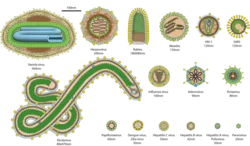
The article then moves from discovery to structure. Some viruses are helical, like tobacco mosaic virus, whose RNA is wound through repeating protein subunits. 2 Others are icosahedral, using a geometric shell that lets a virus build a stable container from repeated pieces. 2 Enveloped viruses add a membrane taken from host cells, a feature that changes how they enter cells and how fragile they may be outside the body. 2
Replication is where the page starts to feel less like a catalog and more like a mechanism. A virus must attach to a host cell, enter it, release its genome, make viral components, assemble new particles, and exit. 2 The details vary by genome type, which is why the article introduces the Baltimore classification system. David Baltimore proposed that system in 1971, grouping viruses by how they make messenger RNA. 2 For a general reader, the point is straightforward: viruses can carry DNA or RNA, single-stranded or double-stranded, and that genetic format determines the route they must take inside a cell. 2
The page also makes evolution feel practical rather than abstract. Viral genomes mutate, recombine, and, in segmented viruses, reassort. 2 The article uses the phrase "viral sex" for the genetic shuffling that happens when segmented viruses exchange genome pieces. 2 In influenza, the familiar distinction between antigenic drift and antigenic shift comes from this logic: small accumulated mutations differ from larger jumps created when genome segments are swapped. 2
From there, the article becomes ecological. Viruses are not only agents of human illness. They shape populations of bacteria and other organisms, move genes between hosts, and influence nutrient cycles. 2 The scale is the point that rearranges the reader's intuition. The article describes viruses as more numerous than stars in the universe and says Earth has more than a quadrillion quadrillion viruses. 2
The human chapter is the one readers know best, but the article keeps it broad. Viruses cause diseases ranging from the common cold and influenza to smallpox, AIDS, and COVID-19. 2 The article also notes one of medicine's great public-health endings: the World Health Organization declared smallpox eradicated in 1980. 2 That single fact sits beside less final stories, including vaccine design, antiviral drugs, cancer therapy, and the difficulty of controlling rapidly evolving pathogens. 2
By the end, the category feels deliberately unsettled. Viruses are not alive in the ordinary cellular sense, but they replicate, evolve, and have histories. 2 They can be parasites, tools, ecological actors, and inherited genomic residue. The article says about 8 percent of the human genome consists of sequences left by endogenous retroviruses, ancient viral insertions that became part of our genetic inheritance. 2
Details that make the article stick
The first memorable detail is the jump from the discovered to the still-unknown. Since the 1892 discovery of tobacco mosaic virus, scientists have described more than 16,000 virus species in detail; the International Committee on Taxonomy of Viruses listed 16,215 species in 2024. 2 That number sounds large until the article places it against the millions of virus types thought to exist. The named catalog is only a small visible layer.
The second detail is how little can be enough. Norovirus can infect a human with fewer than 100 virus particles. 2 That number explains why a virus can behave socially as well as biologically. Transmission is not only a microscopic event. It becomes a problem of hands, surfaces, food, water, ventilation, behavior, and trust.
The third detail is the medical reversal. A virus can be engineered into a therapy. T-VEC, a modified herpes simplex virus, became the first approved oncolytic virus therapy for melanoma in late 2015. 2 The same broad category that includes lethal pathogens also includes tools that can be directed against cancer cells.
The fourth detail is ecological and almost comic in its simplicity: something can eat viruses. In December 2022, scientists reported the first observed case of virovory, with the ciliate Halteria consuming chloroviruses as a food source. 2 The fact changes the mental picture. Viruses are not only invaders. In some settings, they are prey.
The fifth detail is synthetic. The first synthetic virus, poliovirus, was created in a laboratory in 2002. 2 That fact belongs in the article because it shows how virology became an engineering field as well as an observational science. Once a viral genome can be built, the questions become biological, medical, ethical, and security-related at the same time.
The lines worth keeping
The article's best phrase for the central category problem comes from Rybicki's description of viruses as "organisms at the edge of life." 2 It works because it does not force a clean answer. A virus is not a self-sufficient cell, but it is not an inert toxin either.
The scale line that stays in the mind is the article's claim that there are "more viruses than stars in the universe." 2 The phrase is memorable because it moves viruses out of the hospital and into planetary imagination. The reader stops picturing a handful of named diseases and starts picturing an unseen layer of Earth.
The classification word to keep is "replicators," used by Koonin and Starokadomskyy. 2 That word strips the subject down to its essential action. A virus persists by copying, and every structure it carries serves that pressure.
The strangest phrase is "viral sex," used for reassortment in segmented viruses. 2 The phrase is informal, but it makes the mechanism easy to remember: separate genome pieces can be shuffled when related viruses infect the same host cell.
What to remember
Virus works because it refuses to keep viruses in one mental box. The article starts with an infectious agent, then follows the same subject into structure, evolution, ecology, medicine, public health, synthetic biology, and the human genome. 2
The useful takeaway is a four-part checklist. When a virus appears in the news, ask what its genome is, how it enters and exits cells, how it changes over time, and what ecological or medical role it plays beyond the immediate disease story. The Wikipedia article gives enough scaffolding to ask those questions without pretending the answers are simple.
Viruses are small enough to vanish from ordinary sight and numerous enough to reshape life at planetary scale. That tension is the reason today's Featured Article holds together.
Today's article is Wikipedia's Featured Article for July 9, 2026: Virus, selected by Wikipedia's editorial community. 1
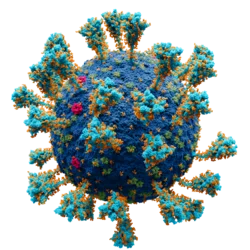
Cover image: SARS-CoV-2 virus-particle medical illustration from Wikipedia's Virus article. 2
Fuentes de referencia
Contenido relacionado
- Inicia sesión para comentar.