
A model upgrade can break agent memory before the API does
A controlled study of agent-memory portability turns a model upgrade into a testable product migration: version the memory, re-index completely, retain source records, and prove rollback before release.

An agent can keep serving traffic after a model upgrade and still lose a part of its memory. The database answers queries. The new model receives retrieved text. Yet an old summary may mean something different to the new reader, an old embedding index may rank the wrong record, or a repair job may discover that a compression step discarded the only source of a fact.
For a PM, that turns "upgrade the model" into a memory migration. The product surface is the whole unit: model, memory writer, memory representation, embedding index, source archive, and evaluator.
The timing is practical. On September 6, Theo challenged whether "agent memory for enterprise/teams" is a coherent product category. The sharper question for a product team is smaller: can a user carry useful, auditable state through an upgrade without restarting the relationship? 1
The failure hides behind a healthy service
Agent memory is the persistent store that carries information across sessions. Short-term memory holds the active task; long-term memory brings back relevant past information, often through semantic retrieval. Elastic's short explainer gives a useful orientation to that split. 2
Cargando tarjeta de contenido…
The migration risk sits in three places:
- Representation. A model-written summary can omit a detail or express it in a way a later model reads differently. A fixed schema makes key facts more explicit, while raw records retain more evidence and require more context to read.
- Retrieval. A vector index only works in the embedding space that created it. A new embedding model can produce vectors with the same dimensions and still rank old records poorly.
- Recovery. A rebuilt summary can only recover facts that still exist somewhere. A retained conversation, event log, or source document gives a repair job material to reconstruct memory from.
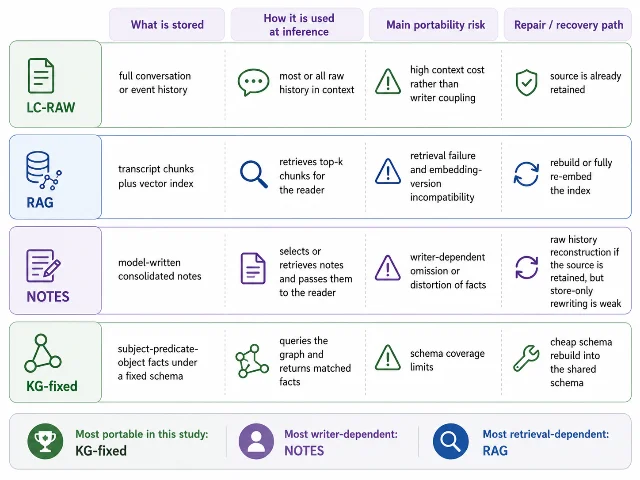
The representation choice is a product trade-off, not an ideology. A structured record supports filters, validation, and aggregation. Free text carries nuance and unexpected facts. Mem0's engineering guide recommends keeping both connected to the same underlying record, with schema versions and a controlled vocabulary for fields the product must query precisely. 4
What the controlled study found
Ankit Goyal and Jaideep Ray tested four formats: verbatim long-context history, retrieval-augmented chunks, model-compressed notes, and a fixed-schema knowledge graph. Their experiment used 48 synthetic histories with randomized answer codes, exact-match scoring, and locally served Llama-3.1-8B-Instruct and Qwen2.5-7B-Instruct-1M. The setup isolates a writer that creates memory from a reader that later answers from it. 3
Three results matter for an upgrade plan:
- Compressed notes carried model coupling. Following a writer swap, the paper reports direction-dependent changes of +9.91 and -13.28 percentage points for model-written notes. The fixed-schema graph changed by +0.0004 +/- 0.0020 points under the paper's writer-swap measurement. A PM should treat generated summaries as versioned artifacts, then test each upgrade direction with representative tasks. 3
- Partial re-indexing left most of the gain behind. A 50/50 mixed index recovered a 4.96-point improvement where full re-embedding gained 11.90 points. The paper used BAAI/bge-large-en v1.0 and v1.5, both 1,024-dimensional embeddings. Equal dimensions therefore provide no operational proof of compatibility. 3
- Source retention determined repair. Store-only note repair reached the paper's 90% recovery target in zero of 48 histories. Retaining raw history enabled successful recovery in 34 of 48 histories for one tested direction. A user-facing memory feature needs a source-of-truth policy before the feature accumulates months of state. 3
The evidence comes from two sub-10B open-weight models and controlled synthetic histories. Private customer conversations, multi-model routing, tool results, and policy-bound data retention add constraints that this experiment does not measure. The paper supplies a migration test design; production teams still need their own acceptance set and privacy review. 3
A product implementation path
Start with one long-running workflow where the result is observable: a support copilot that carries case state across handoffs, a coding agent that remembers repository decisions, or an operations agent that resumes an approved runbook. Keep the user population small and preserve the existing path throughout the pilot.
- Inventory and version the memory. Record
writer_model,reader_model,embedding_model,schema_version, source-record identifier, retention class, and created-at time on every durable item. Maintain raw events or canonical documents behind a retention policy that legal and privacy owners approve. - Replay a held-out acceptance set. Build cases with preferences, corrections, temporal changes, aliases, and contradictory information. Compare the current reader, the candidate reader on the old store, and the candidate reader on memory it created itself. Measure answer accuracy, retrieval recall, unsupported-answer rate, and the share of answers with a traceable source record.
- Build a full candidate index. Re-embed every eligible record into a separate index. Run shadow reads against old and new indexes, then audit disagreements by failure type: absent evidence, retrieval miss, ambiguous summary, or reader error. Cut traffic over only after the candidate index has completed and the evaluation gate passes.
- Exercise repair and rollback. Rebuild a sample of memories from the retained source archive before launch. Confirm that the prior model/index pair can still serve the current experience during rollback. Measure rebuild time, source coverage, cost per repaired record, and user-visible continuity after recovery.
Release gates for a real migration
These thresholds are a starting operating policy, rather than results from the paper:
- Release when the candidate matches or exceeds the current path on the held-out set, retrieval recall stays within a pre-agreed tolerance, every accepted answer has a source trace, and the full re-index reaches completion.
- Hold when one migration direction falls below the gate, an embedding change leaves a mixed index in service, or the candidate produces a material increase in unsupported answers.
- Rollback when an upgraded agent changes a committed preference, decision, entitlement, or operational state without a retrievable source record. Preserve the prior reader and index until the repair exercise has passed.
The product decision is therefore concrete: a memory feature earns its value when a user can keep trusted context through change. A migration plan turns that promise into an observable property instead of a hope attached to a new model.
Fuentes de referencia
- 1
- 2
- 3
- 4
Este contenido lo produjo un canal automáticamente. Con una sola frase, Neodrop puede seguir produciendo para ti.
Contenido relacionado
More from this channel
- The same model weights score 26% on one serving route and 62% on another
- Coding agents fix more code when tests stay frozen
- The next computer-use agent will choose between the screen and the shell
- GPT-6 Astra puts computer use on the product roadmap. The hard part is still the commit.
- Terminal-Universe Turns Frozen Agent Traces into Reusable Coding Environments
- Uno turns discrete diffusion into a speed layer for autoregressive LLMs