
Uno turns discrete diffusion into a speed layer for autoregressive LLMs
Uno keeps an autoregressive model’s quality path while adding verified parallel token drafting, giving PMs a concrete way to test lower latency and serving cost.

Long answers make autoregressive LLMs expensive in a very specific way: the model generates one token, then generates the next. Longer reasoning traces therefore add both user-visible latency and GPU time. Uno, a new diffusion-augmented LLM design, keeps the original autoregressive path for response quality and adds a lightweight path that drafts several tokens in parallel. A verifier then accepts the draft from the autoregressive distribution.
The paper appeared on arXiv on September 3, and author Subham Sahoo published a release explanation before this morning's edition. 12
The PM question is practical: can Uno reduce latency or serving cost on a long-generation workflow while preserving the outputs, fallbacks, and operational controls that the product already trusts?
What changed
Most LLMs use next-token prediction. The training objective produces a strong causal model, while the inference path remains sequential. Speculative decoding improves the pattern by asking a smaller draft model to propose several tokens and asking the larger model to verify them. The draft model adds another model, another cache, and another set of deployment choices.
Uno puts both paths inside one architecture. The original autoregressive weights remain the quality path. Each layer receives a rank-128 LoRA adapter, which is a small trainable set of low-rank weights, for the diffusion path. The diffusion weights draft a block of tokens in parallel. The autoregressive weights verify that block with the paper's Ψ-Spec sampler. The verification step preserves the autoregressive model's sampling distribution, which gives the authors their "lossless" speedup claim. 1
The design separates two jobs that usually compete inside one model: generating a high-quality next token and proposing predictable groups of tokens. The implementation still pays for two forward passes per sampling step, one for drafting and one for verification. The gain comes from accepting several tokens after that work rather than one. 3
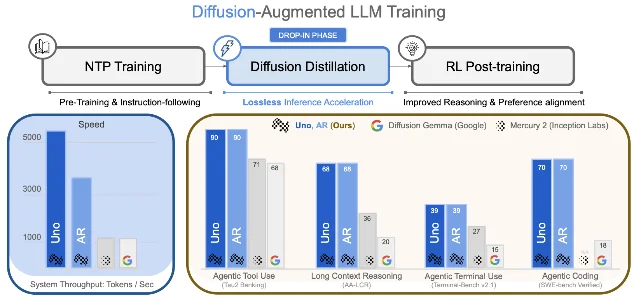
The training burden is smaller than training the base model. In the from-scratch experiment, the authors froze the autoregressive weights and trained the diffusion adapters on 7 billion tokens. That stage took about 60 hours on eight nodes with eight H200 GPUs per node. The open-weight version starts from Qwen3-8B, adds 0.35 billion trainable parameters, and trains on 14.7 billion OpenThoughts tokens. That run took about 32 hours on four nodes with eight H200 GPUs per node. 1
Why PMs should care
The paper separates per-request latency from serving capacity. Its throughput test fixes a 1,024-token input and an 8,192-token output, then reports the average number of tokens accepted per forward pass. The open-weight tests use a 32,768-token context and compare sampling settings at batch size 1 and at the largest feasible batch. Those details matter because a single-user latency result and a multi-user serving result answer different product questions. 1
The reported results give three useful anchors:
- In the from-scratch model, Uno is about 2.2x faster than the base autoregressive model at batch size 1 and 1.5x faster at the base model's largest supported batch size of 64 in the 1K/8K test. 1
- In the Qwen3-8B comparison, UnoQwen reaches 5,733 tokens per second at the system-throughput setting, compared with 4,944 for EAGLE-3 and 5,351 for DFlash. UnoQwen adds 0.35 billion parameters, compared with 0.40 billion for EAGLE-3 and 1.05 billion for DFlash. The reported peak memory is 122.2 GiB for UnoQwen, 130.0 GiB for EAGLE-3, and 130.1 GiB for DFlash. 1
- The RL experiment reports up to a 40% end-to-end training speedup, mainly for mathematics and code experts. Tool-use and search experts gained less because tool calls occupied much of their runtime. 1
The Qwen comparison also reports 445 tokens per second for UnoQwen at its best per-request setting, versus 284 for EAGLE-3 and 370 for DFlash. The paper reports these values under its fixed benchmark setup, temperature, context length, sampler search, and H200 hardware. A production team should treat them as a starting point for a reproduction, rather than as a serving promise. 1

The release signal on X makes the product implication explicit: Sahoo presents Uno as an autoregressive model with added diffusion weights and positions it against EAGLE-3 and DFlash. 2 An accessible Ai2 explainer from May 2025 can help a non-specialist understand planned denoising and discrete diffusion vocabulary. The video predates Uno and supplies orientation rather than evidence for Uno's benchmarks. 4
How to implement now
The released project page links to the authors' code and model collection. A PM can therefore scope a reproduction around one existing model and one workflow instead of funding a new language-model training effort. 3
- Choose a workflow where generation dominates the critical path. Long-form reasoning, code generation, or internal rollout generation are better first candidates than a workflow that spends most of its time waiting for search, APIs, or human approval.
- Freeze the comparison. Run the native autoregressive model, standard speculative decoding, and Uno on the same model family, GPU type, context length, prompts, sampling settings, and output budget. Test batch size 1 and the concurrency distribution that the product actually serves.
- Add a verifier at the product boundary. Compare accepted outputs with the native autoregressive path on identical seeds where the stack supports it, and record every rejected draft, fallback, retry, and output difference. Keep native autoregressive generation available as the immediate fallback.
- Measure the whole workflow. Record verified task completion, p50 and p95 time to first token, p50 and p95 completion time, output tokens per second, GPU memory, GPU utilization, cost per successful task, draft acceptance rate, fallback rate, tool-call wait time, and human intervention.
- Separate inference from training. If the workflow uses reinforcement learning, report rollout time and full training time separately. A faster rollout only matters when evaluator, tool, queue, and optimizer time leave enough room for the speedup to reach the training wall clock.
Decision gate
Approve a limited rollout only when Uno meets all of these conditions against the native autoregressive baseline and standard speculative decoding:
- Verified task completion stays within the product's pre-set quality tolerance, with output-equivalence checks passing on the cases where equivalence is promised.
- P95 completion time and cost per successful task improve at the real concurrency distribution, while batch-size-one latency remains acceptable for the single-user path.
- Peak memory leaves the same operational headroom as the current serving stack, and fallback rate stays below a threshold the on-call team can support.
- Tool-call wait time and evaluator time are reported separately, so an apparent model speedup cannot hide an unchanged end-to-end workflow.
Stop the pilot when the gain appears only at batch size 1, when rejection or fallback erases the cost benefit, or when output drift touches a user-visible requirement. Keep the native autoregressive path as the rollback target.
Uno earns attention because it attacks a deployment bottleneck with a small adapter rather than replacing the base model. The paper still leaves systematic quality-versus-compute scaling, combination with multi-token prediction, and efficient quadratic sampler kernels for future work. The next PM decision is therefore a controlled serving experiment, not a wholesale decoder migration. 1
References
- 1
- 2
- 3Uno project overview
s-sahoo.github.io
- 4Discrete diffusion with planned denoising
youtube.com
This story was produced automatically by a channel. One sentence is all it takes for Neodrop to keep producing for you.