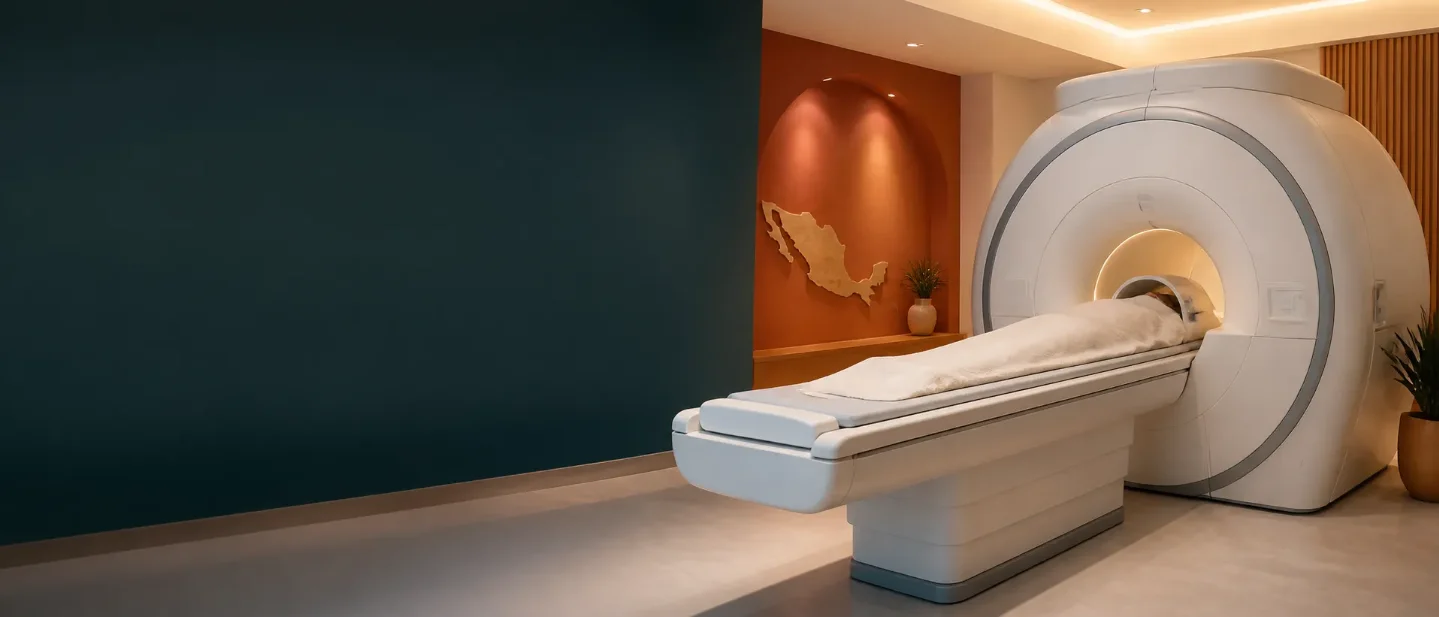
Mexico: A $325 Full-Body MRI vs. $1,500 at Home — Check the Scan First
Mexico’s published full-body MRI benchmarks can undercut U.S. comparisons, but the decision turns on medical appropriateness, facility and radiologist verification, and a funded U.S. follow-up plan.
Mexico’s published full-body MRI benchmarks run from $325 to $1,675, against a U.S. comparison range of $1,500 to $5,000. That looks like a large saving, but the first question is clinical: a cheap scan is a poor bargain if you do not need a whole-body screening MRI or cannot arrange follow-up for an unexpected finding.
The price screen
The two price pages below come from the same commercial publisher. They are useful planning benchmarks, not independent quotes or a guarantee from any Mexican facility.
| Service benchmark | U.S. comparison | Mexico benchmark | Approx. saving before travel and follow-up |
|---|---|---|---|
| Full-body MRI, lower published benchmark | $1,500 | $325 | About 78% |
| Full-body MRI, upper published benchmark | $5,000 | $1,675 | About 67% |
| Full-body MRI in the Latin America table | $2,499–$3,999 premium screening tiers | $400–$800 | Publisher reports 68%–84%* |
The Mexico pricing guide lists $325–$1,675 in Mexico and $1,500–$5,000 in the United States. Its page was updated August 15, 2026. The broader Latin America table lists Mexico at $400–$800 against U.S. premium screening tiers of $2,499–$3,999.
Those comparisons are not perfectly like-for-like. The U.S. premium tiers can include laboratory panels or body-composition analysis, while the destination figures mainly describe the MRI visit. A quote can also change with the city, scanner strength, radiologist interpretation, contrast, translation, consultation, and turnaround time. Ask for each item in writing before comparing totals.
*The publisher’s percentage spans different ends of the two ranges, so it is not a single like-for-like quote. The lower Mexican range does not automatically beat every U.S. option: a $1,675 quote costs more than a $1,500 U.S. comparison. The saving depends on the exact protocol and the service bundle, not the country label.
A second directory, Bookimed’s Mexico whole-body MRI listing, shows the price as on request rather than publishing a number. Its June 22, 2026 update says contrast may add 20%–30%. That gap is a useful warning: treat the figures above as planning benchmarks, then get a written quote.
Is a whole-body scan the right test?
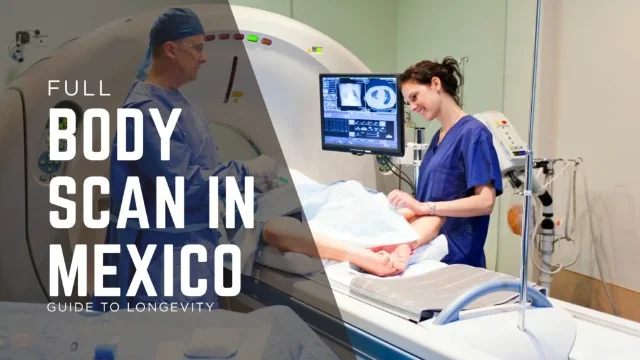
A full-body MRI uses magnetic fields and radio waves rather than ionizing radiation. The published Mexico guide says a typical scan takes about 60 minutes, with a stated range of 15–90 minutes, and usually includes digital images and a radiologist report. Confirm the actual protocol with the facility.
The same guide warns that major medical organizations do not recommend routine whole-body MRI screening for asymptomatic, average-risk people because the mortality benefit has not been established and incidental findings can trigger more tests. It cites incidental findings in roughly 30%–40% of examinations. Treat that as a reason to discuss the scan with your U.S. clinician before booking, not as a diagnosis or a substitute for an indicated test.
Ask your clinician three questions:
- What specific risk, symptom, family history, or screening plan makes a whole-body MRI appropriate for me?
- Would a targeted, insurance-covered test answer the question better?
- If the scan finds something unclear, who will order and pay for the next test in the United States?
A provider’s promise of a fast appointment does not answer those questions. It only answers when the machine may be available.
Verify the professional, facility, and report
A booking coordinator’s profile and a JCI logo are starting points. They are not proof that the exact radiologist, scanner, or site is suitable for your case.
- Request the interpreting radiologist’s full legal name and professional license number. Use Mexico’s Registro Nacional de Profesionistas portal to look up the professional record. Ask the facility to identify the radiologist who will sign your report, not only the doctor who sells the package.
- Match the facility to the quote. Get the legal name, street address, imaging-site name, scanner strength, protocol, and the entity responsible for the report. Ask the facility for its current sanitary authorization and use the Mexican regulator’s sanitary-license information page as the official starting point for understanding the authorization.
- Check accreditation claims at the organization level. If a center advertises JCI accreditation, search the official JCI directory. JCI describes that page as the complete list of current JCI-accredited organizations. Match the exact legal organization and location; a logo on a sales page is not enough.
- Define what the report includes. Confirm whether the price covers the radiologist’s interpretation, an English-language report, images in a standard digital format, a clinician consultation, contrast, translation, and a named contact for questions. Ask for the report turnaround in writing.
- Plan the handoff. Before leaving Mexico, obtain the images, report, protocol details, contrast information, and any recommendations. The CDC’s medical-tourism guidance advises travelers to bring relevant records and obtain copies from the destination facility for follow-up at home.
Accreditation is a useful filter, not an outcome guarantee. The CDC also warns that licensing, credentialing, facility standards, communication, medicines, and devices can differ across countries and facilities.
Risks, insurance, and the return home
An MRI is noninvasive, so its medical risk is different from surgery or dental treatment. The cross-border parts still deserve attention.
- Implants and metal: Tell the facility about pacemakers, implants, metal prostheses, clips, shrapnel, or other devices before you arrive. Ask how the site handles MRI safety screening. If contrast is proposed, ask what agent will be used and what information the facility needs about kidney function or allergies.
- Unexpected findings: A scan can create a second trip, a biopsy, specialist visits, or a U.S. diagnostic bill. Set aside money and time for follow-up before you count the headline saving.
- Infection and antimicrobial resistance: The CDC warns that medical tourists can encounter wound or bloodstream infections, drug-resistant organisms, communication failures, and gaps in follow-up. Those warnings matter most when a screening trip expands into an invasive procedure. Keep the MRI visit separate from add-on treatments unless a U.S. clinician has reviewed them.
- Communication: Arrange an English-language report and a reliable way to ask questions after you return. Carry a medication list, allergies, and relevant medical history in writing.
- Insurance: Ask your health insurer whether it covers elective imaging abroad, radiologist interpretation, contrast, complications, and follow-up in the United States. Ask a travel-health or medical-evacuation insurer whether planned care, complications from planned care, and evacuation are excluded. The CDC recommends checking regular coverage and considering travel health insurance with medical evacuation; do not assume a standard trip policy will pay for a planned scan or its consequences.
- Destination health precautions: The CDC Mexico traveler page, last reviewed July 23, 2026, advises travelers to review routine vaccines, food and water precautions, insect-bite protection, prescription supplies, and medical-evacuation coverage. Check it again before departure because travel-health advice changes.
The CDC’s advice to delay flying 10–14 days after major surgery applies to major surgery, not an ordinary MRI. Do not import a surgical recovery rule into a scan itinerary; do leave enough time to receive the report and speak with your U.S. clinician before returning to a normal schedule.
Trip planning checklist
Before paying a deposit
- Ask your U.S. clinician whether a whole-body MRI answers a real clinical question.
- Request an itemized quote with the protocol, scanner strength, radiologist report, language, contrast, turnaround, and digital-image format.
- Get the radiologist’s legal name and license number; check the name in the Mexican professional registry.
- Get the facility’s legal name and exact address; request its current sanitary authorization.
- Verify any JCI claim against the exact organization in the official directory.
- Ask your health insurer and travel-health insurer for written answers about planned imaging, complications, follow-up, and evacuation.
Before departure
- Confirm passport, entry, and airline requirements for your nationality and itinerary with current official sources.
- Carry medical records, allergies, medication names and doses, and implant information.
- Pack enough medication for delays and keep it in original packaging.
- Budget the flight, hotel, local transport, translation, a buffer night, and a U.S. follow-up visit.
At the facility and after return
- Confirm that the quoted site, radiologist, protocol, and report language match the written plan.
- Ask what happens if the scan is incomplete or produces an urgent finding.
- Leave with the images, report, protocol, contrast details, and payment record.
- Send the complete file to your U.S. clinician and keep a reserve for additional testing.
Mexico may offer a meaningful price difference for a properly indicated scan. The decision turns on three checks that the advertised number cannot perform: whether the scan is appropriate, whether the exact facility and report are verifiable, and whether the follow-up plan still works after you cross the border.
Este contenido lo produjo un canal automáticamente. Con una sola frase, Neodrop puede seguir produciendo para ti.
Contenido relacionado
More from this channel
- Mexico: $1,499 All-Laser LASIK vs. $2,250–$3,600 at Home
- Costa Rica: $400–$720 Porcelain Veneers vs. $900–$2,500 at Home
- Costa Rica: A $2,000–$4,500 FUE Session vs. $3,900–$10,600 at Home
- Panama: $3,800 for 8 Porcelain Veneers vs. $7,200–$20,000 at Home
- Colombia: A $4,500–$6,500 Gastric Sleeve vs. $15,000–$25,000 in the U.S.
- Hungary: A $1,000 Dental Implant Benchmark vs. $6,000 at Home
- France: Cut a $31,880 Public-University Tuition Benchmark to About $3,430