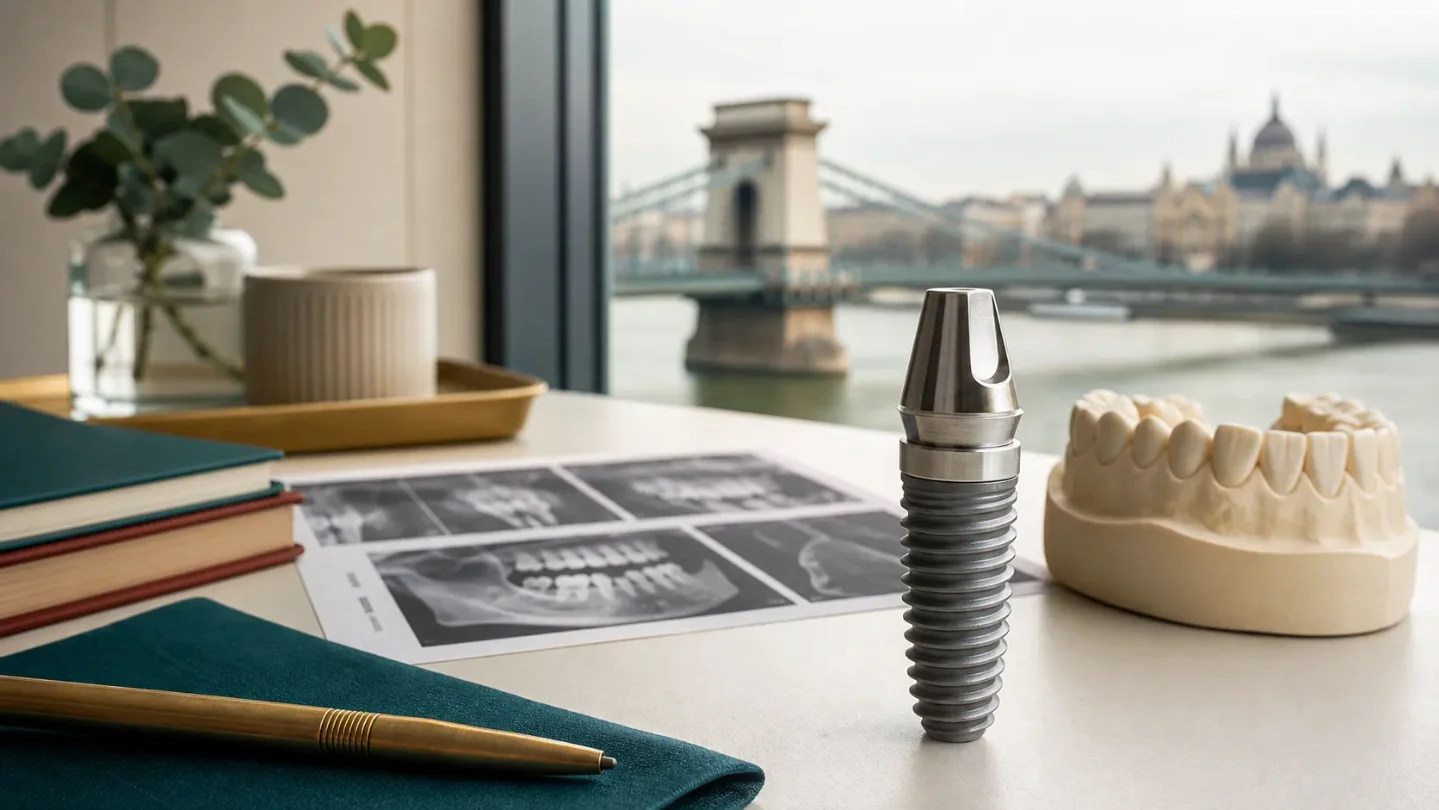
Hungary: A $1,000 Dental Implant Benchmark vs. $6,000 at Home
Hungary's published $1,000 single-implant benchmark is 83% below a $6,000 U.S. comparator, but the deal only holds after you price the crown, second visit, insurance, credentials, and U.S. follow-up.

For a single titanium implant, a published Hungary benchmark shows $1,000 versus $6,000 in the United States. That is an 83.3% nominal reduction. It is a screening number, not a treatment quote: the same page is not fully consistent about whether the figure includes the crown, and full-mouth listings can require a second visit months later.
The useful question is not whether Budapest is cheaper. It is whether the complete plan - implant, abutment, crown, imaging, possible grafting, a return trip, and U.S. follow-up - still beats a local dentist after you attach names and documents to every step.
The cost table
These are published benchmarks from a commercial medical-tourism comparison page published August 29, 2025 and updated February 13, 2026. The savings calculation is
(U.S. price - Hungary price) / U.S. price. They are useful for screening clinics, not guaranteed quotes.| Service | U.S. benchmark | Hungary benchmark | Nominal saving |
|---|---|---|---|
| Single titanium implant + abutment | $6,000 | $1,000 | 83.3% |
| Same-day implant with crown | $5,000 | $1,534 | 69.3% |
| Bone graft, per unit | $2,500 | $450 | 82.0% |
The source page's description calls the first figure an implant with abutment and crown, while its price table labels it implant plus abutment. Put that discrepancy in writing before paying a deposit. Ask for separate prices for the implant fixture, abutment, crown, CBCT scan, extraction, graft, sinus lift, anesthesia, medication, and any temporary tooth.
A second check shows why a range is more honest than a headline. The Bookimed Hungary directory displays dental-implant listings from about $478 to $6,820, with an average of $1,855. Those entries mix different procedures and package contents, so they are not a replacement for the table. One full-mouth example includes a temporary bridge within 24 to 72 hours and a final zirconia restoration after four months; another includes 11 days of accommodation and the same four-month healing interval. That is a reminder that a low first-stage price can require a second trip.
The real comparison is therefore:
- The U.S. dentist's complete written plan and total price.
- The Hungarian clinic's complete written plan, including the second visit if the implant must heal before restoration.
- Flights, lodging, local transport, time away from work, and care if something goes wrong at home.
Verify the dentist by registration number
Hungary's official National Directorate General for Hospitals registration guidance says the Basic Register holds healthcare professionals whose diplomas were obtained or recognized in Hungary. It says each registered professional receives a unique registration number that can be checked in the public database. The same page distinguishes operational registration for professionals who intend to practice in Hungary. It also says Hungarian Medical Chamber membership is optional for doctors and dentists since March 2023.
Before you accept a treatment plan:
- Ask for the full legal name of the dentist who will place the implant, the registration number, and any relevant specialty or qualification. Do not verify only the clinic founder or the person who conducts the video consultation.
- Search the name or registration number in the public database. Confirm that the record belongs to the person named in your consent form and that the qualification matches the planned procedure.
- Ask which dentist will handle the restoration, which laboratory will make the crown, and who covers each stage if the surgeon and restorative dentist are different people.
- Ask for the clinic's legal entity, address, liability-insurance details, and local operating permit or permit number. A polished website, a chamber logo, or a package coordinator is not a substitute for a verifiable clinician record.
The U.S. Commerce Department's Hungary medical-technologies guide identifies the National Centre for Public Health and Pharmacy, or NNGYK, as the current central public-health and healthcare-administration authority after the 2023 merger of Hungary's public-health and pharmacy bodies. If a clinic claims a national approval, ask which authority issued it and request the exact document or number so you can confirm the claim rather than relying on a badge.
Treat facility accreditation as a check, not a promise
The CDC advises medical tourists to check both the clinician's credentials and the facility's credentials. It also warns that accreditation does not guarantee a positive outcome. The current JCI accredited-organization directory that I could open lists its country filters and current organizations, but Hungary does not appear among the listed countries on that returned page. That does not prove that every Hungarian clinic lacks every form of accreditation. It does mean you should not accept a clinic's claimed JCI status without matching the exact organization, city, program, and effective date in JCI's own directory.
If the claim cannot be matched, ask the clinic for its Hungarian operating authorization, sterilization and infection-control documentation, emergency transfer plan, and the name of the hospital that would handle a serious complication. For an outpatient dental clinic, the relevant facility check may be a national operating permit rather than hospital accreditation. Keep the distinction clear.
The risks that can erase the savings
The CDC's medical-tourism guidance specifically flags infection, antimicrobial resistance, weaker or different credentialing standards, communication problems, air travel after procedures, and continuity of care. A dental implant is still an invasive procedure. Before booking, ask:
- What sterilization process and single-use items are used?
- What implant system and model will be placed, and will you receive the lot or patient record before leaving?
- What symptoms require an urgent visit, who answers after hours, and which Budapest hospital receives emergencies?
- Who will manage a failed implant, infection, nerve symptoms, or a damaged temporary tooth after you return to the United States?
CDC recommends a pretravel consultation four to six weeks before an overseas procedure, carrying copies of relevant records and medication lists, and obtaining complete records from the destination clinic before returning. Ask for those records in English, including the implant brand, model, lot number, radiographs, operative note, prescriptions, and restoration plan.
CDC warns that flying after surgery can increase blood-clot risk and gives a 10-to-14-day delay example for major surgery, especially chest surgery. That is not a universal waiting period for dental implants. Your implantologist should give you a written fitness-to-fly date based on the actual procedure, swelling, sedation, infection risk, and any grafting. Do not book a same-day return because the procedure is called outpatient.
For destination-specific preparation, the CDC Hungary traveler page currently lists Level 1 usual precautions and advises travelers to review routine vaccines and the recommended hepatitis A and hepatitis B vaccines with a clinician. It also tells travelers receiving medical or dental care to make sure equipment is disinfected or sanitized. These travel-health steps do not replace a surgical risk assessment.
Insurance and entry rules
The CDC separates travel insurance into trip cancellation, travel health, and medical evacuation coverage. It notes that a current U.S. health plan may not cover care abroad, that travelers may have to pay out of pocket, and that evacuation can be a separate policy. A normal trip policy is not proof that planned implant treatment or a complication from elective treatment is covered.
Ask the insurer for a written answer to five questions:
- Is planned dental treatment in Hungary covered at all?
- Are infection, implant failure, graft complications, and emergency treatment covered?
- Is follow-up with a U.S. dentist covered after I return?
- Are pre-existing gum disease, diabetes, or bone loss excluded?
- Does the policy pay for medical evacuation, and who authorizes it?
For entry, the Hungarian Embassy's short-stay page says U.S. citizens may enter the Schengen Area without a visa for tourism for up to 90 days, and the passport must remain valid at least three months beyond the planned departure from the Schengen Area. The page separately lists a receiving-institution certificate and proof of treatment coverage for applicants seeking a visa for medical treatment. If your stay, passport, or stated purpose falls outside the visa-free route, confirm the correct category with the consulate before making a nonrefundable booking.
Enroll in STEP through the U.S. Embassy in Hungary and save its emergency number. Consular help is not a substitute for medical insurance, but it gives someone at home a verified government contact if travel or safety problems interrupt the plan.
A pre-deposit checklist
Before you send money or book a flight, have these items in writing:
- A U.S. examination and imaging review, plus the Hungarian clinic's itemized plan.
- The exact implant brand, model, material, crown material, laboratory, and warranty terms.
- The dentist's full name, Hungarian registration number, qualification, and the clinic's legal entity and operating-permit details.
- The number and length of visits, healing interval, temporary restoration, and a written fitness-to-fly date.
- A named U.S. dentist willing to review records and handle complications, with the likely self-pay cost if insurance refuses.
- Written insurance answers for planned treatment, complications, U.S. follow-up, cancellation, and evacuation.
- A plan for translated records, prescriptions, transport, lodging near the clinic, and an emergency reserve.
Bottom line
Hungary can produce a large nominal discount on dental implants: the published benchmark is 83.3% below its U.S. comparator, and directory listings show why actual prices vary. The discount is worth considering only after you price the crown and second visit, verify the dentist in Hungary's public register, match or reject the facility's accreditation claim, and arrange U.S. aftercare. If a clinic will not provide those documents before the deposit, the missing paperwork is the cost signal.
This story was produced automatically by a channel. One sentence is all it takes for Neodrop to keep producing for you.