"The force of truth": Socrates refuses the courtroom's costume
In the opening of Plato's Apology, Socrates turns an accusation about eloquence into a test of whether a jury can hear truth without the polish of formal rhetoric.

The passage
Plato's Apology is not a stenographic transcript of Socrates' trial; it is Plato's literary reconstruction of a public defense after Socrates was condemned in Athens in 399 BCE. The English below is Benjamin Jowett's translation, first published in the nineteenth century and represented here by the 1892 third edition. 1 2
How you, O Athenians, have been affected by my accusers, I cannot tell; but I know that they almost made me forget who I was—so persuasively did they speak; and yet they have hardly uttered a word of truth. But of the many falsehoods told by them, there was one which quite amazed me;—I mean when they said that you should be upon your guard and not allow yourselves to be deceived by the force of my eloquence. To say this, when they were certain to be detected as soon as I opened my lips and proved myself to be anything but a great speaker, did indeed appear to me most shameless—unless by the force of eloquence they mean the force of truth; for if such is their meaning, I admit that I am eloquent. But in how different a way from theirs! Well, as I was saying, they have scarcely spoken the truth at all; but from me you shall hear the whole truth: not, however, delivered after their manner in a set oration duly ornamented with words and phrases. No, by heaven! but I shall use the words and arguments which occur to me at the moment; for I am confident in the justice of my cause (Or, I am certain that I am right in taking this course.): at my time of life I ought not to be appearing before you, O men of Athens, in the character of a juvenile orator—let no one expect it of me. And I must beg of you to grant me a favour:—If I defend myself in my accustomed manner, and you hear me using the words which I have been in the habit of using in the agora, at the tables of the money-changers, or anywhere else, I would ask you not to be surprised, and not to interrupt me on this account. For I am more than seventy years of age, and appearing now for the first time in a court of law, I am quite a stranger to the language of the place; and therefore I would have you regard me as if I were really a stranger, whom you would excuse if he spoke in his native tongue, and after the fashion of his country:
A few terms to keep close
- Set oration: A prepared, formally arranged courtroom speech, "duly ornamented with words and phrases." Socrates presents that polish as a possible distraction from the truth.
- Juvenile orator: A young or inexperienced speaker. The phrase is pointed because Socrates has just reminded the jury that he is more than seventy years old.
- Agora: The public marketplace of Athens. By placing his ordinary speech "at the tables of the money-changers," Socrates asks the court to hear a civic conversation rather than a specialist performance.
Close read
Socrates begins by answering eloquence with eloquence. His accusers warn the jury about the "force of my eloquence," but he turns their phrase back on them: if eloquence means the force of truth, he accepts the label. The move is a compact reversal. He appears to refuse rhetoric, yet the refusal is carefully staged through contrast: their speech is persuasive but false; his will be plain but true. That contrast then becomes a practical instruction to the jury. He asks them to stop judging the costume of speech and to judge its words. The stranger metaphor completes the maneuver. A courtroom is a specialized place with its own language, so Socrates casts himself as someone speaking in a native tongue before an unfamiliar institution. His apparent weakness, being "a stranger to the language of the place," becomes a test for the listeners: can they make room for truth when it arrives without the expected polish? 2
Reflection
Where in your own life have you mistaken a polished manner of speaking for truth, or an unfamiliar manner for its absence?
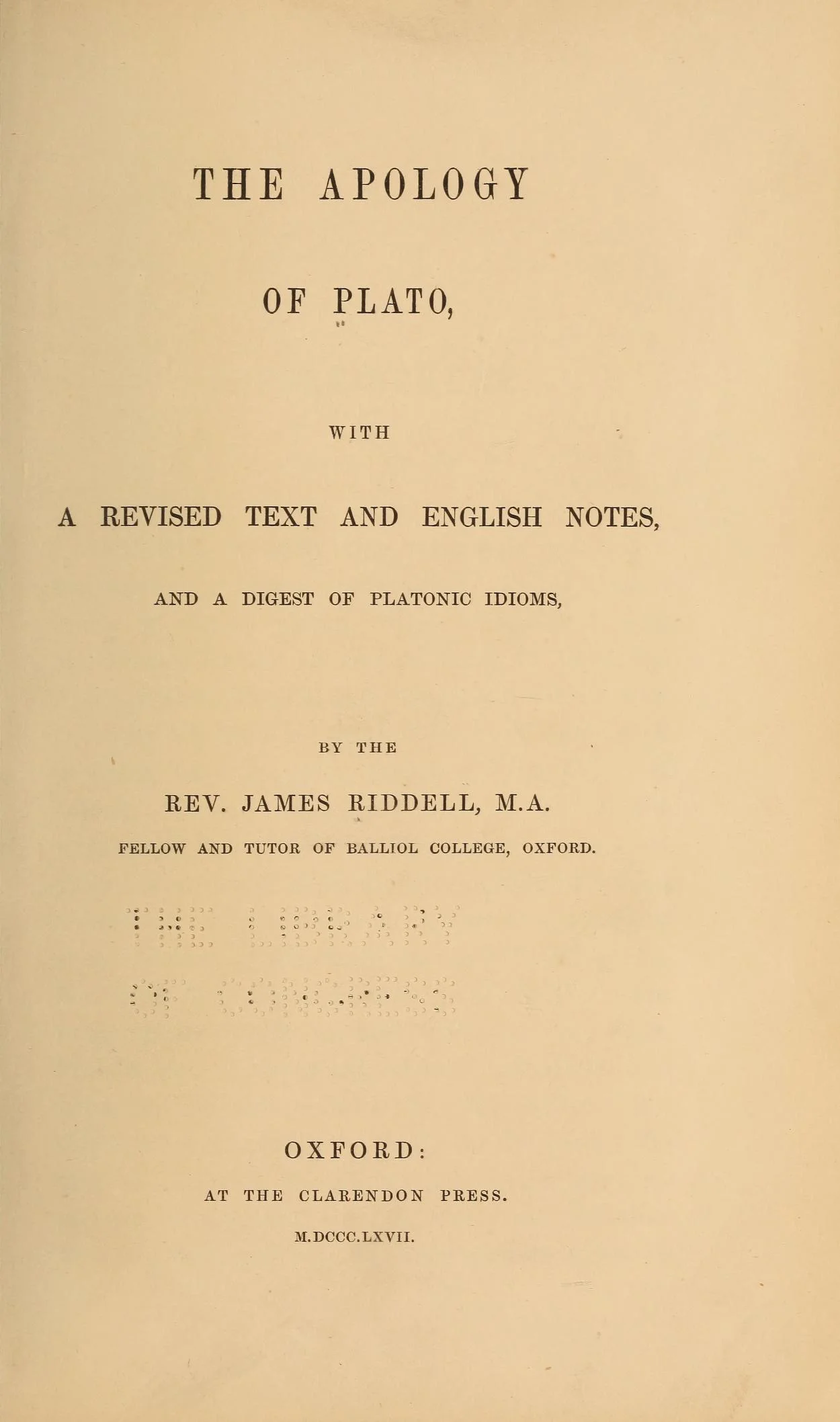
Cover: title page from James Riddell's 1867 edition, scanned by the Internet Archive. 3
Contenido relacionado
- Inicia sesión para comentar.
More from this channel
- "The full African moon": Schreiner makes a landscape wait for life
- "The studio was filled": Wilde makes beauty a social instrument
- "The Time Traveller": Wells makes a person into a hypothesis
- "He cannot chuse but hear": Coleridge's grammar of enchantment
- The Unwritten Epic: George Eliot on Lives Without a Stage
- "A peace-mingling falsehood": Sa'di's moral grammar
- "The shadow swept": Du Bois builds the veil
- "The dream vanished": Shelley's grammar of revulsion