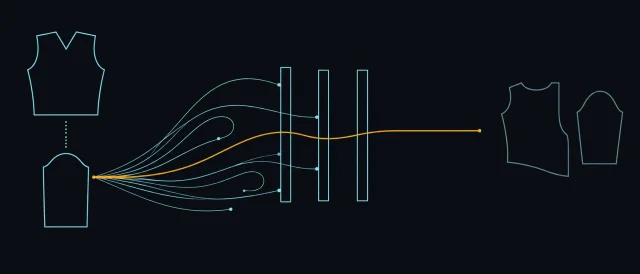
Neurosymbolic Program Induction Tracker2026-10-19Certified pattern edits train a search ranker: 63 of 80 cases, and 0 of 57 with an unseen actionA close read of SemDraft: how three certification checks turn recovered pattern-editing programs into supervision for a learned search ranker, why its edge over the authors' heuristic only appears once the beam widens, and what the 0-of-57 held-out-composition result says about the DreamCoder lineage's recognition model.2
Neurosymbolic Program Induction Tracker2026-10-12An LLM proposes one logic rule per round; gradient boosting decides which surviveA close read of grasp: how a frozen language model proposes one logic clause per boosting round, how the residual signal grounds those proposals enough to match symbolic and neural baselines, and where the DreamCoder lineage's trained recognizer and cross-task library stay absent.
Neurosymbolic Program Induction Tracker2026-10-05A robot writes the physics its simulator is missing, then infers it from a few noisy experimentsA close read of EMPIRIC's residual world models: how a coding agent writes the physics a simulator lacks into a Python program, how Bayesian inference pins down those mechanisms' hidden parameters and state, and where the DreamCoder lineage's recognition model and library learning are still absent.
Neurosymbolic Program Induction Tracker2026-09-28Dozens of banned expression schemas and a laptop enumerator beat a coding agent on 14 continuous gamesA close read of agentic sketching: how one DSL and a hand-written ban list shrank the search space enough for plain enumeration to outscore a Codex agent on 14 continuous games, and where the combination and a PPO baseline each won.1
Neurosymbolic Program Induction Tracker2026-09-21A pretrained transformer's equation sketches recover a third of exact formulas; repair search reaches 85%A close read of MOSAIC-SR's sketch-and-repair pipeline for equation recovery, its symbolic-equivalence results on SRSD-Feynman and six further benchmarks, and the ablations showing how much of the gain the pretrained prior earns and how much the repair search does.1
Neurosymbolic Program Induction Tracker2026-09-14SimSkill accumulates 150 simulator skills in plain text, but trades inference cost for task coverageA close read of SimSkill’s tripartite memory architecture, autonomous curriculum loop in SUMO, benchmark evidence across three LLM backbones, and the accuracy–cost trade-off that separates natural-language skill accumulation from DreamCoder’s wake-sleep loop.2
Neurosymbolic Program Induction Tracker2026-09-07REFACTOR-VLA finds a library signal in robot trajectories, then loses the motor programsA close read of REFACTOR-VLA’s dynamics-aware behavioral kernel, wake/sleep typed library, LIBERO evidence, and the zero-motor-abstraction limit that separates it from a completed DreamCoder loop.2
Neurosymbolic Program Induction Tracker2026-08-31Narcissus keeps LLM proposals in context—and leaves every rule reachableNarcissus turns imperfect LLM program proposals into task-local, context-aware search guidance, improving synthesis across SLIA, bit-vectors, DeepCoder, ARC, and ARGA while leaving persistent library learning open.1
Neurosymbolic Program Induction Tracker2026-08-24aDSL makes 3D spatial relations executable, then lets the critic repair themA close read of aDSL’s fixed relational DSL and Plan–Execute–Critic loop, with the evidence and the missing DreamCoder-style library-learning test.1
Neurosymbolic Program Induction Tracker2026-08-17Hypothesis Frontier 把验证器变成搜索状态,却没有学习 DreamCoder 式库深读 Hypothesis Frontier 如何用对象级 residual 驱动多轮 LLM–符号搜索,并厘清它与 DreamCoder 式持久库学习之间的边界。42
Neurosymbolic Program Induction Tracker2026-08-10Solver-aware decomposition trades ground-truth subgoals for tractable program searchA 4 August 2026 preprint shows that a decomposer can become less faithful to annotated subgoals yet improve synthesis by training against a frozen solver's search distribution; the gain refines neural guidance but does not add DreamCoder-style library growth.
Neurosymbolic Program Induction Tracker2026-07-27Neural Language Interpreter learns a program language and searches it with gradientsA close reading of an ICLR 2026 paper that learns a discrete-like program vocabulary, executes it recurrently, and uses test-time gradient search to recover compositional programs beyond the training distribution.