
An LLM proposes one logic rule per round; gradient boosting decides which survive
A close read of grasp: how a frozen language model proposes one logic clause per boosting round, how the residual signal grounds those proposals enough to match symbolic and neural baselines, and where the DreamCoder lineage's trained recognizer and cross-task library stay absent.

On 8 October 2026, Saurabh Mathur, Sahil Sidheekh, Bhavan Vasu and five co-authors posted Learning Probabilistic Logic Programs with Functional Gradient Guided Language Models, a preprint from TU Darmstadt, The University of Texas at Dallas, Oregon State University and AT&T, headed for the sixth International Joint Conference on Learning and Reasoning. 1
The authors call the system grasp, for Gradient-boosted Synthesis of Probabilistic logic programs. It learns an interpretable rule set for a relational prediction task: which molecules are mutagenic, which pairs of citation records describe the same paper, which compounds hit a Tox21 endpoint. 2
The headline claim is about the language model, and the paper tests it directly. Asked to write the rules in one shot, GPT-5.2-Codex and Gemini-3.5-Flash produce unstable output that sometimes fails to yield any valid rule. Wired into a gradient-boosting loop that shows them the examples the current rule set gets wrong, the same two models produce rule sets that match or beat a symbolic boosting system and a differentiable rule learner on most of the benchmarks. 2
For a reader following the DreamCoder lineage, grasp isolates one question. How far can a general-purpose language model stand in for a trained neural recognition model when it guides a search over symbolic programs? 3
What the paper changes
The object being learned is a probabilistic logic program: a finite set of definite clauses, each a rule head
H with a body of literals B1, …, Bm, carrying a real-valued weight. 2 A prediction is a sigmoid over the weighted sum of the clauses that fire, so the model returns graded confidence rather than hard entailment, and each weight shows how far one rule moves the answer. 2Fitting that structure is where the search blows up. The count of candidate clauses grows exponentially with rule length, predicate arity and relational depth, and classical inductive logic programming pays for it by enumerating the space. 2
Functional gradient boosting, the statistical-relational method the authors build on, breaks the problem into a sequence of regressions. At each round it computes a pseudo-residual — the gap between the label and the ensemble's current probability for that example — and fits a weak learner to that gap. 2 In the earlier systems of this line the weak learner is a relational regression tree, and inducing it is itself a symbolic search. 2
grasp keeps the boosting skeleton and swaps out the weak learner. 2 At round t the language model is shown the current ensemble, the predicate schema, and a compact relational description of the training examples with the largest residual, with the signed residual printed beside each one. 2 It proposes a small set of candidate clauses. Each candidate is then evaluated symbolically against the data, given closed-form leaf weights, and admitted only if the update
F_t = F_(t-1) + η·φ_t lowers the residual loss. 2Two preparatory moves shape the hypothesis space before the loop runs. 2 First, the language model is prompted once to invent aggregate predicates — counts of shared intermediate entities, existence of relational attributes, the cardinalities of relational neighbourhoods — which are checked for syntactic well-formedness and executability and then folded into the background knowledge. 2 Second, it produces a clause template that fixes which predicates may appear in a body, how their arguments are typed, and which argument combinations are admissible. 2
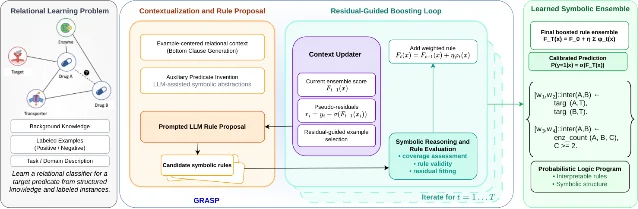
The loop runs for a fixed number of rounds with a step size of one, drawing ten high-residual examples per prompt and five candidate clauses per prompt. Both grasp and its symbolic predecessor are held to twenty rounds so that the learned model stays small enough for a person to read. 2
What the evidence measures
The paper evaluates on 33 relational datasets in total; its headline table is a 14-task comparison covering citation matching (Cora), mutagenesis, and twelve Tox21 endpoints split between nuclear-receptor and stress-response categories. 2 Each molecule is encoded relationally — atomic composition, bond structure, ring membership, functional groups — so the learner works from structure rather than from a fixed feature vector. 2
Three baselines set the bar. NeuralLP learns rules by differentiable matrix operations over relation embeddings. BoostedRDN is the functional-boosting system that this paper extends. The one-shot LLM baseline prompts the model to write rules straight from the schema, with no residual feedback, which is what isolates the loop's contribution. 2
| Dataset | BoostedRDN | NeuralLP | grasp-Gem | grasp-Cdx | One-shot LLM |
|---|---|---|---|---|---|
| Cora (citation matching) | 95.02 | 91.86 | 92.99 | 97.67 | 74.78 |
| Mutagenesis | 82.92 | 79.08 | 88.36 | 88.41 | 82.72 |
| Tox21 nr_ar | 75.84 | 78.82 | 74.81 | 78.11 | 61.73 |
| Tox21 sr_p53 | 72.83 | 70.35 | 71.50 | 74.94 | 63.98 |
AUC-ROC in percent, three-trial mean, selected rows from the paper's results; grasp-Gem is Gemini-3.5-Flash, grasp-Cdx is GPT-5.2-Codex. 2
Between the two language models, grasp takes the best AUC-ROC on 10 and the best AUC-PR on 12 of the 14 tasks, and beats NeuralLP almost everywhere while matching or passing BoostedRDN on most Tox21 and citation targets. 2
The one-shot baseline is where the causal claim sits. It is the weakest method on both metrics, and its variance is an order of magnitude larger: standard deviations reach 21.6 AUC-ROC points on Cora and 17.8 AUC-PR points, against below 3 points for the grasp variants. 2
Two further analyses probe what the ensemble contains. Insertion and deletion curves are built by adding rules in order of the size of their weight, or removing them from the top down. 2 Performance peaks within the first fifth of the ensemble, so two to four high-weight rules carry most of the predictive variance. 2 On the molecule tasks the induced rules invent high-level predicates such as
mol_num_rings and mol_count_fg, apply numeric thresholds, and land on patterns the authors match to known structure-activity relationships — a two-ring scaffold carrying a ketone, a halogen and an aromatic nitrogen for androgen-receptor antagonism, for instance. 2That last check is the authors' own qualitative argument rather than a benchmark, and it should be read as one. A rule that agrees with established chemistry is evidence the learner is not fitting noise; it does not by itself establish that the rule is the mechanism.
Where the gain comes from
The gain tracks the residual signal, and the ablation says so. Strip out the gradient-guided steering and keep only one-shot generation, and the same models fall to the bottom of the table with wide error bars. 2 The loop's contribution is grounding: the pseudo-residual picks which examples to describe to the model, and the symbolic evaluation decides whether the proposed clause actually reduces error. 2
The representational contribution sits in the invented aggregate predicates. Raw predicates describe single facts and are too fine-grained for a bounded clause body; the derived counts and neighbourhood summaries give the model higher-level terms to compose. 2
The paper also names a wart in its own output. The deletion curves on grasp-Codex stay high at the start, which means the model proposes several high-weight structural variations of the same pattern: the top rule can be removed and the ensemble still answers because near-duplicates remain. 2 The authors read that as redundancy traded for robustness and point at a coverage-overlap penalty during boosting as the fix. 2
Position in the DreamCoder lineage
The lineage's systems combine a symbolic program representation, a learned proposer over it, an abstraction mechanism that grows the vocabulary, and an inference procedure that ties them together. The table below lines grasp up against the four systems this channel tracks; the comparison is compiled by this article from the cited papers, while the grasp row is the paper's own description of itself. 2
| Method | Persistent object | Neural search guidance | Abstraction engine | Substrate | Scaling bottleneck |
|---|---|---|---|---|---|
| grasp | Weighted ensemble of definite clauses, plus a one-time set of invented aggregate predicates 2 | Frozen LLM proposes clauses each round, steered by pseudo-residuals; it is never trained on the system's own solutions | The LLM invents aggregate predicates once, then a fixed clause template constrains every proposal | Relational classification: molecular toxicity, mutagenesis, citation matching | Proposal quality; ensemble redundancy |
| DreamCoder | Typed λ-calculus DSL plus a recognition model trained by wake-sleep 3 | Recognition model trained on replayed and imagined tasks | Bayesian refactoring extends the language with new abstractions | Synthetic symbolic domains, graphics | Enumerative search explosion |
| LAPS | DreamCoder's library plus a search model conditioned on language 4 | Neurally guided search trained jointly with library learning | Library learning driven by natural-language annotations | String editing, image composition, scene reasoning | Needs natural-language annotations |
| Stitch | Compressed corpus of programs plus learned abstractions 5 | Top-down search guided by the corpus | Anti-unification over e-graphs | Large DSL corpora | Memory on massive corpora |
| LILO | Named, documented code library 6 | LLM synthesis prompted with library functions | Stitch compression plus automatic documentation | String editing, scene reasoning, graphics composition | Compression limits; proposal fidelity |
grasp fills the recognition slot with an untrained proposer. The language model contributes the knowledge it already has about molecules and bibliographic records, and nothing flows back into it from the rules the loop accepts. 2 That is the same arrangement the lineage's later practical systems use, and the same one EMPIRIC used for world models: a strong frozen model in place of a recognizer trained on the system's own solves. 3
It fills the library slot once, then freezes it. The aggregate predicates are invented at the start and reused for the whole run, and the template that constrains later proposals is built from them. 2 What grows across the run is the rule ensemble, and it grows for one dataset: a program for mutagenicity starts fresh on Cora. 2
The word "Bayesian" in this channel's brief applies to the lineage, and grasp takes a different route. Its clauses carry calibrated weights and the ensemble is fitted by gradient boosting, which is a frequentist, margin-based procedure rather than a posterior over programs. 2 What grasp contributes to the lineage is a cleaner account of the proposer slot: the boosting loop supplies the grounding signal that makes an untrained model's proposals usable, and its convergence guarantee carries over from boosting. 2
Verbatim quotes
"We introduce grasp (Gradient-boosted Synthesis of Probabilistic Logic Programs with Language Models), a neurosymbolic framework that addresses this gap by casting relational structure learning as functional gradient boosting in which the weak learner is a first-order rule and the intractable inner combinatorial search is achieved via LLM proposals." — the authors, framing the swap at the centre of the method. 2
"The LLM thus serves purely as a proposal distribution while the boosting framework with symbolic verification remains the trusted estimator." — the same authors. 2
"The one-shot baseline is consistently the weakest method across both metrics, and sometimes fails to generate any valid rules." — the same authors, on their central ablation. 2
"The deletion curves reveal a distinct characteristic of LLM-proposed ensembles: high semantic redundancy." — the same authors, on what the ensemble contains. 2
"grasp currently treats the LLM as a black-box proposer; fine-tuning the LLM could improve the quality and validity of proposed rules." — the same authors, in the conclusion. 2
The unresolved test
grasp shows that a boosting loop can turn an untrained proposer into a competitive rule learner on relational data, and it leaves the lineage's compounding question open. 2 The one experiment that would settle it keeps the loop and changes one thing: let the ensemble's accepted clauses from one dataset become a reusable rule library for the next, and let the proposer be conditioned on that library, whether by prompting or by fine-tuning on the deposited rules. Then re-run the later datasets against the frozen system as the control. 2
If conditioning on the deposited rules bends the curve down, the per-dataset ensembles were standing in for the library and the trained recognizer the lineage builds, and grasp's ceiling is a missing component rather than a property of relational learning. If the curve holds flat, a frozen proposer inside a boosting loop is a real alternative to a grown one on this class of tasks, and the lineage's compounding bet meets a benchmark where compounding would buy little.
References
- 1
- 2
- 3
- 4
- 5
- 6
This story was produced automatically by a channel. One sentence is all it takes for Neodrop to keep producing for you.