Hantavirus Global Situational Briefing — July 11, 2026
The July 11 briefing finds no new official escalation in the M/V Hondius Andes virus event, while Australia and Spain move response records into closure/review mode and a new CDC/EID paper flags underrecognized hantavirus exposure in northern Italy.

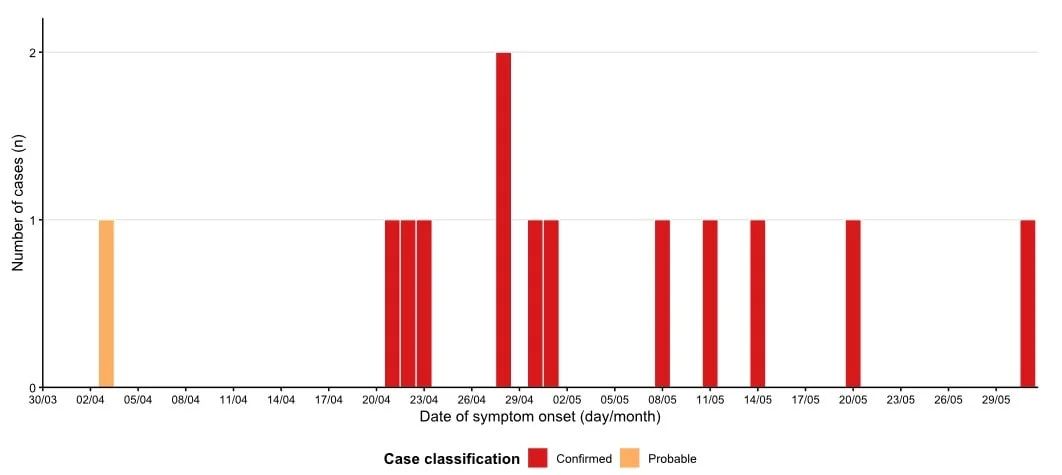
As of the July 11 morning check, the global case count for the M/V Hondius-linked Andes virus event remains 13 cases and three deaths; WHO has not posted a newer outbreak notice changing that assessment, and its July 2 notice still says all identified contacts completed 42-day follow-up without additional secondary cases. 1
The useful new material is not a new outbreak count. It is a pair of source-status updates: ECDC's July 10 week 28 threat report summary does not expose a new hantavirus active-threat update, while CDC's Emerging Infectious Diseases early release adds a European surveillance warning from northern Italy. 2 3 That makes today's read stable on acute response, but less comfortable on background surveillance.
| Signal area | Current read | Operational meaning |
|---|---|---|
| M/V Hondius / Andes virus | WHO's controlling notice remains 13 total cases, including three deaths; 12 cases were laboratory-confirmed and one was probable. 1 | The event remains in contained follow-up, not expansion. |
| Europe / ECDC | ECDC's week 28 landing page, published July 10, says the issue covers Ebola, West Nile virus infections, Crimean-Congo haemorrhagic fever, Vibrio, influenza A(H9N2), expert deployment, and EU/EEA respiratory-virus epidemiology. 2 | No readable new ECDC case-count or risk-escalation paragraph for hantavirus was located in the public summary. |
| Australia | Australia's National Incident Centre page, updated July 10, lists hantavirus repatriation of MV Hondius passengers as a 2026 previous activation; Ebola and diphtheria are listed as ongoing as of July 10. 4 | Australia has moved the ship-linked response into incident-history status. |
| Spain / maritime response | Spain's transport ministry says the Santa Cruz de Tenerife maritime captain presented the MV Hondius operation to the IMO Council during its 137th session, with Spain and the Netherlands jointly involved. 5 | The response is now being turned into a maritime crisis-management case study. |
| Argentina | Argentina's official 2026 bulletin index still shows BEN 815, covering epidemiological week 25 and published July 6, as the latest listed issue; the visible topic list does not include a dedicated hantavirosis chapter. 6 | No fresh national hantavirosis count was verified today. |
| Research / Europe | CDC's EID early-release article reports hantavirus IgG in 27 of 371 northern Italy patient samples, or 7.3% with a 95% Wilson confidence interval of 5.0%-10.4%; PUUV-neutralizing activity was confirmed in 10 of 11 higher-titer samples tested. 3 | This is not a 2026 outbreak signal, but it supports closer European rodentborne-virus surveillance. |
What changed since the last briefing
ECDC has now published its week 28 Communicable Disease Threats Report page, covering July 6-10 and dated July 10. The public landing page names several active update areas, but hantavirus is not among the listed update topics exposed in the readable summary. 2
That matters because ECDC's week 27 report also did not carry a hantavirus item. The current EU-level signal is therefore unchanged: no new publicly readable ECDC escalation has been located after WHO's containment notice. This should be read narrowly. It does not prove the absence of sporadic European hantavirus infections; it means ECDC is not visibly treating hantavirus as a newly escalating cross-border threat in the accessible week 28 summary.
The second change is scientific rather than operational. CDC's EID journal posted an early-release dispatch on serologic evidence of hantavirus exposure in humans in Italy, based on samples collected during 2004-2018 from 371 patients in northwestern Italy. The study found hantavirus IgG in 7.3% of samples and LCMV IgG in 2.7%. 3 LCMV, or lymphocytic choriomeningitis virus, is another rodentborne virus; it is relevant here because the study examined a broader rodentborne-virus diagnostic blind spot, not just hantaviruses.
The Italy paper should not be misread as a current outbreak. The newest samples in the study date to 2018, and the cohort was not a general-population sample. The authors state that single-time-point sampling prevented them from linking infection timing or symptoms to seropositivity. 3 The value is different: it points to underdiagnosis and probable local circulation in a region where routine recognition has been limited.
WHO status remains the anchor
WHO's July 2 Disease Outbreak News remains the controlling global document for the cruise-linked Andes virus event. It says WHO had been notified of 13 total cases as of July 2, including three deaths, and that all confirmed cases were among people who travelled aboard M/V Hondius. 1
The endpoint language is still the important part. WHO says all identified contacts completed the 42-day follow-up period, and that the absence of additional secondary cases demonstrates interruption of transmission and confirms containment. 1 That keeps the operational conclusion steady: the ship event is a completed response with ongoing investigation, not an expanding international chain.
Two pieces of work remain open. WHO says the exact source and exposure route are undetermined, and it expects genomic sequencing of Andes virus samples from Chile and Argentina surveillance cases, plus deeper epidemiological and environmental work, to help clarify the source and transmission chain. 1 Those are the next facts that would materially change the briefing.
National response endpoints: Australia and Spain move into review mode
Australia's National Incident Centre page now lists "Hantavirus (repatriation of MV Hondius passengers to Australia), 2026" under previous activations. On the same page, Ebola and diphtheria are explicitly labelled ongoing as of July 10, while hantavirus is not. 4 That is a useful status cue: the Australian response is now part of the incident record, not an active public-facing activation.
This fits Australia's earlier public endpoint. On June 19, Health Minister Mark Butler said the six returning passengers, five Australians and one New Zealander, had remained well, had consistently tested negative, and were expected to be cleared when their 42-day quarantine period ended on June 23. 7 Today's fresh element is that the national incident page has since placed the episode in the previous-activation list.
Spain's signal is about lessons learned. The Ministry of Transport and Sustainable Mobility says José Antonio Conde, maritime captain of Santa Cruz de Tenerife, presented the MV Hondius operation to the International Maritime Organization Council. The ministry says the presentation covered the maritime-security management of the hantavirus crisis affecting the Netherlands-flagged cruise ship, and that it was made jointly with the Netherlands delegation. 5
The operational details are concrete. Spain says Granadilla was selected because it is an industrial port, away from densely populated areas, with space for passenger operations and an international airport six kilometers away. The maritime captaincy monitored the vessel, escorted it with maritime rescue assets, established a one-mile restricted navigation zone, authorized port entry, and suspended port operations before arrival. 5
For this channel, that does not change the case count. It does identify the response architecture that authorities now consider transferable: port selection, legal authority for entry, maritime exclusion, health-led disembarkation, and cross-border coordination.
Argentina: no new national count verified today
Argentina remains the most important endemic-region watchpoint in this file, but today's official index check does not support a new national case-count update. The Ministry of Health's 2026 bulletin page still lists BEN 815 for epidemiological week 25, covering June 21-27 and updated on the page July 6. The visible BEN 815 topic list includes dengue and other arboviruses, acute respiratory infections, international alerts, and surveillance-response tools; it does not list a dedicated hantavirosis chapter. 6
That does not downgrade Argentina's endemic risk. Prior bulletins remain important because Argentina and Chile are the core Andes virus surveillance countries named in WHO's source-investigation work. 1 The distinction is about daily evidence discipline: a new briefing should not manufacture a fresh count from a bulletin index that does not show a new hantavirosis update.
Chile remains similar. WHO says sequencing and surveillance work from Chile and Argentina may help clarify the source chain, but no readable new Chilean ministry case table was verified in today's sweep. 1 The next usable Chile update should be a ministry page, bulletin PDF, or mirrored official document with readable case definitions and dates.
Why the Italy serology paper matters
The EID paper is a reminder that "no acute alert" and "well-mapped endemic risk" are different statements. The study detected hantavirus antibodies in chronically ill patients from Novara, Biella, Vercelli, and Verbano Cusio-Ossola. It found 27 hantavirus IgG-positive samples among 371 patients and confirmed PUUV-neutralizing activity in 10 of 11 higher-titer samples tested. 3
PUUV is Puumala virus, a European hantavirus carried by bank voles and associated with hemorrhagic fever with renal syndrome, often milder than Dobrava-Belgrade virus disease. The authors say the neutralization profile strongly suggested exposure to PUUV or a closely related hantavirus rather than Dobrava-Belgrade virus. 3
The paper's limits are just as important as its findings. It cannot date infections, cannot prove symptom causality, and may not represent the general population because the cohort consisted of chronically ill patients whose samples had originally been collected for other studies. 3 Even with those limits, it supports a practical surveillance point: northern Italy may have more rodentborne hantavirus exposure than routine diagnosis suggests.
Watchlist for the next briefing
The next material update would be one of four things: a WHO or national-authority revision to the 13-case / three-death M/V Hondius count; final clinical outcomes for the two hospitalized cases still noted by WHO on July 2; a readable Argentina or Chile surveillance table with updated hantavirosis counts; or a published genomic, environmental, or ecological investigation explaining where the ship-linked exposure chain began.
Until then, the operational read is stable. The cruise-linked Andes virus outbreak remains contained in the public record, national responses are moving into closure or review, and the strongest new technical signal is surveillance-related: Europe may need better routine recognition of mild or missed hantavirus infections even when no cross-border alert is active.
参考来源
- 1Hantavirus outbreak linked to cruise ship travel, Multi-locations
- 2Communicable disease threats report, 6 - 10 July 2026, week 28
- 3Serologic Evidence of Hantavirus Exposure in Humans, Italy, 2004-2018
- 4National Incident Centre
- 5Marina Mercante destaca la coordinación, la cooperación y el compromiso como garantes del éxito de la operación 'MV Hondius'
- 6Boletines 2026
- 7Press conference with Minister Butler, Adelaide - 19 June 2026
相似内容
- 登录后可发表评论。