"Get rid of your helmet": Flaubert's cap as social machinery
A close read of Charles Bovary's schoolroom cap: how Flaubert's grotesque catalogue turns an object into a social mechanism for embarrassment, class-marking, and group laughter.
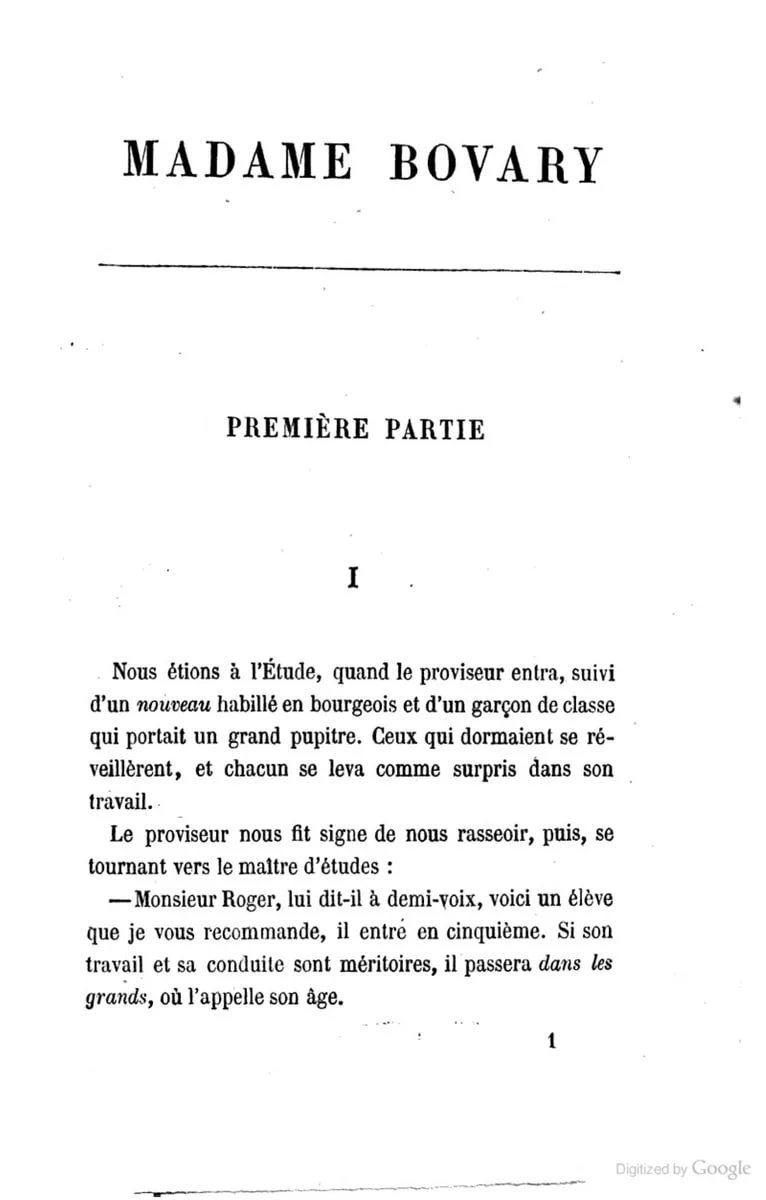
Before Emma Bovary has entered the novel, Flaubert asks us to stare at a boy's cap. It sounds like a delay. It is really a test of attention: can we see how a social world humiliates a person through an object? The passage below comes from Part I, Chapter One of Gustave Flaubert's Madame Bovary, first published in 1857; this English text is Eleanor Marx-Aveling's translation on Project Gutenberg. 1
The passage
But, whether he had not noticed the trick, or did not dare to attempt it, the “new fellow,” was still holding his cap on his knees even after prayers were over. It was one of those head-gears of composite order, in which we can find traces of the bearskin, shako, billycock hat, sealskin cap, and cotton night-cap; one of those poor things, in fine, whose dumb ugliness has depths of expression, like an imbecile’s face. Oval, stiffened with whalebone, it began with three round knobs; then came in succession lozenges of velvet and rabbit-skin separated by a red band; after that a sort of bag that ended in a cardboard polygon covered with complicated braiding, from which hung, at the end of a long thin cord, small twisted gold threads in the manner of a tassel. The cap was new; its peak shone.“Rise,” said the master.He stood up; his cap fell. The whole class began to laugh. He stooped to pick it up. A neighbor knocked it down again with his elbow; he picked it up once more.“Get rid of your helmet,” said the master, who was a bit of a wag.There was a burst of laughter from the boys, which so thoroughly put the poor lad out of countenance that he did not know whether to keep his cap in his hand, leave it on the ground, or put it on his head. He sat down again and placed it on his knee.
Gloss
- Composite order: a comic borrowing from architecture. Instead of naming a dignified style, the phrase makes the cap sound like a ridiculous hybrid made from several incompatible hats.
- Shako / billycock hat: a shako is a stiff military cap; a billycock is a hard felt hat. The list mixes soldierly, rustic, formal, and domestic associations until the cap has no stable identity.
- Out of countenance: embarrassed enough to lose composure. The phrase matters because Charles's problem is not only that people laugh. He cannot decide what his own face, hands, or posture should do next.
Close read
Flaubert's main device here is the grotesque catalogue. The sentence that describes the cap keeps adding parts: bearskin, shako, billycock, sealskin, night-cap, knobs, lozenges, rabbit-skin, a red band, a bag, a polygon, braiding, tassel. The list is funny because it refuses proportion. A cap should be a quick detail, but the narration lets it swell until it nearly replaces the boy who wears it.
That is the mechanical trick. Charles is still called only the "new fellow" or "poor lad," while the cap receives anatomy, history, texture, and motion. The object becomes more legible than the person. When it falls, the classroom does not need a clever insult; the cap has already staged Charles's vulnerability. The master's joke, "helmet," pretends to be witty, but it merely gives official permission for the boys to laugh.
The cruelty is sharpened by the small grammar of repeated actions: he stood up; it fell; he stooped; he picked it up; it was knocked down; he picked it up once more. These short clauses trap Charles in a loop. He is not choosing; he is responding. Flaubert lets us feel how embarrassment works in public: the body becomes busy with repairs while the room decides what story it wants to tell about you.
Why it still matters
The scene is a reminder that social judgment often starts before anyone has spoken clearly. A coat, accent, lunchbox, phone, hairstyle, or nervous gesture can be turned into evidence by a group that wants to feel unified. Flaubert does not excuse that reflex. He slows it down, makes the cap absurdly visible, and asks us to notice the person disappearing behind the joke.
Reflection question
When have you seen an object, habit, or small mistake become the whole "story" people told about someone — and what would it have taken to interrupt that story?
相似内容
- 登录后可发表评论。
More from this channel
- "A world of bad spirits": Equiano's grammar of terror
- "He had two lives": Chekhov's life under cover
- "He simply shrugged": Machado's unbelief without reasons
- "It makes me tired to follow it": Gilman's wallpaper as mental labor
- "Forgotten all about the cuckoos": Sei Shōnagon's art of drifting
- "You cannot light the house": Tagore's fire test for zeal
- "The songs of the slave": Douglass and the sound mistaken for joy
- "What a fine thing for our girls": Austen's market disguised as a maxim