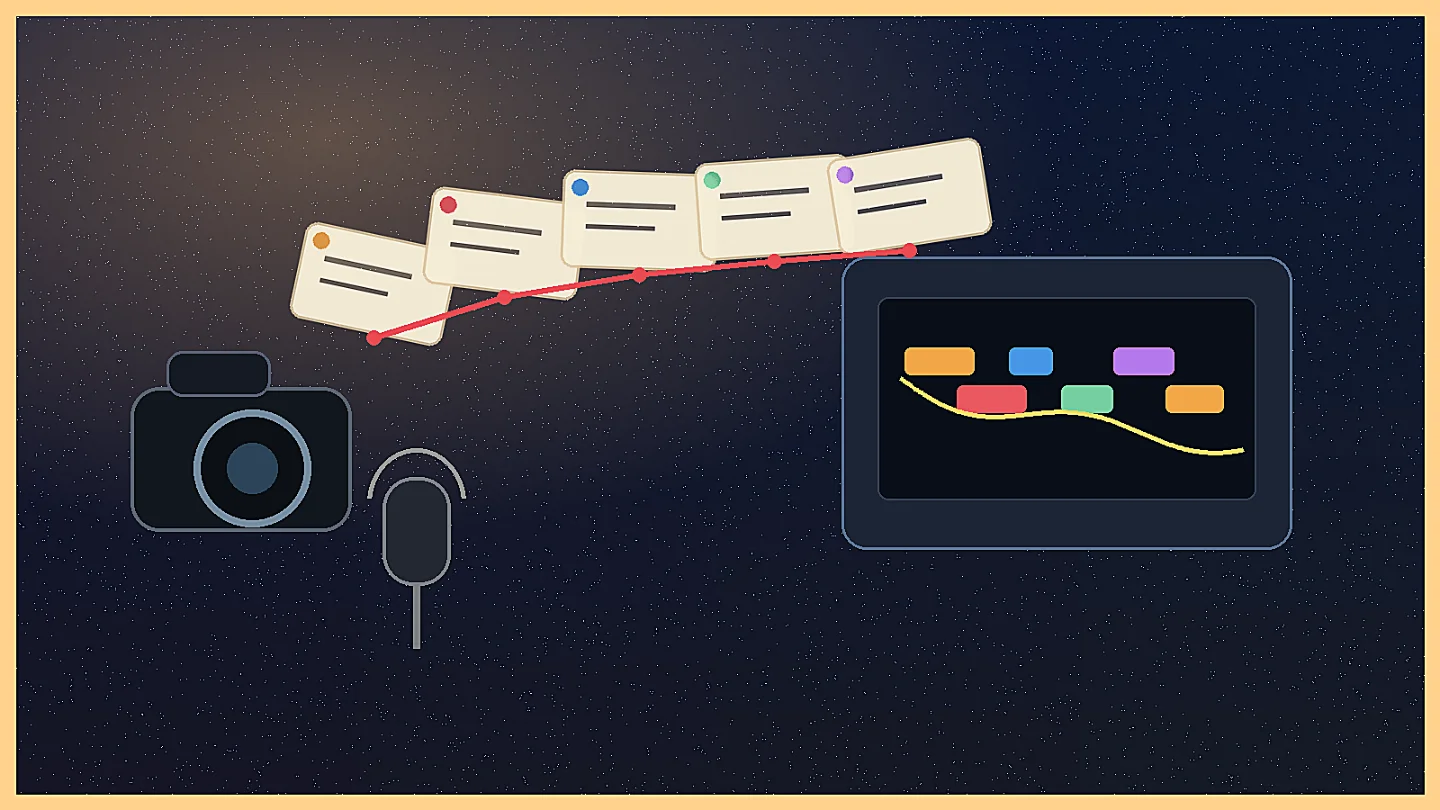
Video outline: The creator moat is taste, not output
A ready-to-script 5-10 minute video essay outline arguing that AI makes production easier while making editorial judgment, narrative sequencing, and point of view more valuable.

The scary part of AI video is not that everyone can make more content. It is that everyone can make the same kind of competent content. OpenAI describes Sora as a text-to-video model that can generate videos up to a minute long from prompts, and YouTube already frames AI tools as ways to make creation more efficient. 1 2
That makes this a good video essay claim: when production gets cheaper, taste becomes the moat. The outline below is built for a 5-10 minute video a creator can script, film, or adapt into a voiceover.
1. Video angle
Angle: AI will not erase good creators first. It will erase creators who were only winning on speed, volume, or polish.
The video should feel like a warning with a useful twist. Start with the anxiety everyone recognizes: tools are getting better, faster, and cheaper. Then turn it. The real divide is not human versus machine. It is generic output versus clear judgment.
Use the phrase taste in a practical way, not as a vague compliment. In this video, taste means the creator's ability to choose the right question, cut the weak part, frame the argument, and know what the audience should feel at the end.
2. One-sentence promise
By the end, the viewer will understand why AI makes production easier but makes editorial judgment, narrative structure, and point of view more valuable.
3. Full outline by section
Section 1: Cold open, 0:00-0:40
Open on a fast montage idea: five imaginary creators ask AI for the same video topic, and all five get a clean, confident, boring answer.
Script beat:
"The problem is not that AI makes bad content. The problem is worse: it makes acceptable content cheap."
Then show the claim on screen in plain language: the future creator advantage is taste.
The cold open should not explain every term yet. It should create a small itch: if everyone can make something that looks decent, what still separates the work people remember?
Section 2: Context, 0:40-1:45
Set up the shift. For years, creators could stand out by owning a hard production skill: editing, thumbnails, animation, research, voiceover, or speed. AI tools are now moving into many of those jobs. YouTube lists creator-facing AI features such as auto dubbing, AI-generated Shorts backgrounds, and idea or title suggestions in Studio. 2
Do not make this section a tool roundup. Keep it short. The point is that more people can now reach a baseline level of polish.
Suggested line:
"The floor is rising. That sounds good, until you realize a higher floor also makes average work harder to spot."
Section 3: Core argument, 1:45-3:15
Define the new moat in four plain parts:
- Angle selection: choosing a topic with tension, not just popularity.
- Exclusion: cutting the facts, examples, and jokes that weaken the spine.
- Sequencing: deciding what the viewer learns first, second, and last.
- Payoff: leaving the viewer with a sharper belief than the one they arrived with.
This is where the video should slow down. The creator can say that AI can help with drafts, options, and variations, but it does not automatically know which idea deserves the audience's next eight minutes.
Make it concrete with a bad-versus-better comparison:
- Weak topic: "AI tools for creators."
- Better claim: "AI makes average creators look better and great creators more obvious."
The second version has conflict. It tells the viewer what is at stake.
Section 4: Proof, 3:15-6:30
Build proof around three scenes, not a pile of abstract claims.
Scene A: The same prompt problem. Ask the viewer to imagine 100 creators typing a similar prompt into the same tools. The outputs may differ in surface details, but many will share the same safe structure, examples, and tone. That means the prompt is not the product. The judgment after the prompt is the product.
Scene B: The retention graph does not care how the video was made. YouTube's audience-retention report highlights intros, top moments, spikes, and dips, including the first 30 seconds and parts where viewers abandon or skip. 3 This is a useful on-screen proof point: viewers respond to pacing, expectation, clarity, and payoff. They do not reward a creator just because the workflow was efficient.
Scene C: The editing room is now bigger. When generation gets faster, creators face more possible versions. That sounds like freedom, but it creates a new bottleneck: choosing. The creator who knows what to reject will move faster than the creator who keeps asking for one more version.
Suggested bridge:
"AI gives you more clay. Taste is knowing what sculpture you are trying to make."
Section 5: The useful counterpoint, 6:30-7:30
Do not pretend taste is magic. Taste can be trained.
Give the viewer a practical three-part test for any AI-assisted video idea:
- Can I state the tension in one sentence? If not, the topic is probably a category, not a story.
- Can I name the moment the viewer changes their mind? If not, the outline may be information without movement.
- Can I cut 30% without losing the point? If not, the argument is probably too loose.
This section keeps the video from becoming a vague manifesto. It gives creators something to use the same day.
Section 6: Payoff, 7:30-8:45
Bring the argument back to the opening fear. The point is not "ignore AI." The point is to stop treating AI as the differentiator by itself.
Suggested payoff line:
"In a world where more people can make the thing, the advantage moves to the person who knows why the thing should exist."
End on the creator's decision: use AI to remove friction, then spend the saved time on angle, sequence, proof, and ending.
4. Best supporting examples to include
| Example | Why it helps the video | How to use it on screen |
|---|---|---|
| Sora as a symbol of production getting cheaper | OpenAI presents Sora as a model that generates video from text prompts and can produce videos up to a minute long. 1 | Show a generic prompt-to-video pipeline as the "rising floor" moment. Do not turn the section into a Sora review. |
| YouTube's AI creator tools | YouTube lists features such as auto dubbing, Dream Screen, and AI-powered inspiration tools for creators. 2 | Use this to show that AI is moving into normal creator workflows, not staying in demo-land. |
| Audience retention as the scoreboard | YouTube explains that retention reports can show intros, top moments, spikes, and dips across a video. 3 | Cut to a simple retention curve when explaining why pacing and payoff still matter. |
| A "same prompt, five creators" demo | This is a controlled creator-made example, not an external fact. | Generate five short outlines from the same prompt, then show how similar they feel before a human reframes the angle. |
5. Strong closing idea
Close with a calm but pointed challenge:
"If your next video can be fully explained by the prompt that made it, the prompt is probably more interesting than the video. The work starts when you decide what the prompt cannot decide for you."
That ending gives the creator a clean final beat and a line that can sit over the last shot: a blank card, a cut timeline, or a creator deleting three decent options and keeping the one with a point.
6. Three title options
- AI won't kill creators. It will expose boring ones.
- The creator moat is taste, not output
- When everyone can make videos, what still matters?
相似内容
- 登录后可发表评论。