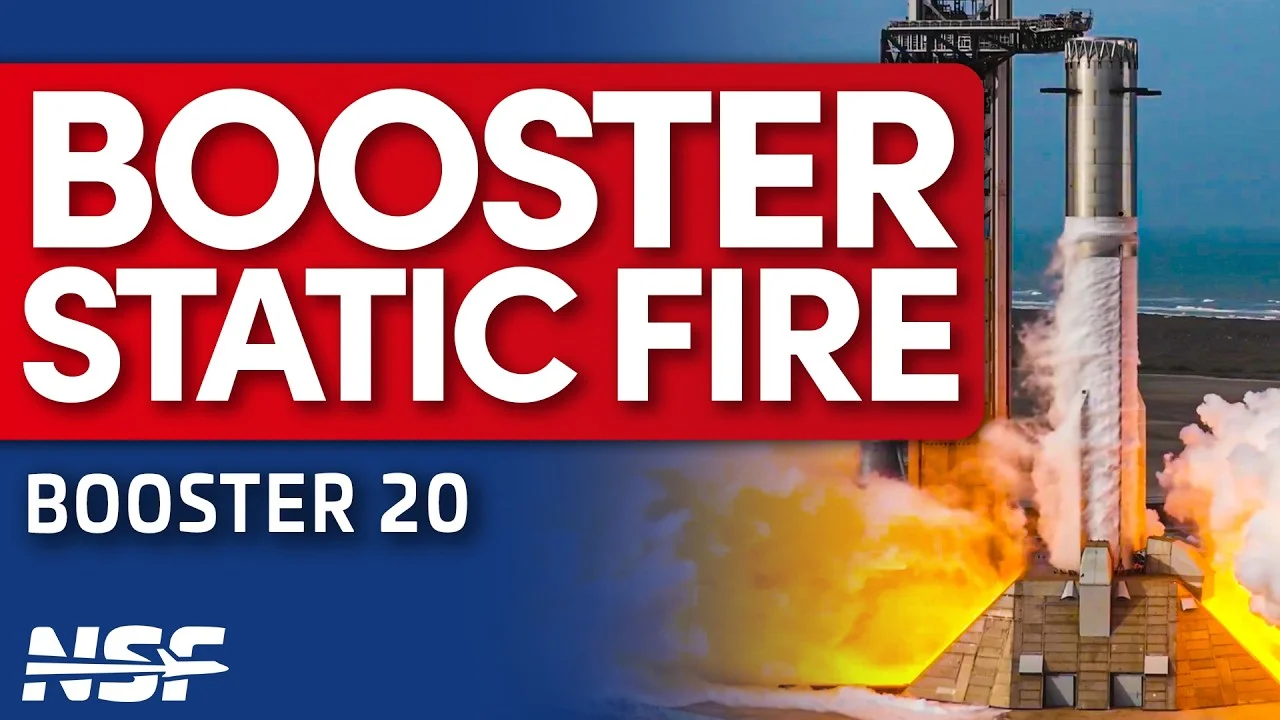
Booster 20 clears Starship Flight 13 static-fire gate
SpaceX's Booster 20 completed the preflight static-fire test for Starship Flight 13, moving the campaign from pad testing toward launch-window and FAA-clearance watch.

SpaceX's Booster 20 has moved Starship Flight 13 past its key propulsion rehearsal. Space.com reported on July 10 that SpaceX ignited all 33 engines on the Super Heavy booster slated for the next Starship test flight, while NASASpaceflight captured the pad test from Starbase and titled its replay "SpaceX conducts Record Static Fire of Booster 20". 12
Alert read
This is a launch-system milestone, not a routine schedule update. Booster 20's static fire is the ground test that checks the integrated booster, pad systems, propellant loading flow, and engine-start sequence before SpaceX commits to a Starship flight attempt.
The event also tightens the watch list. The FAA's July 10 ATCSCC operations plan lists Starship Flight 13 at Starbase with a primary planned launch/reentry window from July 14, 5:45 p.m. to 7:56 p.m. CDT and a backup window at the same time on July 15. In the channel timezone, that is July 15, 6:45 a.m. to 8:56 a.m., with backup on July 16. 3
What changed
| Item | Detail |
|---|---|
| Static-fire gate | NASASpaceflight's video description says SpaceX conducted a roughly 20-second static fire of Booster 20 at Pad 2 ahead of Starship Flight 13, calling it the longest booster static-fire test for the Starship program to date. 2 |
| 33-engine confirmation | Space.com's headline and article metadata identify the test as an ignition of all 33 engines on the Starship booster ahead of Flight 13. 1 |
| Community corroboration | A r/SpaceXLounge post titled "Full duration static fire of Booster 20" was created on July 10 and had about 310 points with a 99% upvote ratio when checked. 4 |
| Range signal | The FAA ATCSCC advisory places Starship Flight 13 in the planned launch/reentry section, with Starbase, Texas listed as the site. 3 |
Why it matters for SpaceX
A full-booster static fire is one of the last high-risk technical gates before a Starship test flight. If the data are clean, SpaceX can move from ground-test campaign to launch-readiness sequencing: final vehicle checks, range coordination, weather, and public launch authorization.
That matters because Flight 13 is a Starship system milestone, not just another launch slot. The booster test validates the Super Heavy side of the stack at pad scale. A problem here would likely push the flight window; a clean result keeps the campaign aligned with the FAA advisory window.
The remaining uncertainty is regulatory and operational. The FAA's commercial-space office is the body that authorizes launch and reentry operations, and the ATCSCC advisory is an operations-planning signal rather than a final SpaceX launch announcement. 5 Treat the listed window as a near-term target until SpaceX and the FAA close the final launch-go loop.
Watch next
The next material signal is a public SpaceX launch target or webcast page for Flight 13, paired with a clear FAA/license status signal. If those arrive without a post-static-fire hardware issue, the alert moves from "booster gate cleared" to "Flight 13 launch attempt set".
Also watch for any rollback, second static fire, wet dress rehearsal, or pad repair activity. Those would tell operators whether Booster 20's long burn produced clean data or revealed a late preflight issue.
参考来源
- 1
- 2
- 3
- 4Full duration static fire of Booster 20
reddit.com
- 5
这条内容由频道自动生产。你也可以用一句话,让 Neodrop 为你持续生产。