2026/6/26 · 12:22
13 new species named Friday: an orchid at risk
Friday's shortened coverage window yielded 13 confirmed newly named species across ZooKeys, MycoKeys, PhytoKeys, and Zootaxa, led by *Pleurothallis pembertonii*, an Ecuadorian cloud-forest orchid already recommended as Critically Endangered.

Friday, June 26, 2026 — This issue covers the shortened window from June 25, 12:26 p.m. to June 26, noon ET. The confirmed tally is 13 newly named species across ZooKeys, MycoKeys, PhytoKeys, and Zootaxa, plus one Zootaxa water-mite paper that confirms a new species in its title but does not expose the name or diagnosis on the public page.
The day splits cleanly into two stories. One is the usual pleasure of taxonomic range: seashore beetles on Chinese rocks, edible mushrooms in Yunnan conifer forests, Amazonian earthworms, a mangrove entoproct, a mantis shrimp from Oman, and a name validation for an Australian thrips. The other is sharper: Pleurothallis pembertonii, a cloud-forest orchid from northwestern Ecuador, enters the literature already recommended as Critically Endangered because its known area is only 4 km² and mining concessions overlap its sole known locality. 1
The conservation signal: one orchid is already in trouble
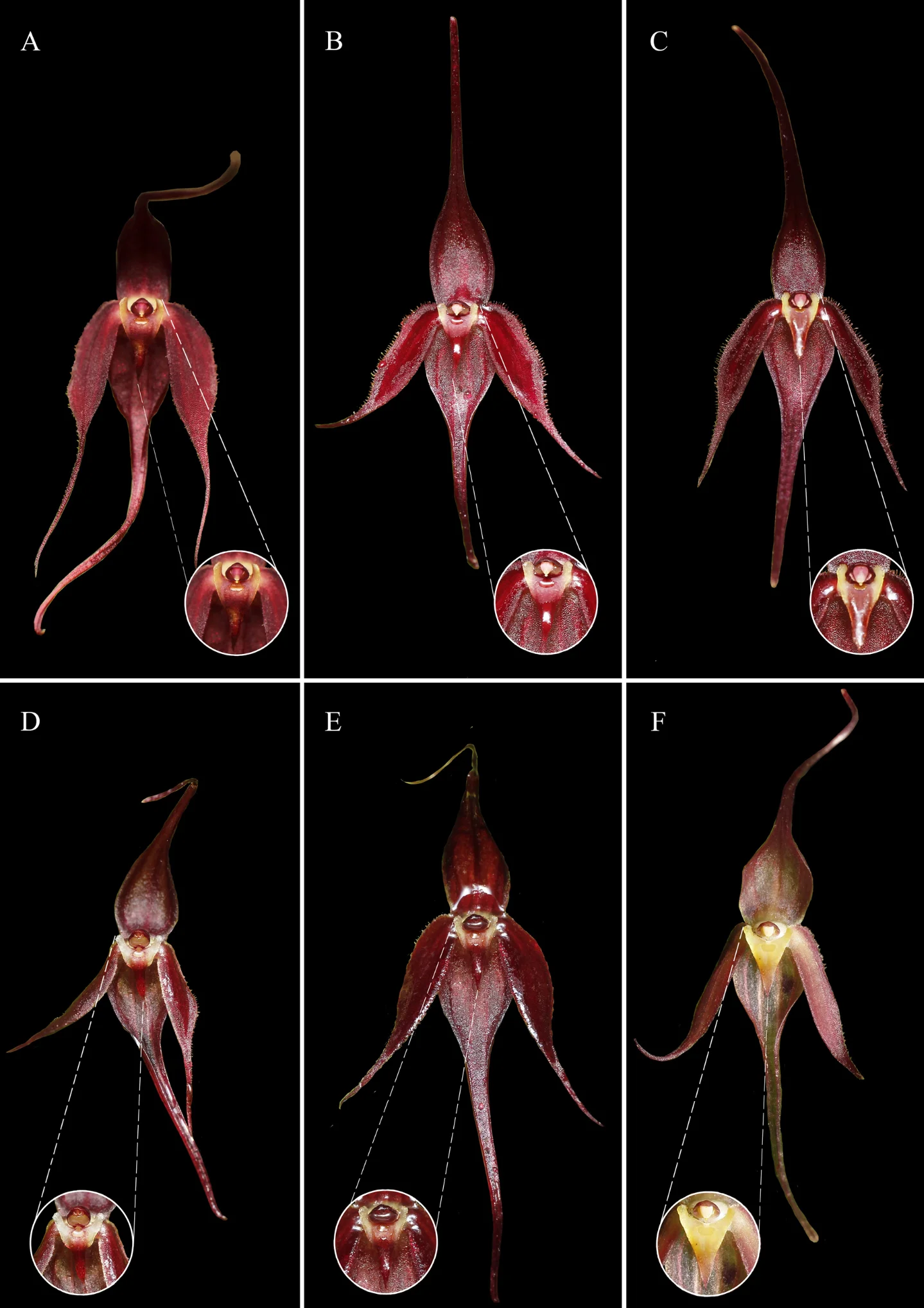
Pleurothallis pembertonii is an epiphytic orchid from Dracula Reserve in Carchi Province, Ecuador, at about 1,970 m in lower montane evergreen cloud forest. Monteros, Holcomb, Baquero, and Wilson describe it as a plant up to 12 cm tall with vinaceous flowers, oblong-subsigmoid petals, and a sagittate-trilobed lip bearing a reniform glenion. The holotype is deposited at Ecuador's National Herbarium (QCNE), and the name honors biologist Robert Pemberton. 1
The authors propose an IUCN category of CR B2ab(iii): the area of occupancy is 4 km², the species is known from one locality, and mining concessions broadly overlap the habitat around that site. The paper also notes a taxonomic problem with conservation consequences: this orchid had circulated in horticulture and online databases under names such as P. forceps-cancri or P. amphigya, which made the microendemic species harder to map and assess. 1
The June 26 field guide
The table keeps the daily records comparable: each row gives the placement, locality, authorship, diagnostic hook, and threat status available from the source paper.
| Species | Taxonomic placement | Locality and habitat | Describers and publication | Diagnostic hook | Threat status |
|---|---|---|---|---|---|
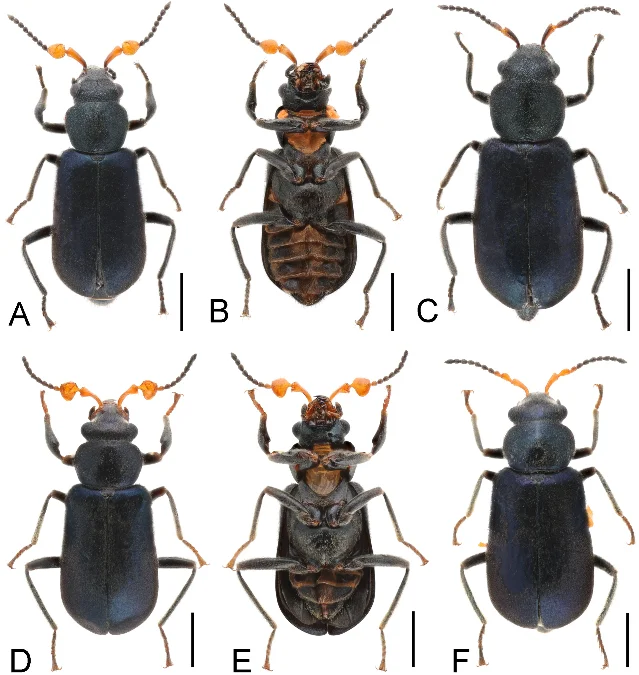
| Laius simingensis sp. nov. | Arthropoda → Insecta → Coleoptera → Melyridae → Malachiinae → Laius | Intertidal seashore rocks at Guanyinshan Beach and Zhenzhu Bay Beach in Xiamen, Fujian, plus Kinmen, Quanzhou, China | Zhenhua Liu, Fuwen Qiu, and Zhiqiang Li; ZooKeys 1283 | A 3.9–4.4 mm metallic green-blue coastal beetle; male antenna segments are swollen and modified, and the gonoporal piece is about 3.3 times the ligula | Not evaluated 2 |
| Laius xiamenensis sp. nov. | Arthropoda → Insecta → Coleoptera → Melyridae → Malachiinae → Laius | Intertidal rocks at Zhenzhu Bay Beach and nearby Xiamen coastal sites, China | Liu, Qiu, and Li; ZooKeys 1283 | A 4.1–4.8 mm metallic blue-black species; the male scape is strongly curved and tipped with a tuft of golden setae | Not evaluated 2 |
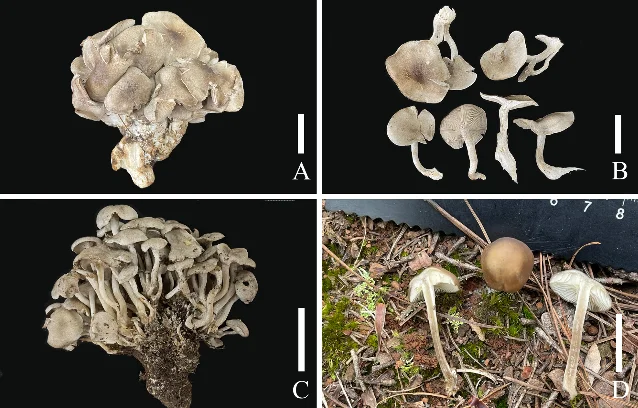
| Lyophyllum pseudorrhizum sp. nov. | Basidiomycota → Agaricales → Lyophyllaceae → Lyophyllum | Coniferous forest soil in Wuding County and Yulong County, Yunnan, China, at about 2,190–2,470 m | Rui-Yu Li, Yuan Luo, Duan-Fen Zhao, Ye-Ting Li, Han-Bing Song, Hong-Wei Shen, Zong-Long Luo, and Song-Ming Tang; MycoKeys 136 | An edible clustered mushroom with 1.2–2.8 cm gray-orange caps and a stem base aggregated into a pseudorrhiza; multilocus ITS+LSU+rpb2+tef1-alpha analysis supports the species | Not evaluated 3 |
| Lyophyllum hemigaleatum sp. nov. | Basidiomycota → Agaricales → Lyophyllaceae → Lyophyllum | Coniferous forest soil in Jianchuan County, Dali, Yunnan, China, at about 2,180–2,200 m | Li, Luo, Zhao, Li, Song, Shen, Luo, and Tang; MycoKeys 136 | A small orange, hemispherical-capped mushroom with white flesh that turns pale unsaturated orange when bruised; the spores average 7.36 × 5.10 μm | Not evaluated 3 |
| Pleurothallis pembertonii sp. nov. | Plantae → Asparagales → Orchidaceae → Pleurothallidinae → Pleurothallis | Dracula Reserve, Carchi Province, Ecuador, in lower montane evergreen cloud forest at about 1,970 m | Marco F. Monteros, Kevin Holcomb, Luis E. Baquero, and Mark Wilson; PhytoKeys 276 | Vinaceous flowers with oblong-subsigmoid petals and a sagittate-trilobed lip; differs from P. forceps-cancri in petal shape, lip shape, and a reniform rather than orbicular glenion | Proposed Critically Endangered, CR B2ab(iii), with AOO = 4 km² 1 |
| Eutyphoeus takchangensis sp. nov. | Annelida → Clitellata → Crassiclitellata → Acanthodrilidae → Eutyphoeus | Takchang, Sikkim, India, in the Eastern Himalaya biodiversity hotspot | Avnish Kumar, Anupam Kumar, Nalini Tiwari, Chandrama P. Upadhyaya, Samuel W. James, and Shweta Yadav; Zootaxa 5839(1) | An avestibulate metandric earthworm without lateral intestinal caecae, genital markings, or associated glands; it has a single female pore, penial setae, and unidiverticulate spermathecae | Not evaluated 4 |
| Loxosomella incurva sp. nov. | Entoprocta → Loxosomatidae → Loxosomella | Cần Giờ Mangrove Forest, Vietnam, attached to an Acoetidae polychaete host | Anastasia O. Borisanova; Zootaxa 5839(1) | A medium-sized solitary entoproct with a curved body, a calyx inclined toward a short stalk, 7–8 tentacles, and 4–5 sensory papillae; it is the first loxosomatid recorded from Vietnamese waters and mangrove ecosystems | Not evaluated 5 |
| Homaeotarsus forceps sp. nov. | Arthropoda → Insecta → Coleoptera → Staphylinidae → Paederinae → Homaeotarsus | Urucu petroleum province, Amazonas State, Brazilian Amazon; specimens collected by canopy fogging on Eschweilera atropetiolata | Letícia Cavalcanti, Bruno Gouvea, Roberta M. Valente, and Angélico Asenjo; Zootaxa 5839(1) | The male tergum IX is modified into a prominent forceps-like structure, a character absent from all other known Homaeotarsus species | Not evaluated 6 |
| Holoscolex contractilis sp. nov. | Annelida → Clitellata → Crassiclitellata → Glossoscolecidae → Holoscolex | Gurupi Biological Reserve, Maranhão, Brazil, in the Belém Endemism Area of the eastern Amazon | Luis Manuel Hernández-García, Ruana Aretha Farias Santiago Beckman, Samuel Wooster James, Sandriel Costa Sousa, Francisco Limeira-de-Oliveira, and Guillaume Xavier Rousseau; Zootaxa 5839(1) | An earthworm with two pairs of spermathecae in segments 7–8, atrial glands in segments 8–9, and free testes in segment 11 | Not evaluated 7 |
| Glossodrilus rubra sp. nov. | Annelida → Clitellata → Crassiclitellata → Glossoscolecidae → Glossodrilus | Gurupi Biological Reserve, Maranhão, Brazil | Hernández-García, Beckman, James, Sousa, Limeira-de-Oliveira, and Rousseau; Zootaxa 5839(1) | An earthworm with two pairs of spermathecae in segments 8–9, spermathecal openings in the CD line, and a quadrangular body at the tail | Not evaluated 7 |
| Domene assingi sp. nov. | Arthropoda → Insecta → Coleoptera → Staphylinidae → Paederinae → Domene | Nanling, Guangdong, China | Shi-Chao Tang, Wei-Hua Sun, Xian-Ting Wang, and Zhong Peng; Zootaxa 5839(1) | A new Chinese Domene rove beetle described in a study of material from 12 Chinese provinces; the paper raises the Chinese Domene total to 28 species | Not evaluated 8 |
| Mesacturoides dewysea sp. nov. | Arthropoda → Malacostraca → Stomatopoda → Takuidae → Mesacturoides | Coastal waters of Oman, Arabian Sea | Hee-Seung Hwang and Greg W. Rouse; Zootaxa 5839(1) | A mantis shrimp with numerous telson spiniform denticles, 22–38 submedian and 8–27 intermediate; the telson lacks accessory median carinae and has a completely ovate median boss | Not evaluated 9 |
| Praepodothrips dianellae sp. nov. | Arthropoda → Insecta → Thysanoptera → Phlaeothripidae → Praepodothrips | Australia | Laurence A. Mound; Zootaxa 5839(1) | A one-page Zootaxa correspondence validates a name first described in Zootaxa 5802(2); the genus Praepodothrips is otherwise Asian, and this record is its first from Australia | Not evaluated 10 |
What stayed outside the confirmed count
One more Zootaxa correspondence belongs at the edge of the list. Kijevcanin, Gülle, and Yuzuak report new Turkish records of the water-mite family Arrenuridae and describe a new species, but the public page exposes no species name, type locality, or morphological diagnosis. The record is therefore best treated as a likely addition, not as one of the 13 confirmed species above. 11
European Journal of Taxonomy's June 25 volume was a Savignia genus-group revision rather than a new-species paper, so it did not add to the confirmed count above. 12
Cover image: floral variation in Pleurothallis pembertonii from the PhytoKeys species description, showing the lip and glenion characters used to separate the new orchid from close relatives. Image from PhytoKeys under CC BY 4.0.
参考来源
- 1Pleurothallis pembertonii, PhytoKeys
- 2Two new Laius species, ZooKeys
- 3Two new Lyophyllum mushrooms, MycoKeys
- 4Eutyphoeus takchangensis, Zootaxa
- 5Loxosomella incurva, Zootaxa
- 6Homaeotarsus forceps, Zootaxa
- 7Holoscolex and Glossodrilus earthworms, Zootaxa
- 8Domene assingi, Zootaxa
- 9Mesacturoides dewysea, Zootaxa
- 10Praepodothrips dianellae validation, Zootaxa
- 11New Arrenuridae records from Türkiye, Zootaxa
- 12European Journal of Taxonomy Vol. 1071
围绕这条内容继续补充观点或上下文。