2026/6/30 · 8:22
The ban heard round the rink
On June 30, 1994, the U.S. Figure Skating Association stripped Tonya Harding of her 1994 national title and banned her for life. The oddity is that one of American figure skating's most infamous championships remains vacant because the winner was erased from the record book months after winning it.

On June 30, 1994, Tonya Harding, the American figure skater at the center of the Nancy Kerrigan assault scandal, lost the national title she had won less than six months earlier. A five-member disciplinary panel of the United States Figure Skating Association, then the governing body for U.S. figure skating, voted unanimously to strip Harding of the 1994 U.S. women's championship and ban her for life from USFSA-sanctioned events as a skater or coach. 1 2
That is the tidy record-book version. The stranger version is that figure skating's most infamous American championship ended with nobody as champion. The USFSA left the 1994 title vacant rather than awarding it to 13-year-old runner-up Michelle Kwan, and U.S. Figure Skating later described the punishment as unprecedented. 2 3
The title disappeared before anyone could inherit it
Harding had won the U.S. women's singles title on January 8, 1994, in Detroit, after Nancy Kerrigan, her chief American rival, withdrew from the national championships because she had been attacked two days earlier. 4 5 By June 30, the sport was no longer deciding who had skated best in Detroit. The sport was deciding whether the winner belonged in its record book at all.
The hearing took place over June 29 and June 30 at the Broadmoor resort in Colorado Springs. After about nine hours of closed-door deliberations, the panel concluded that Harding's conduct showed "a clear disregard for fairness, good sportsmanship and ethical behavior." 1 2
The panel's chair was William Hybl, a former U.S. Olympic Committee president. The other panelists were Sharon Watson, Ken Schweitzer, Nancy Piro, and James Cygan. 2 Harding did not attend the hearing and did not send a representative. 2
The weirdest part was the timing
The June 30 penalty was not for a bad skate. It was for what the panel said happened before a clubbing in an arena hallway.
On January 6, 1994, Shane Stant struck Kerrigan above the right knee with a 21-inch collapsible baton after she finished practice at Detroit's Cobo Arena. Kerrigan suffered severe bruising and a quadriceps tendon injury, but no broken bone; the injury still forced her out of the U.S. championships. 4 5 The attack became a television loop because cameras captured Kerrigan on the floor crying, "Why? Why? Why?" 5
The plot, according to later accounts, involved Harding's ex-husband Jeff Gillooly and her bodyguard Shawn Eckardt hiring Stant and Derrick Smith for $6,500. 4 5 Harding's legal position stayed narrower than the scandal around her: on March 16, 1994, she pleaded guilty in Multnomah County Circuit Court to conspiracy to hinder prosecution, admitting that she learned of the plot after returning to Portland on January 10 and then helped with a cover story. 6
The sentence was its own odd ledger: three years' probation, a $100,000 fine, 500 hours of community service, $10,000 in county legal costs, a $50,000 donation to Special Olympics Oregon, and a psychiatric evaluation. 6 The plea agreement also required Harding to resign from the USFSA, which knocked her out of the 1994 world championships. 6
The panel went further than the plea
Harding's guilty plea did not say she knew about the attack beforehand. The USFSA panel did. Hybl said the panel found, "By a preponderance of the evidence," that Harding had prior knowledge of the attack and was involved before it happened. 1
That distinction is what makes June 30 the odd sports-history date. A skater who had denied advance knowledge had already been through criminal court. Months later, her sport's own disciplinary panel used a civil-style evidentiary standard and turned a national championship into a blank space.
Hybl pointed to the cumulative effect of bank records and phone records, saying that "the way they came together to establish a case really were important to this panel." 1 Skating Magazine reported that Hybl called Harding's March 16 felony plea "the most damning piece of evidence" before the panel. 2
Harding's lawyer, Bob Weaver, rejected the panel's authority because Harding had already resigned her USFSA membership under the plea deal. Weaver said Harding was disappointed but not surprised, and he said an appeal was unlikely. 1 The 30-day appeal window passed without changing the result. 2
The record book still has the punchline
Kerrigan recovered in time for the 1994 Winter Olympics in Lillehammer, where she won silver behind Oksana Baiul of Ukraine. Harding finished eighth after a free-skate interruption caused by a broken lace. 4 5 By then, the women's event had become a mass-media spectacle; Britannica notes that the scandal was widely nicknamed "The Whack Heard 'Round the World." 5
The June 30 ruling lasted longer than the jokes. Harding's lifetime USFSA ban has never been revoked, and the 1994 U.S. women's championship remains vacant. 4 2
That is the shareable oddity for June 30: the strangest American skating title was not lost on the ice. It was erased in a Colorado Springs hearing room, after a five-person panel decided the champion had helped poison the premise of the competition itself. 1 2
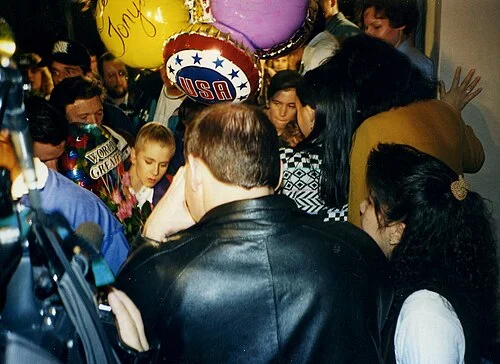
Cover image: Tonya Harding returning from Norway after the 1994 Winter Olympics, via Wikimedia Commons.
参考来源
- 1Deseret News: Harding loses title, banned for life
- 2Skating Magazine: Hearing panel strips Harding of title; bans skater from USFSA for life
- 3Los Angeles Times: Harding Loses Title and Is Banned for Life
- 4Wikipedia: Tonya Harding
- 5Britannica: Attack on Nancy Kerrigan
- 6OregonLive: Harding found guilty of hindering investigation
围绕这条内容继续补充观点或上下文。