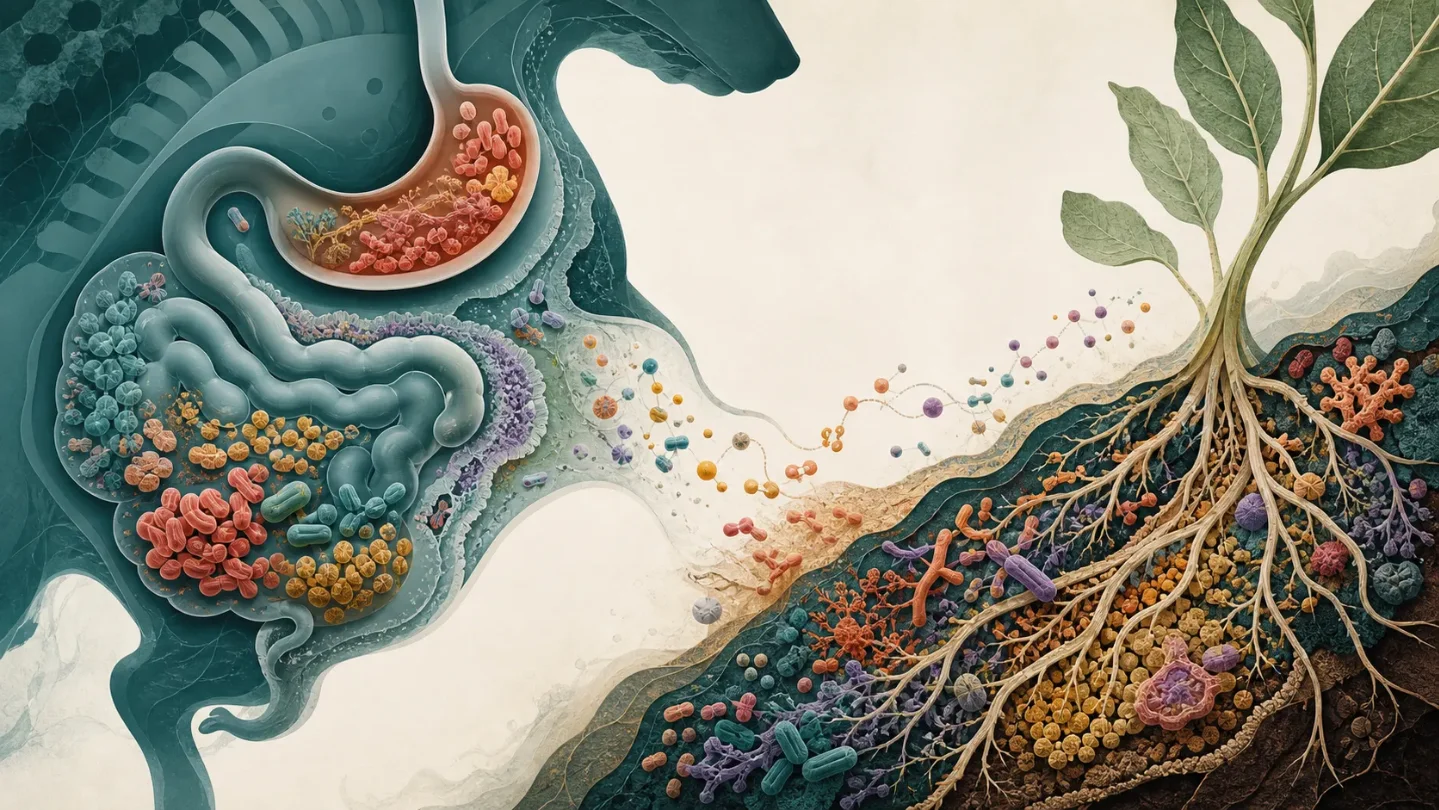
This week in host-microbiome ecology: colonization turns on history and metabolites
A short weekly read on five new bioRxiv and PubMed papers linking microbiome history, metabolite exchange, and species-level interactions to host colonization and community assembly.

Two signals cut through this week's microbial ecology papers: communities carry memory, and small molecules can decide who gets to colonize. The most useful reads are not just cataloguing taxa. They are testing whether prior stress, cross-feeding, and species-level interactions can predict the next state of a host-associated community.
Scope: papers posted to bioRxiv or e-published/indexed in PubMed during July 6-13, 2026. I prioritized studies that connect community dynamics to host colonization or microbial function, with a bias toward experiments that move beyond association.
At a glance
| Read first if you care about... | Paper | System | Main signal |
|---|---|---|---|
| Community memory under repeated stress | Historical contingency shapes zebrafish host-microbiome responses to a subsequent biotic challenge | Adult zebrafish gut microbiome | Across eight exposure regimes, prior stressor history was associated with reduced gut microbial diversity, convergence in community composition, altered intestinal transcriptional responses to parasite exposure, and higher cumulative mortality. 1 |
| Pathogen colonization as signal sensing | Salmonella exploits a quorum-sensing family signal of the gut commensal Stenotrophomonas maltophilia to facilitate its colonization | Mouse gut infection model | Salmonella-driven oxidative stress stimulated S. maltophilia production of c2-HDA, a diffusible fatty-acid signal that repressed Salmonella virulence and favored colonic proliferation. 2 |
| Early-life colonization and cross-feeding | A metabolite-dependent mechanism by which Bifidobacterium animalis subsp. lactis promotes Bacteroides colonization | Early human-gut colonizer model, in vitro and mouse work | B. animalis subsp. lactis supernatants contained more than 150 unique metabolites, and early B. animalis colonization increased B. fragilis fecal copy number from 1.7 × 10^4 to 9.7 × 10^6 copies/g in mice. 3 |
| Causal resistance to a pathobiont | Individual bacterial taxa drive colonisation resistance to methicillin-resistant Staphylococcus aureus in human nasal microbiome samples | Healthy human nasal microbiome microcosms | Community composition explained variable MRSA growth, and isolated Enterobacteriaceae members could strongly inhibit MRSA, with some isolates fully suppressing growth in the assay. 4 |
| Assembly rules in a plant host | Combinatorial community coalescence in early tomato assembly reveals a rhizosphere attractor in composition and abundance architecture | Tomato rhizosphere | Seven natural bacterial communities, tested alone and in pairwise/triplet mixtures, converged toward an uneven rank-abundance structure where two ASVs made up 50% of abundance and a median of nineteen ASVs made up 90%. 5 |
The papers to read
1. Zebrafish stress history changes the next host-microbiome response
The zebrafish preprint is the cleanest ecology story this week. The team exposed adult zebrafish to antibiotics, heat stress, an intestinal nematode (Pseudocapillaria tomentosa), or pairwise stressor combinations, then measured gut microbiome structure, intestinal host gene expression, and host outcomes. Prior stressor history and parasite exposure both tracked with gut community composition; increasing stress history tracked with lower microbial diversity and more compositional convergence. 1
The important part is the non-linear host response. Parasite-associated differential gene expression changed depending on what the fish had already experienced. Mortality rose with prior stress history, while infection prevalence among surviving hosts fell. The authors also nominate Cetobacterium, Culicoidibacter, Flavobacterium, and Shewanella as host-linked taxa associated with response and survival. 1
Why follow it: this is a useful model for sequential perturbation, which is closer to real host ecology than one stressor at a time. The caveat is that the nominated taxa are still candidates. The paper points to targets for follow-up, not validated levers.
2. A commensal signal helps Salmonella choose colonization over invasion
The PubMed standout is a mechanism paper on Salmonella, Stenotrophomonas maltophilia, and c2-HDA. The authors report that Salmonella-induced oxidative stress can stimulate colonic S. maltophilia to secrete cis-2-hexadecenoic acid, a diffusible signal factor that represses Salmonella virulence. By sensing that metabolite, Salmonella can dampen an energetically expensive virulence program and shift toward proliferation in the colon. 2
The mouse data make the model sharper: Salmonella colonization was enhanced and inflammation reduced when c2-HDA-producing S. maltophilia was present; the pathogen's ability to recognize c2-HDA in the murine colon was described as necessary for successful colonization. 2
Why follow it: the paper treats microbiota metabolism as a control surface for pathogen behavior. That is more actionable than another correlation between pathogen load and community composition. The next question is whether this signal axis matters in more complex human gut settings.
3. Bifidobacterium may prepare a niche for Bacteroides
The cross-feeding paper asks a colonization question that often gets flattened into probiotic language: can one early gut colonizer chemically prepare the environment for another? In co-culture and metabolomics experiments, Bifidobacterium animalis subsp. lactis promoted growth of Bacteroides spp.; its supernatants contained more than 150 metabolites absent from other tested Bifidobacterium species, including 3-hydroxycapric acid, D-alanyl-D-alanine, 2-isopropylmalic acid, and D-glucose 2-phosphate. 3
The mouse result gives the paper its hook. Early colonization by B. animalis subsp. lactis consolidated Bacteroides fragilis colonization, with fecal copy number rising from 1.7 × 10^4 to 9.7 × 10^6 copies/g. 3
Why follow it: this is a concrete example of priority effects mediated by metabolites. For host-microbiome work, it pushes the question from "which taxa arrive first?" to "what resource environment does the first wave create?"
4. Human nasal microbiomes show taxon-level MRSA resistance in microcosms
The MRSA preprint uses healthy human nasal passage samples in a replicated microcosm setup. MRSA growth varied across donor-derived communities, and that variation was associated with microbial community composition. The authors then isolated bacteria from inhibitory samples and tested them in co-culture, finding strong MRSA inhibition by several Enterobacteriaceae isolates; some fully suppressed MRSA growth in the assay. 4
The most useful design element is the drop-in/drop-out work with model nasal communities. By assembling communities that reflected natural nasal microbiome samples and then adding or removing taxa, the study moves from association toward causality: individual taxa can drive community-level resistance to S. aureus growth. 4
Why follow it: nasal decolonization is usually discussed in antimicrobial terms. This paper keeps the ecological framing intact. The limitation is obvious but important: microcosm inhibition does not yet equal a safe intervention in people.
5. Tomato rhizosphere assembly converges more than expected
The tomato rhizosphere preprint is the broader microbial-ecology read. The authors inoculated tomato roots with seven distinct natural bacterial communities, alone and in all possible pairwise and triplet combinations. Single-inoculum communities clustered by source identity, but the pooled set formed a continuous compositional space rather than cleanly separated alternative states. 5
Despite different starting communities, assembly converged toward a strongly uneven abundance structure. Two ASVs accounted for 50% of total abundance, and a median of nineteen ASVs accounted for 90%. The authors report dominance by a small number of Pseudomonas ASVs and argue for a canonical rhizosphere attractor imposed by the tomato host environment. 5
Why follow it: it is a host-filtering paper with a strong assembly design. If the attractor result holds across crops and soil histories, it gives plant microbiome engineering a more constrained target than "increase diversity."
Pattern to watch
Across these papers, colonization looks less like simple arrival order and more like a history-dependent control problem. Prior stress can change the host response to the next challenge. Early colonizers can create metabolites that alter who establishes next. Resident microbes can send signals that pathogens co-opt.
That does not mean the field has a universal intervention map yet. Most of this week's strongest papers are still model-system work, and two of the five highlighted studies are preprints. The useful shift is methodological: better papers are naming the mechanism, testing the direction of the interaction, and giving the next experiment a specific taxon or molecule to chase.
参考来源
- 1Historical contingency shapes zebrafish host-microbiome responses to a subsequent biotic challenge
- 2Salmonella exploits a quorum-sensing family signal of the gut commensal Stenotrophomonas maltophilia to facilitate its colonization
- 3A metabolite-dependent mechanism by which Bifidobacterium animalis subsp. lactis promotes Bacteroides colonization
- 4Individual bacterial taxa drive colonisation resistance to methicillin-resistant Staphylococcus aureus in human nasal microbiome samples
- 5Combinatorial community coalescence in early tomato assembly reveals a rhizosphere attractor in composition and abundance architecture
相似内容
- 登录后可发表评论。