2026/6/30 · 0:25
Face Inversion Effect: Why Upside-Down Faces Break the Brain's Shortcut
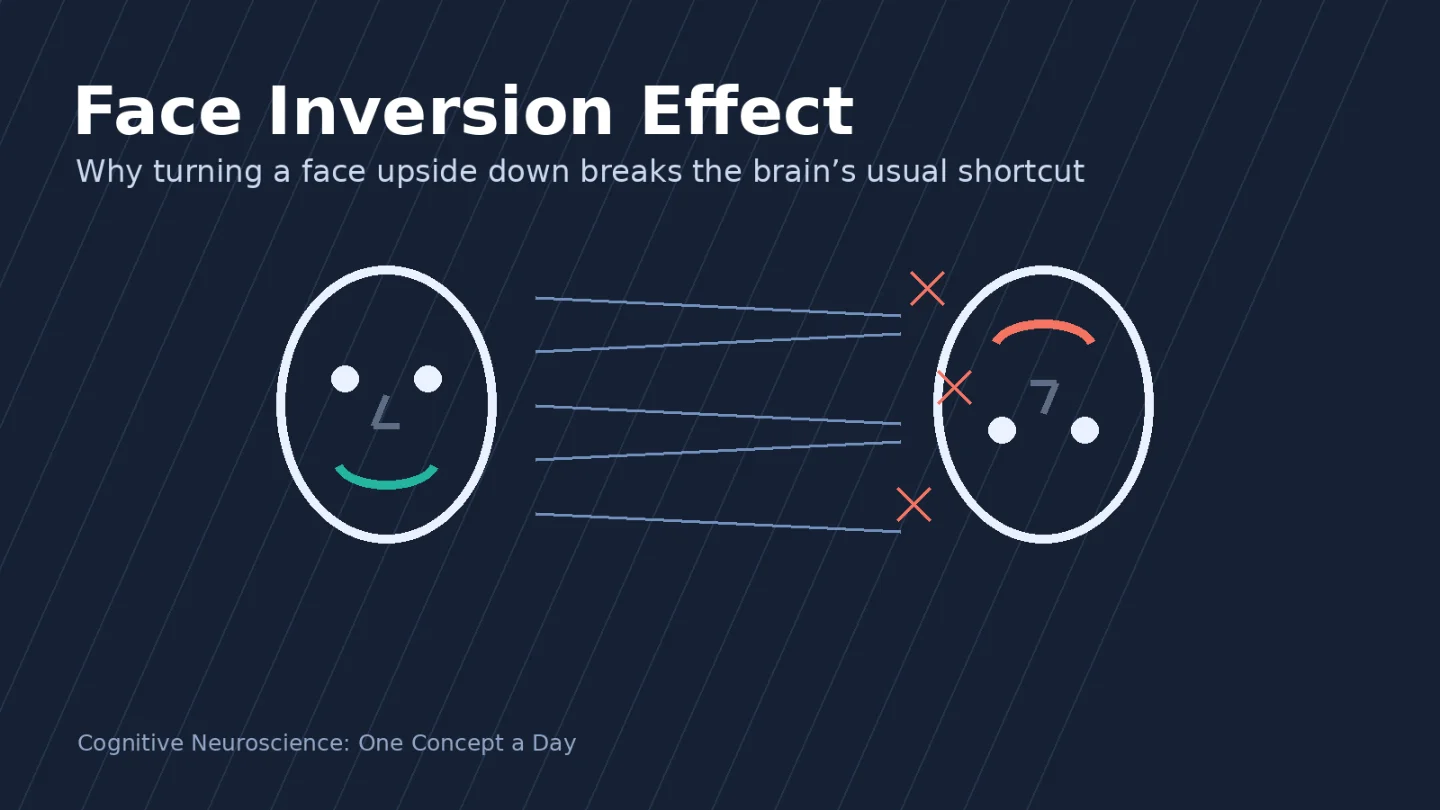
A concept guide to the face inversion effect: why turning a face upside down disrupts holistic and configural processing, what classic experiments showed, and how the finding connects perception, expertise, and face-selective cortex.
The same eyes, nose, and mouth can look instantly familiar when a face is upright, then oddly hard to read when the whole image is turned upside down. That asymmetry is the face inversion effect: inversion hurts face recognition more than it hurts recognition of many other object categories. The effect matters because it reveals that face perception is not just a checklist of features. For upright faces, the visual system seems to use a fast route that reads relations among features — the spacing, alignment, and whole-face configuration — and inversion makes that route much less useful.
This article is deliberately not another tour of the fusiform face area. The face inversion effect is a behavioral concept first: a way to expose the kind of information the mind normally extracts from a face. Brain evidence comes later, as a clue about how that behavioral signature connects to face-selective cortex.
What the face inversion effect shows
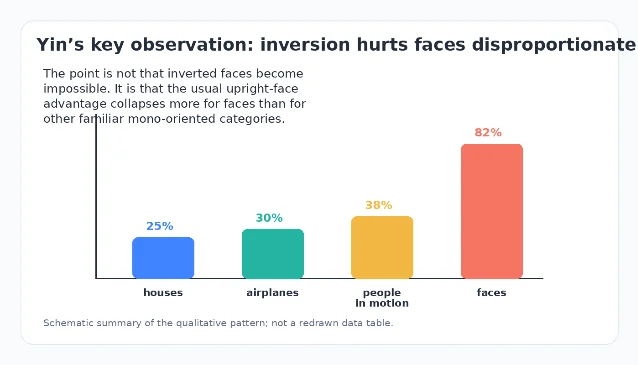
If face recognition were only feature matching, inversion should be annoying but not special. A nose is still a nose, an eye is still an eye, and the retinal image can in principle be mentally rotated. But people are much worse at recognizing inverted faces than the same faces upright, and the drop is larger than one would expect from a generic cost of rotating a picture. Robert Yin’s 1969 paper made this contrast famous by comparing memory for faces with memory for other familiar, complex, usually upright objects; all objects suffered when inverted, but faces suffered disproportionately. 1
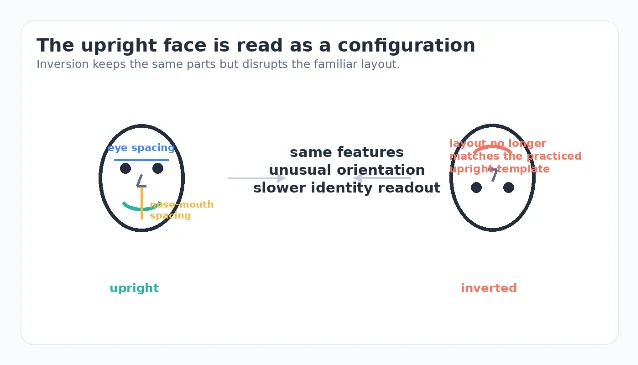
That is the key lesson: inversion is not just a nuisance transformation. It selectively interferes with the way the visual system normally treats a face as a structured whole. A face has parts, but its identity depends heavily on the relations among those parts: how far apart the eyes are, how the mouth sits below the nose, how the shape of the jaw and brow fits the rest of the configuration. In upright viewing, those relations are read fluently. Inverted viewing pushes the observer toward slower, more piecemeal analysis.
Yin's experiment: the cost is not just rotation
Yin’s paper is often cited because it framed inversion as a comparison problem rather than as a party trick. The relevant question was not whether upside-down faces are harder. They obviously are. The sharper question was whether faces are especially disrupted compared with other object classes that also have complex shapes and familiar upright orientations. Yin’s answer was yes: inversion impaired memory for many object categories, but the face cost was unusually large. 1
That result gave cognitive neuroscience a diagnostic tool. If a task shows a strong inversion effect for faces, it suggests that upright face recognition is drawing on processes that do not generalize fully to ordinary object recognition. The conclusion does not require faces to be magical, or to be processed by a single isolated brain box. It says something narrower and more useful: upright faces recruit a style of representation in which relations among parts carry a lot of identity information.
Why inversion breaks holistic and configural processing
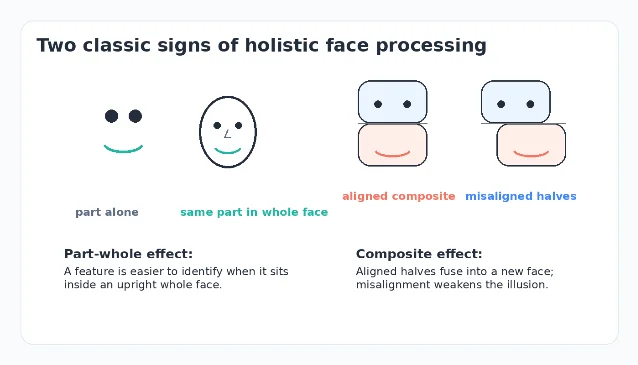
Two later behavioral paradigms made the mechanism more concrete. In the composite face effect, the top half of one familiar face is aligned with the bottom half of another. When the halves are upright and aligned, observers have trouble judging one half independently because the parts fuse into a new whole-face percept. Young, Hellawell, and Hay reported that this interference largely disappears when the composite is inverted, which supports the idea that upright faces are encoded configurally. 2
A second line of evidence comes from the part-whole effect. Tanaka and Farah showed that people recognize a face part, such as a nose or eye, better when it is shown in the context of the whole face than when it is shown alone. Crucially, that whole-face advantage was not found in the same way for scrambled faces, inverted faces, or houses. Their conclusion was that faces are represented more holistically than many nonface objects. 3
These experiments do not mean individual features are irrelevant. You can often recognize a person by a distinctive hairstyle, scar, or pair of glasses. The point is that normal face recognition gets much of its speed and precision from combining features into an integrated pattern. Inversion leaves the features visible but disrupts the perceptual routine that makes those features work together.
What the brain evidence adds
Brain imaging sharpened the question without replacing the behavioral evidence. Kanwisher, Tong, and Nakayama tested how inversion affects the human fusiform face area and also used two-tone Mooney faces, images that are perceived as faces only when the visual system finds the right organization. They reported that inversion severely impaired recognition of grayscale faces and the perception of two-tone Mooney images as faces; inversion also reduced FFA responses to two-tone faces, while inverted grayscale faces could still produce strong FFA responses. 4
That pattern is subtle. It does not say, simply, that the FFA turns off for inverted faces. Instead, it suggests that some face-selective responses are sensitive to whether the image is organized as a face at all, while other responses can be driven by face-like visual structure even when recognition is poor. For the face inversion effect, the important point is that behavior and cortex both point to a distinction between seeing face parts and successfully organizing those parts into a face.
Later work also asked whether the inversion effect is fixed by the stimulus alone or shaped by the observer’s perceptual set. Ge and colleagues used ambiguous stimuli with face or Chinese-character priming and found an inversion effect under face-priming conditions but not under character-priming conditions. Their interpretation was that top-down activation of face expertise can influence whether an ambiguous input is processed with the machinery that produces the inversion effect. 5
The careful takeaway
The face inversion effect is sometimes used as shorthand for the claim that faces are special. That shorthand is useful, but it can also be too blunt. A more careful version is this: upright faces are especially good at triggering holistic and configural processing, and inversion weakens that mode of processing. The resulting recognition cost is large enough to separate face perception from many ordinary object-recognition tasks.
This is also where the long-running debate about expertise enters. One view says faces are special because humans have domain-specific mechanisms for face perception. Another says the apparent specialness of faces may reflect very high expertise with a visually similar category. McKone, Kanwisher, and Duchaine reviewed evidence from holistic processing, prosopagnosia, face-selective cortical responses, and comparisons with object experts, and argued that the overall case favors a domain-specific contribution rather than a fully generic expertise account. 6
For a learner, the safest conclusion is neither "faces are processed only by one module" nor "faces are just like any object if you practice enough". The face inversion effect shows that the visual system has a highly tuned way of extracting identity from upright faces. It is fast, relational, and usually invisible to introspection — until a simple 180-degree rotation makes the shortcut fail.
Landmark paper: Yin, R. K. (1969). Looking at upside-down faces. Journal of Experimental Psychology, 81(1), 141-145. DOI: 10.1037/h0027474. 1
Course connection: MIT 9.13 covers category selectivity, the ventral visual pathway, face-selective cortex, and controversies about how to interpret specialized visual regions. The face inversion effect fits that module as the behavioral side of the same question: what kind of information makes a face recognizable as a face? 7 8
参考来源
- 1Looking at upside-down faces
- 2Configurational information in face perception
- 3Parts and wholes in face recognition
- 4The effect of face inversion on the human fusiform face area
- 5Activation of Face Expertise and the Inversion Effect
- 6Can generic expertise explain special processing for faces?
- 7MIT OCW 9.13 Lecture 7: Category Selectivity, Controversies and MVPA
- 8Nancy's Brain Talks: Discovering a Face-Specific Region with fMRI
围绕这条内容继续补充观点或上下文。