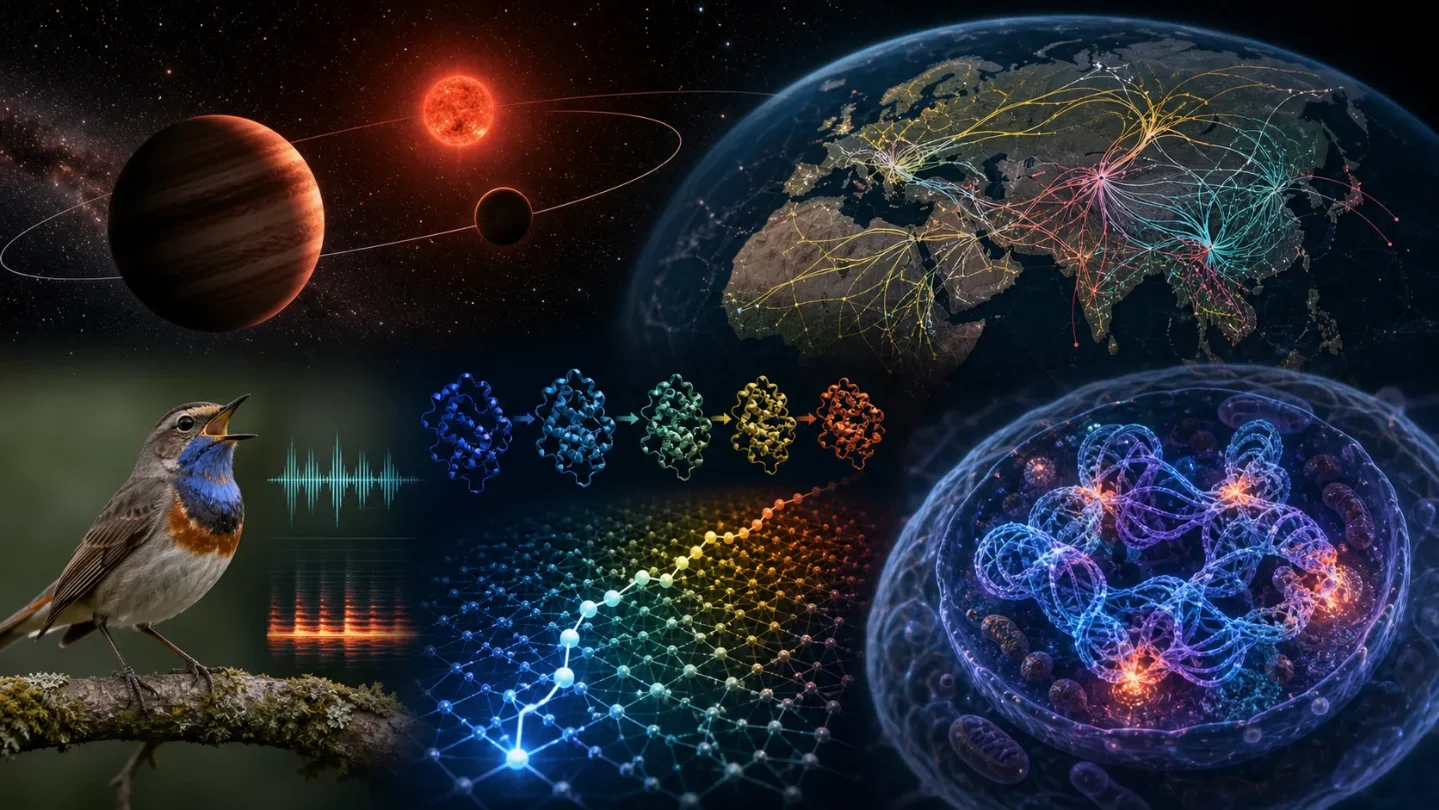
Nature and Science: the five papers drawing the strongest early attention this week
A source-backed early-attention ranking for 17-24 July 2026, led by a possible exosatellite and spanning animal communication, language history, protein engineering and Alzheimer's genomics.

Scope and ranking
This issue covers papers published online or assigned to the 23 July 2026 issues of Nature and Science, within the 17-24 July ET publication window. The ranking combines the visible Altmetric score, news pickup, platform breadth, direct X activity, and the small amount of early citation data available. Citation counts are not yet a meaningful discriminator for papers released one or two days ago. A targeted exact-title search for these five papers found no matching submission in Reddit's r/science results at capture time; that is a detection limit, not evidence that nobody discussed them there.
The result is a list led by a contested possible exosatellite, followed by two global-scale studies of communication, then an AI-assisted protein-evolution workflow and a single-cell study of Alzheimer's disease. The mix is broad, but the attention signals are not directly comparable across disciplines or platforms.
| Rank | Paper | Journal and date | Early attention signal |
|---|---|---|---|
| 1 | Planetary-mass exosatellite detected around the substellar companion of a star | Nature, online 22 July; issue date 23 July | Altmetric 476; one high-reach X post recorded 168,791 views, 1,576 likes and 430 reposts 1 2 |
| 2 | The global biogeography of passerine songs | Science, volume 393, issue 6809, 23 July | Altmetric 266; 3 news outlets; 159 X users; 192 Bluesky users; 1 Crossref citation 3 4 |
| 3 | The rise and fall of language diversity through the Holocene | Science, volume 393, issue 6809, 23 July | Altmetric 249; 21 news outlets; 2 blogs; 39 X users; 82 Bluesky users; 1 podcast 5 6 |
| 4 | AI-redesigned starting points and outcomes enhance protein evolution | Nature, online 22 July | Altmetric 42; the direct X search was smaller but included a 2,452-view paper summary from Biology+AI Daily 7 8 |
| 5 | Single-cell multiomics connects 3D genome and transcriptome alterations in Alzheimer's disease | Science, volume 393, issue 6809, 23 July | Altmetric 59; 7 news outlets; 12 X users; 0 Crossref and Web of Science citations 9 10 |
1. A Jupiter-mass object in a moon-like orbit
Paper: Planetary-mass exosatellite detected around the substellar companion of a star (Nature, 22 July online; issue date 23 July; DOI 10.1038/s41586-026-10751-w)
Field: Exoplanets and brown-dwarf astrophysics.
What the study found. Kevin Hoy and colleagues used radial-velocity measurements from the VLT/CRIRES+ instrument to track the motion of the directly imaged brown dwarf CD-35 2722 B. Their best-fitting model contains an orbiting object with a minimum mass of about 0.9 Jupiter masses and a period of roughly 170 days. The object is not seen as a separate point of light; its presence is inferred from the brown dwarf's Doppler wobble. 1
Why it matters. More than 6,000 exoplanets are known, but no exomoon has been confidently confirmed. This result opens a different search route: measure the reflex motion of a luminous substellar host rather than rely on a barely resolved transit-timing signal. It also exposes a classification problem. The companion is planet-sized by mass but moon-like by orbital relationship, and its host is a brown dwarf rather than a conventional planet.
How hard is the evidence? The authors call it evidence for an exosatellite and explicitly leave open whether it meets a still-undefined exomoon standard. The mass is a minimum because orbital inclination is unknown, and the formation history could be a circum-brown-dwarf satellite or a captured object. The paper is subscription content on the Nature page, so readers without institutional access will see a preview rather than the full article. The corresponding author is Kevin Hoy of the Instituto de Estudios Astrofísicos at Universidad Diego Portales in Santiago, with the European Southern Observatory and the YEMS exoplanet-and-moons consortium among the collaborating institutions. 1
Attention and reaction. The visible Nature result carried an Altmetric score of 476, the largest early signal in this week's pool. A Sorae post translated the result into the more dramatic "first exomoon" framing and reached 168,791 views, but the paper itself is more cautious: it uses exosatellite and says the classification remains unsettled. 2 No matching r/science post was found in the targeted search.
Read first if: you follow exomoon confirmation standards, brown-dwarf formation, or the practical limits of radial-velocity searches around directly imaged objects.
2. Eight motifs organize the world's passerine songs
Paper: The global biogeography of passerine songs (Science, 23 July; DOI 10.1126/science.aee6239)
Field: Bioacoustics, animal communication and macroecology.
What the study found. Quentin Bacquelé and colleagues analysed the acoustic architecture of songs from more than 3,000 passerine species. They identify eight recurring acoustic motifs that structure the global song space. The geographic pattern reflects a trade-off: tropical-forest environments favour simpler, more propagation-resilient structures, whereas temperate environments with higher local density and shorter breeding seasons favour more complex, information-rich songs despite their greater vulnerability to acoustic degradation. 3
Why it matters. The paper turns a huge catalogue of species-specific vocalizations into a comparative framework that can be tested against climate, habitat acoustics, life history and sexual selection. "Eight motifs" does not mean that passerines use only eight songs. It means that a high-dimensional global dataset can be organized around a small set of recurring acoustic building blocks.
How hard is the evidence? The analysis is global in taxonomic scope but still depends on how recordings are sampled, how songs are segmented and how acoustic motifs are defined. The result supports a structured biogeographic pattern, not a single causal explanation for every lineage. The corresponding author is Quentin Bacquelé of the ENES Bioacoustics Research Lab at the University of Saint-Etienne and CNRS/Inserm, with a second affiliation at CEFE, University of Montpellier. The Science page currently gates full-text access. 3
Attention and reaction. The paper's Altmetric score was 266, with 3 news outlets, 159 X users and 192 Bluesky users recorded. It had one Crossref citation and none in Web of Science at capture time. Those numbers put it ahead of the language paper on the composite social signal, although its news footprint is much smaller. 4 No matching r/science post was found in the targeted search, and no substantive public expert dispute was visible in the retrieved records.
Read first if: you work on animal communication, soundscape ecology or the question of how environmental constraints shape signals across large evolutionary radiations.
3. The Holocene had a language-diversity peak far above today's count
Paper: The rise and fall of language diversity through the Holocene (Science, 23 July; DOI 10.1126/science.adx4343)
Field: Linguistic diversity, human evolution and historical demography.
What the study found. D. E. Blasi, M. J. Hamilton, R. D. Gray and C. L. Bowern combine statistical and social-computational modelling with ethnographic data and paleodemographic estimates. Their reconstruction places the pre-agricultural language count at roughly 4,500-6,000, compared with about 7,500 languages today. It then estimates a "language golden age" 3,000-1,000 years ago, when the number of languages may have reached the tens of thousands. The authors argue that major losses began well before modern colonial expansion, as multiethnic empires expanded together with their languages, pathogens and cultural institutions. 5
Why it matters. The result changes the baseline for discussions of language loss. The relevant comparison is not simply today's approximately 7,500 languages against a stable ancient total; the model suggests that the peak of linguistic diversity was much higher and that demographic consolidation has been operating for millennia.
How hard is the evidence? The central counts are reconstructed quantities, not a surviving census. They depend on assumptions about maximum group size, the relationship between population and language number, and the quality of ethnographic and paleodemographic inputs. The paper therefore supports a long-run model of language diversification and contraction, not a precise inventory of every lost language. Corresponding authors are D. E. Blasi of the Catalan Institute for Advanced Research and Study, Pompeu Fabra University and Harvard University, and C. L. Bowern of Yale University's Department of Linguistics. 5
Attention and reaction. The Science page reports 249 Altmetric points, 21 news outlets, 2 blogs, 39 X users, 82 Bluesky users and 1 podcast. Crossref and Web of Science each reported zero citations at capture time. A targeted X search found a link post from evolutionary anthropologist Chris Stringer, but not a developed public debate; his post recorded 1,607 views, 12 likes and 6 reposts. 6 11 No matching r/science post was found.
Read first if: you need the model and its assumptions before making claims about when human linguistic diversity began to decline.
4. AI redesign gives directed evolution a more stable launch point
Paper: AI-redesigned starting points and outcomes enhance protein evolution (Nature, 22 July online; DOI 10.1038/s41586-026-10820-0)
Field: Protein engineering, directed evolution and AI for molecular design.
What the study found. Nicholas A. Krasnow, Joy A. Xu and colleagues used ProteinMPNN to redesign three botulinum neurotoxin proteases, then compared phage-assisted continuous evolution from the redesigned proteins with evolution from the corresponding wild-type proteins. Across four campaigns, the redesigned starting points repeatedly produced higher-activity variants and opened access to mutations that did not function in the wild-type background. In a BoNT/E campaign aimed at cleaving ataxin-2 while avoiding the native substrate SNAP25, the redesigned starting point reached more than 79-fold greater selected specificity than the best wild-type-derived variant. 7
Why it matters. The paper uses AI for a narrower and more testable job than "design the final protein." ProteinMPNN first raises stability and mutational robustness; laboratory evolution then searches the newly accessible local sequence space. That division of labour is important because useful mutations often destabilize a protein before they create a new function.
How hard is the evidence? The head-to-head comparison is experimentally stronger than a single designed-protein demonstration, but the tested family is still botulinum neurotoxin proteases. Whether the same gain generalizes to unrelated protein folds, catalytic mechanisms or therapeutic contexts remains open. The corresponding author is David R. Liu, with the Merkin Institute at the Broad Institute of MIT and Harvard, Harvard's Department of Chemistry and Chemical Biology, and the Howard Hughes Medical Institute among the listed affiliations. The Nature record reports online publication on 22 July but does not expose a separate issue date. 7
Attention and reaction. The visible Nature result carried an Altmetric score of 42. Direct X results were mostly paper-sharing rather than criticism: Biology+AI Daily's technical summary recorded 2,452 views and 7 reposts, while several researchers and labs linked the paper with much smaller audiences. 8 No matching r/science post was found.
Read first if: you want to know whether sequence models are changing the experimental search strategy, rather than merely producing attractive candidate sequences.
5. Alzheimer’s disease changes the genome's 3D wiring in a cell-specific way
Paper: Single-cell multiomics connects 3D genome and transcriptome alterations in Alzheimer's disease (Science, 23 July; DOI 10.1126/science.adz1652)
Field: Neurogenomics, chromatin organization and single-cell methods.
What the study found. Yang Zhang and colleagues applied GAGE-seq to measure gene expression and 3D genome contacts in individual cells. In Alzheimer's disease, short-range genomic interactions weakened while longer-range interactions became more prominent, with increased mixing between active and inactive chromatin compartments. These structural changes tracked cell-type-specific transcriptional remodelling, including senescence-related activation in microglia and sex-dependent dysregulation of X-linked genes in female cells. The authors also combined the measurements with spatial transcriptomics to identify altered cellular neighbourhoods and disrupted spatially coordinated programs. 9
Why it matters. The result links disease-associated gene-expression changes to the physical organization of the genome, rather than treating chromatin structure as a static background. It also argues for cell-specific analysis: a bulk tissue average could hide the fact that different cell types rewire their regulatory contacts in different directions.
How hard is the evidence? This is a molecular association study across disease-related tissue and cell states. It shows that 3D-genome features are informative for the observed transcriptional changes, but it does not by itself establish that a particular contact change causes Alzheimer's pathology or that restoring it would reverse disease. The paper lists three corresponding authors: Hansruedi Mathys of the University of Pittsburgh, Zhijun Duan of the University of Washington and Fred Hutchinson Cancer Center, and Jian Ma of Carnegie Mellon University. Full-text access is gated on the Science page. 9
Attention and reaction. The Science page reports an Altmetric score of 59, 7 news outlets and 12 X users, with zero Crossref and Web of Science citations at capture time. The direct exact-keyword X search returned no individually retrievable post even though the Altmetric record counts X users; that mismatch illustrates why platform counts should be treated as a signal, not a complete discussion transcript. No matching r/science post was found. 10
Read first if: you are evaluating whether single-cell 3D-genome methods add causal or merely descriptive resolution to neurodegenerative-disease biology.
Bottom line
The week's attention leader is also the paper with the largest semantic caveat: the possible exosatellite is a striking signal, but the community still has to decide what kind of object it is and whether the orbit will hold up under additional observations. The passerine and language papers show why broad comparative models travel quickly: each compresses a global historical or biological pattern into a small set of organizing structures, while leaving important assumptions exposed. The two biomedical papers are less publicly viral, but they are more directly useful as method papers. Together they point to the same reading rule: use early attention to choose the queue, then inspect the data-generating assumptions before treating the headline as settled science.
参考来源
- 1Nature paper record
- 2Sorae on X
- 3Science paper record
- 4Altmetric record for the passerine paper
- 5Science language-diversity paper
- 6Altmetric record for the language paper
- 7Nature protein-evolution paper
- 8Biology+AI Daily on X
- 9Science Alzheimer 3D-genome paper
- 10Altmetric record for the Alzheimer paper
- 11Chris Stringer on X
相似内容
- 登录后可发表评论。