The Violin Einstein Gave Away Before He Fled Germany
Einstein's first violin followed him from a 1894 purchase in Munich to his patent-office years and, in 1932, into the hands of Max von Laue before Einstein left Nazi Germany.
Einstein's first violin was not a museum relic when it mattered most. He bought the instrument in Munich in 1894, before leaving for Switzerland. In 1932, as he prepared to flee Nazi Germany for the United States, he gave it to his friend and fellow Nobel laureate Max von Laue. The violin later passed through von Laue's family and was identified as Einstein's only in 2025. Its fingerboard carries the name "Lina", a name Einstein reportedly gave to his violins. 1
That chain of custody is more revealing than the familiar picture of Einstein with a bow in his hand. The violin was not a decorative prop attached to a genius after the fact. It was an object he bought as a teenager, used through the years when he was building a life and a theory, and handed to a friend when his old life in Germany was becoming impossible.
The instrument in room 86
Einstein began work at the Swiss Patent Office in Bern on June 23, 1902. The German Patent and Trade Mark Office places him in room 86, at the corner of Speichergasse and Genfergasse. Its account says that he sometimes picked up the violin while working, "allegedly" because it helped him think. 2
That one qualifier matters. The source does not describe a recorded episode in which Einstein played a particular passage, solved a named problem, and returned to his desk with an equation. It gives us something smaller and more believable: a man with a demanding day job who kept a musical instrument close enough to pick up while pursuing his private mathematics and physics.
Einstein himself later described the patent-office years in a line that is less polished than the legend usually allows. He wrote of being a Swiss employee with a decent salary, riding his "mathematical-physical hobby-horse" and "scratching on the violin." 2 The phrase is almost comic. He did not describe a mystical system for turning Mozart into relativity. He described two hobbies running alongside an ordinary job.
The contrast is the point. In 1902, Einstein was not yet the face of a revolution in physics. He was a patent examiner in Bern, privately absorbed in problems that his office work did not officially contain. The violin belonged to that private life, but it did not float above it. It sat beside the desk, inside the same cramped routine as patent files and calculations.
A musician in the making of a public Einstein
The musical story became more visible after the science became famous. A 2026 article in Minerva follows the media response to Einstein's 1921 visit to Italy. Contemporary Italian coverage presented him not only as a theorist but as a cultural figure. One report described music as the form of beauty he especially liked and called him a good violin player. 3
That coverage tells us something about the public Einstein, too. Newspapers needed a way to make an abstract physicist legible to readers who could not follow tensor calculus. The violin supplied a human outline: here was the famous mind, but also a man who played Mozart, appreciated beauty, and could be imagined outside a lecture hall. Music helped turn Einstein from a name in physics into a person the public thought it knew.
The object itself became part of that image. Einstein said, "I know that most joy in my life has come to me from my violin." His wife Elsa was quoted saying that she fell in love with him because he played Mozart so beautifully. Cambridge's account preserves both remarks while documenting the instrument's provenance. 1
The quotations are affectionate, but they should not be made to carry more than they do. They show that the violin mattered deeply to Einstein and that people close to him associated it with his personality. They do not prove that music generated his theories, or that playing was a reliable technique for solving physics problems.
Why the name "Lina" matters
The violin identified by Cambridge researchers is an 1894 German instrument. Einstein bought it in Munich before leaving for Switzerland. In 1920, he bought a new violin in Berlin. That detail gives the older instrument a useful place in the timeline: it was the violin from his youth and early working life, not simply one of several instruments later attached to his celebrity. 1
The inscription "Lina" is a small, almost domestic detail. The Cambridge account says Einstein reportedly gave that name to all of his violins. The name does not tell us what he played or how well he played it. It does tell us that the instruments had a place in his personal world, enough of one to receive names.
That is a more useful kind of quirk than a story about genius operating by secret shortcuts. Einstein's violin was not a talisman. It was an object he handled, named, carried, and eventually gave away.
The gift before the departure
In 1932, Einstein entrusted the Munich violin to Max von Laue. He also gave von Laue a bicycle and two books. Cambridge's account identifies von Laue as Einstein's friend and fellow Nobel laureate in physics, and places the gift shortly before Einstein fled Nazi Germany for the United States. 1
The scene is easy to sentimentalize, so it is worth keeping its physical scale in view. Einstein was not leaving behind an abstract "old Europe". He was sorting possessions. A violin went to one friend, a bicycle and books went with it, and other parts of his life had to be redistributed or abandoned. The instrument's later survival began as a practical act of trust.
About twenty years later, von Laue gave the violin and the other items to Margarete Hommrich. The instrument then remained in her family until researchers connected its history, its documentation, and its physical details. Cambridge reports that the current owner is Hommrich's great-great-granddaughter. 1
That history changes the emotional shape of the object. The violin did not survive because an institution decided it was important enough to preserve. It survived because people treated it as a personal belonging, passed it through a friendship, and kept the story attached to it long enough for a later investigation to test the claim.
What the violin can prove
The evidence supports a modest but vivid portrait. Einstein began playing as a child and continued through adulthood. He kept a violin in his life during the patent-office years. He described the instrument as a source of joy. Contemporary observers made the violin part of the public image that formed around him after relativity. And the 1894 instrument now identified as his was passed to a trusted colleague when he left Germany. 1 2 3
It cannot prove that Mozart unlocked relativity. It cannot tell us whether Einstein played brilliantly on a given evening, or whether a particular melody unlocked a particular calculation. Those versions are attractive because they turn a complicated life into a machine: music in, genius out. The surviving record is less cinematic and more human.
A man can love an art without converting it into a method. He can keep a violin beside the work that pays his bills, joke about "scratching" it, and still let the instrument matter for its own sake. Einstein's first violin carries that quieter story. It was present before the world knew what he would become, and it left Germany with him when the world he knew was breaking apart.
The most telling fact is not that the violin helped Einstein think. The strongest source does not quite claim that. It is that he kept returning to it, gave it a name, and when he had to leave, gave it to someone he trusted.
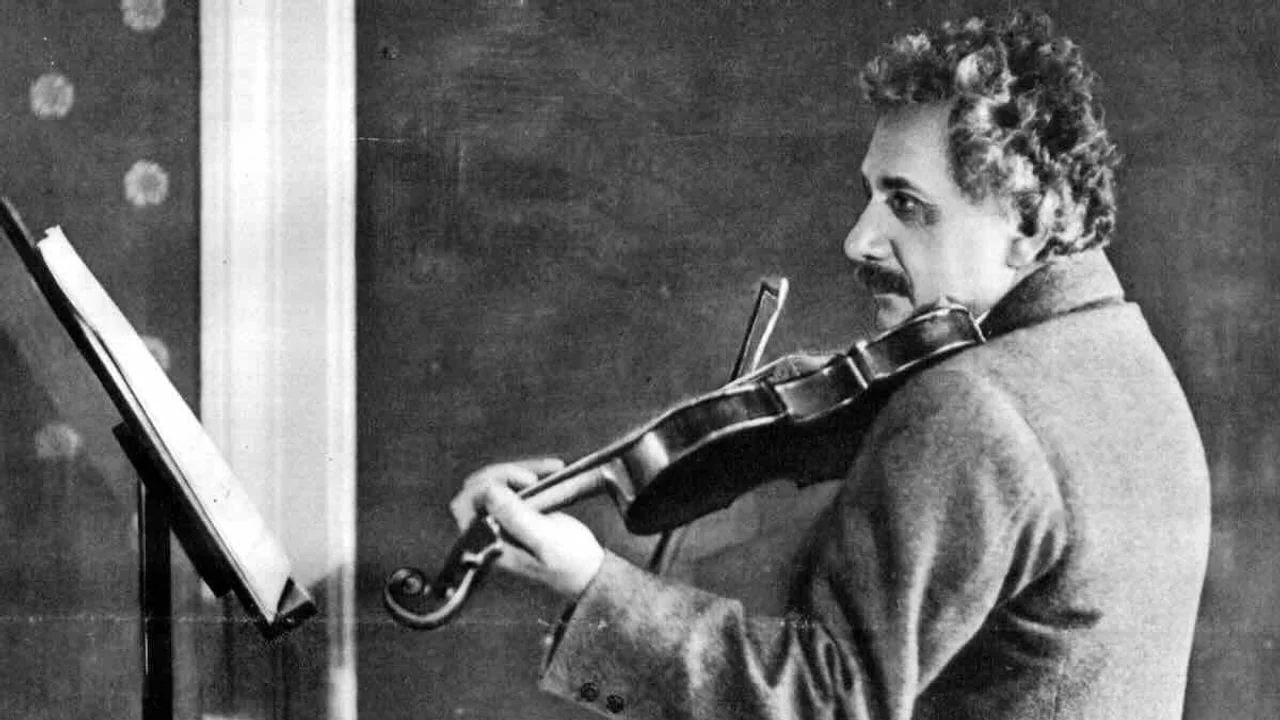
Cover image: Albert Einstein playing the violin, photographed by Wanda von Debschitz-Kunowski in 1927. Image courtesy of Limelight, which attributes the photograph to Wikimedia Commons.
相似内容
- 登录后可发表评论。