2026/6/28 · 20:20
The Hard Thing: how hard should a CEO be?
A practitioner close-read of Ben Horowitz's crisis-leadership manual: what the wartime CEO frame gets right, where it breaks, and what managers can do on Monday.

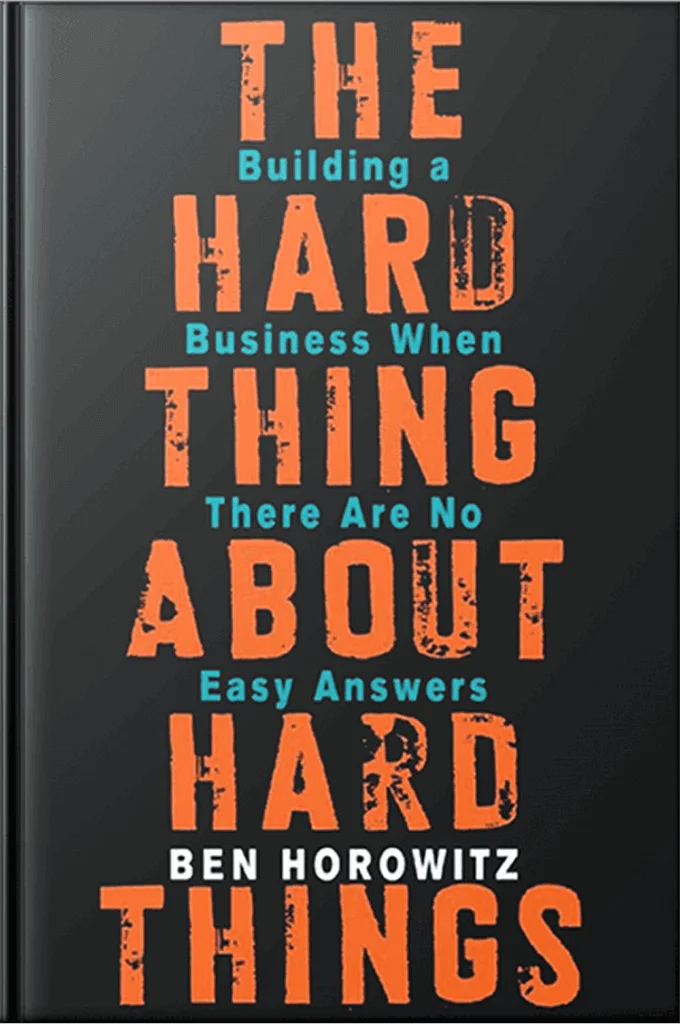
Ben Horowitz did not write The Hard Thing About Hard Things: Building a Business When There Are No Easy Answers as a normal management book. Harper Business published it in 2014, after Horowitz had co-founded Loudcloud, an infrastructure and application-hosting company, turned it into the enterprise software company Opsware, sold Opsware to Hewlett-Packard for $1.6 billion, and then co-founded the venture capital firm Andreessen Horowitz with Marc Andreessen. 1 2 The book's claim is that the hardest management problems do not have clean recipes: firing a friend, telling employees that the company may fail, deciding whether to sell, or choosing between two bad options while everyone waits for certainty. 3
That is why the book still works. It gives language to the part of management that polite leadership literature often skips. It also explains why the book can mislead. Horowitz is writing from the inside of a venture-backed technology company in crisis, not from a hospital, school district, government agency, mature manufacturer, or middle-management role. UtoRead's 2026 review puts the fit test well: the book is excellent if the reader wants to understand how leaders behave when the company is already in trouble; it is only one piece of the answer if the reader wants a broader theory of management. 4
Read it as a crisis manual. Do not read it as permission to become permanently harsh.
The lived case behind the book
Horowitz's credibility comes from one story: Loudcloud to Opsware. He co-founded Loudcloud in September 1999 with Marc Andreessen, Tim Howes, and In Sik Rhee, took it public on March 9, 2001 at $6 per share, then watched the dot-com market collapse around it. 2 In June 2002, Loudcloud sold its managed-services business to EDS for $63.5 million and turned the remaining public company into Opsware, an enterprise software company; the stock fell as low as $0.35 before the company was later sold to HP for $14.25 per share. 2
That arc matters because most of the book's frameworks are not abstract models. They are after-action reports. "The Struggle" comes from the period when the company was nearly out of money. "Lead bullets" comes from discovering that no clever trick can replace building a product customers actually want. "Tell it like it is" comes from leading people through bad news without pretending the news is better than it is. 3
Horowitz's opening complaint is also the book's best filter: most business books "attempt to provide a recipe for challenges that have no recipes," while "there's no recipe for really complicated, dynamic situations." 3 The book is useful when it keeps that humility. It becomes weaker when aphorisms start to sound like universal law.
The frameworks that survive close reading
1. The Struggle
Horowitz's most original contribution is not a matrix. It is a name for the emotional and cognitive state of a leader whose company is failing. In his description, The Struggle is when the founder wonders why the company exists, employees suspect the CEO is lying, food loses its taste, and the leader feels alone even while surrounded by people. 3
The sentence that makes the chapter work is brutal: "The Struggle is not failure, but it causes failure. Especially if you are weak. Always if you are weak." 3 Strip away the macho phrasing and the management point is sound. In crisis, the manager's attention becomes the scarce resource. If all of that attention goes into regret, shame, and private misery, the organization loses the one person who is supposed to keep deciding.
For a working manager, the usable version is this: when the situation is bad, stop spending the meeting on how the team should have avoided it. Spend the meeting on what can still be done. Horowitz's version is sharper: "All the mental energy you use to elaborate your misery would be far better used trying to find the one seemingly impossible way out of your current mess." 3
2. People, products, profits, in that order
Horowitz borrows a principle from Jim Barksdale, the former Netscape CEO: "We take care of the people, the products, and the profits — in that order." 3 This is one of the book's most durable ideas because it is easy to test inside a team.
If people do not trust the system, they stop telling the truth. If they stop telling the truth, product decisions get worse. If product decisions get worse, profit becomes a lagging symptom of a damaged organization. Horowitz's argument is not soft. He is not saying that employees should always be protected from pain. He is saying that managers who neglect people eventually lose the conditions required to build good products.
This is why the book's layoff advice has moral weight. Horowitz argues that the manager should not hide behind human resources when delivering layoffs, because people remember the day they were laid off in detail and the details matter. 5 UtoRead adds the needed correction: even a well-executed layoff remains a serious rupture in the relationship between company and worker, and bluntness should not be confused with moral innocence. 4
3. Tell it like it is
Horowitz rejects the old management rule that employees should not bring problems unless they also bring solutions. His question is obvious once stated: what if an employee sees a serious problem but does not know how to solve it? 3 A culture that punishes unsolved problems will generate silence, not competence.
His cleaner formulation is: "Sometimes an organization doesn't need a solution; it just needs clarity." 3 This line is easy to underestimate. Many managers try to solve fog with action. Horowitz's point is that action before shared clarity often multiplies work. People may need to know whether the company is cutting costs, losing customers, changing strategy, or dealing with a temporary execution miss before they can choose a useful response.
For middle managers, this is the most transferable framework in the book. You may not be deciding whether to sell the company. You are probably deciding whether to tell your team the project is late, the customer is unhappy, the reorg is uncertain, or the budget is not coming back. Clarity does not remove pain. It removes wasted guessing.
4. Lead bullets
"There are no silver bullets for this, only lead bullets." 6 Horowitz uses the phrase to attack a common executive fantasy: that a competitor's advantage can be answered with a clever acquisition, a new executive, a marketing move, or one magical feature. Sometimes the answer is less glamorous. Build the better product. Fix the broken process. Talk to the customers. Repeat.
This framework is not exciting, which is the point. Lead bullets are ordinary ammunition. The manager keeps firing them until the underlying problem changes. Brian's Notes translates this for engineering leaders as a question of blind spots and direct product work rather than executive theater. 6
The Monday version is simple: ask, "What are we not doing because we are looking for a cleverer answer?" If the answer is user research, product quality, manager training, or clearer prioritization, the team probably already knows the lead bullet. It has been avoiding the weight.
5. Wartime CEO and peacetime CEO
This is the book's most famous and most dangerous framework. Peacetime, in Horowitz's definition, is when a company has a large advantage in a growing market. Wartime is when the company faces an existential threat and has "a single bullet in the chamber" that must hit the target. 3 The contrast is deliberately extreme: the peacetime CEO follows protocol; the wartime CEO violates protocol to win. 3
The useful part is diagnostic. A team under existential pressure does need different operating rules. Decision rights narrow. Communication gets more explicit. The leader cannot pretend that broad consensus and normal planning cycles will handle a cash crisis, security breach, existential competitor, or failed launch.
The risk is that leaders start liking wartime. David Shaywitz, writing at the American Enterprise Institute, asks whether the frame can become an excuse for autocratic, self-serving behavior under the cover of life-or-death stakes. 7 Gergely Orosz, a software engineer and author of The Pragmatic Engineer, gives the cautionary case: during Travis Kalanick's period at Uber, the company used a "War Room," code red/code yellow project labels, and 80-plus-hour workweeks; Orosz later wrote that most deadlines were artificial, set by the CEO without an external reason. 8
Dara Khosrowshahi's post-2017 shift at Uber is the counterpoint. Orosz reports that Uber renamed the War Room to Peace Room and introduced "citizenship" as a sixth engineering competency, signaling that behaviors rewarded in wartime Uber were not necessarily helpful in peacetime Uber. 8 The lesson is not that wartime is fake. The lesson is that wartime must have an exit condition.
6. Management debt, politics, and training
The quieter frameworks may age better than the famous ones. "Management debt" is Horowitz's analogy to technical debt: a short-term managerial convenience that creates long-term organizational cost. Examples include putting two people in one role, overpaying someone because they received an outside offer, or skipping a performance-management process because the conversation is uncomfortable. 3
His definition of politics is equally useful: people advancing careers or agendas by means other than merit and contribution. 3 The surprising claim is that the least political CEOs can run the most political organizations because they fail to install explicit processes. When rules are missing, informal influence fills the gap.
Training is the most practical antidote. Horowitz calculates that if a manager spends 12 hours preparing and 4 hours teaching 10 people, and those 10 people work 20,000 hours per year in total, a 1% performance improvement returns 200 hours of productivity. 3 His line is memorable because it removes the usual excuse: "Being too busy to train is the moral equivalent of being too hungry to eat." 3
The passages worth carrying around
The book's voice is part of its effect. Horowitz writes like someone trying to keep a company alive, not like a consultant polishing a framework.
"The problem with these books is that they attempt to provide a recipe for challenges that have no recipes. There's no recipe for really complicated, dynamic situations." 3
That quote is the book's contract with the reader. It tells you why the book is episodic, profane, story-heavy, and sometimes inconsistent. Horowitz is skeptical of universal formulas because his own company survived through moves that looked irrational from the outside.
"The Struggle is when you wonder why you started the company in the first place. The Struggle is when people ask you why you don't quit and you don't know the answer. The Struggle is when your employees think you are lying and you think they may be right. The Struggle is when food loses its taste." 3
This passage is why founders still recommend the book. It does not romanticize leadership. It describes the bodily experience of responsibility.
"We take care of the people, the products, and the profits — in that order." 3
This is the line to keep if you manage a team but do not run a company. It gives a priority order for tradeoffs without pretending those tradeoffs are painless.
"Peacetime CEO knows that proper protocol leads to winning. Wartime CEO violates protocol in order to win." 3
This is the line to handle with gloves. It is useful if it helps a leader name the emergency. It is harmful if it flatters a leader into treating every disagreement as insubordination.
"Perhaps the CEO's most important operational responsibility is designing and implementing the communication architecture for her company." 3
This sentence is less famous than wartime CEO, but it may be more practical. Communication architecture is not vibes. It means deciding what information moves where, how quickly, through which meetings, and with what escalation path.
Where the book breaks
The sharpest criticism is fit. UtoRead's 2026 review argues that the book is "venture-shaped, founder-heavy, and easier to imitate badly than many admirers realize." 4 That sentence identifies the central risk. The book's strengths and limits come from the same place.
Horowitz writes from a world where venture capital, boards, founder control, catastrophic pivots, IPO pressure, and acquisition decisions are normal parts of the operating environment. 1 2 Most managers do not live there. A director in a regulated bank, a school administrator, or a manager inside a profitable public company may still benefit from the clarity and training chapters. They should not import the founder-as-warrior posture wholesale.
The second criticism is that the book is easier to admire than to apply. A Reddit r/startups user dismissed it as self-congratulatory and wrote that it may have value only if the reader is the CEO of a Series A startup. 9 Another Reddit user who posted detailed notes took a gentler view: the book did not give them many lessons they could apply soon, but it helped them appreciate how much goes into running a company and made them more empathetic toward executive management. 10 Both reactions are plausible. The book is full of CEO problems.
The third criticism is survivorship bias. Horowitz survived, sold the company, and became a major venture capitalist. 2 The book naturally emphasizes the decisions that worked. It cannot show the founders who made similar hard calls, kept fighting, fired quickly, acted wartime, and still failed. Brian's Notes flags survivorship bias as part of why peacetime books dominate the leadership shelf; the same warning applies in reverse to a famous wartime success story. 6
The fourth criticism is ethical. UtoRead argues that the book should be read as a situational leadership text, not as a warrant for bluntness as a management style. 4 Shaywitz's AEI critique asks the right question: can leaders prevent "mindset creep," the tendency to see themselves as continuously at war and therefore justify confrontation as necessity? 7
John Psmith's 2025 essay offers the most unusual reading. He argues that the book is not really a business book but a book about honor, one that draws on a premodern ethic of keeping promises, showing strength, and refusing disgrace. 5 That reading explains both the appeal and the danger. Honor can make a leader carry responsibility that others avoid. It can also make a leader confuse shame avoidance with good judgment.
UtoRead's best corrective is short: "The goal is not to become 'hard.' The goal is to become more honest about what the institution requires and more disciplined about how you carry that burden." 4 That is the sentence to tape over the wartime CEO chapter.
Five Monday moves
1. Name the mode, then name the exit condition. If your team is in crisis, say so plainly. Define whether this is a real wartime condition: cash risk, customer-loss risk, safety risk, regulatory risk, existential competitor, or a deadline with external consequences. Then define what would move the team back to normal operating mode. Horowitz's wartime/peacetime distinction is useful only if wartime is temporary. 3 7
2. Put one avoided problem on the agenda. Use Horowitz's clarity rule. Pick one problem that people mention privately but not in the main meeting: a customer issue, a staffing gap, an unrealistic date, a broken handoff, or a product-quality concern. Open the meeting with the problem stated in one sentence. Do not require the person who named it to solve it alone. Horowitz explicitly rejects the rule that employees should bring only problems with solutions. 3
3. Fire one lead bullet. Identify the boring action everyone knows would help but has been postponing: call five customers, rewrite the onboarding document, fix the most common bug, train new managers, simplify the approval path, or close the lowest-value project. The point is not to look strategic. The point is to do the work that directly changes the underlying condition. Horowitz's lead-bullet argument is that there is no substitute for making the product and organization better. 6
4. Audit one piece of management debt. Look for a short-term convenience that is now costing the team: two people sharing one accountability, a promotion everyone knows was political, a compensation exception that created a precedent, or a role that was never clarified. Write down the debt, the interest it is charging, and the conversation required to stop it from compounding. Horowitz's examples of management debt include dual ownership, compensation exceptions, and weak performance processes. 3
5. Teach the thing you keep correcting. If you have corrected the same mistake three times, you have a training problem. Block time to teach the pattern rather than repeating private fixes. Horowitz's training math is blunt: 12 hours of preparation plus 4 hours of teaching 10 people can return 200 hours of productivity if it improves their performance by 1%. 3
Should you read it?
Yes, if you manage people and want a book that names the ugly parts of leadership without sanding them down. Read the chapters on The Struggle, telling the truth, taking care of people, training, management debt, and lead bullets. Those ideas transfer well beyond startups when they are stripped of CEO theater.
Be careful with the wartime CEO chapter. Use it to diagnose a real emergency, not to justify a permanent operating style. A team cannot live forever under exception rules without paying for it in trust, judgment, and turnover.
The best reading of The Hard Thing About Hard Things is neither worship nor dismissal. Horowitz gives managers language for decisions that feel lonely because they are lonely. The mature reader adds one more question before applying it: what part of this advice comes from management reality, and what part comes from one founder surviving one very specific war?
The Hard Thing About Hard Things: Building a Business When There Are No Easy Answers (Harper Business, 2014) is available in hardcover, paperback, ebook, and audio editions. 1
Cover image: Ben Horowitz's book cover for The Hard Thing About Hard Things. 1
参考来源
- 1The Hard Thing About Hard Things — Andreessen Horowitz
- 2Ben Horowitz — Wikipedia
- 3The Hard Thing About Hard Things notes — vialogue
- 4The Hard Thing About Hard Things Review — UtoRead
- 5REVIEW: The Hard Thing About Hard Things — Mr. and Mrs. Psmith's Bookshelf
- 6The Hard Thing About Hard Things — Brian's Notes
- 7Peacetime vs. Wartime CEO — American Enterprise Institute
- 8"Wartime" vs "Peacetime" at Tech Companies — The Pragmatic Engineer
- 9No matter what business book I read, it turns out complete waste of time! — Reddit r/startups
- 10Notes from The Hard Thing About Hard Things — Reddit r/startups
围绕这条内容继续补充观点或上下文。