July 18 in business history: The commitment is the product
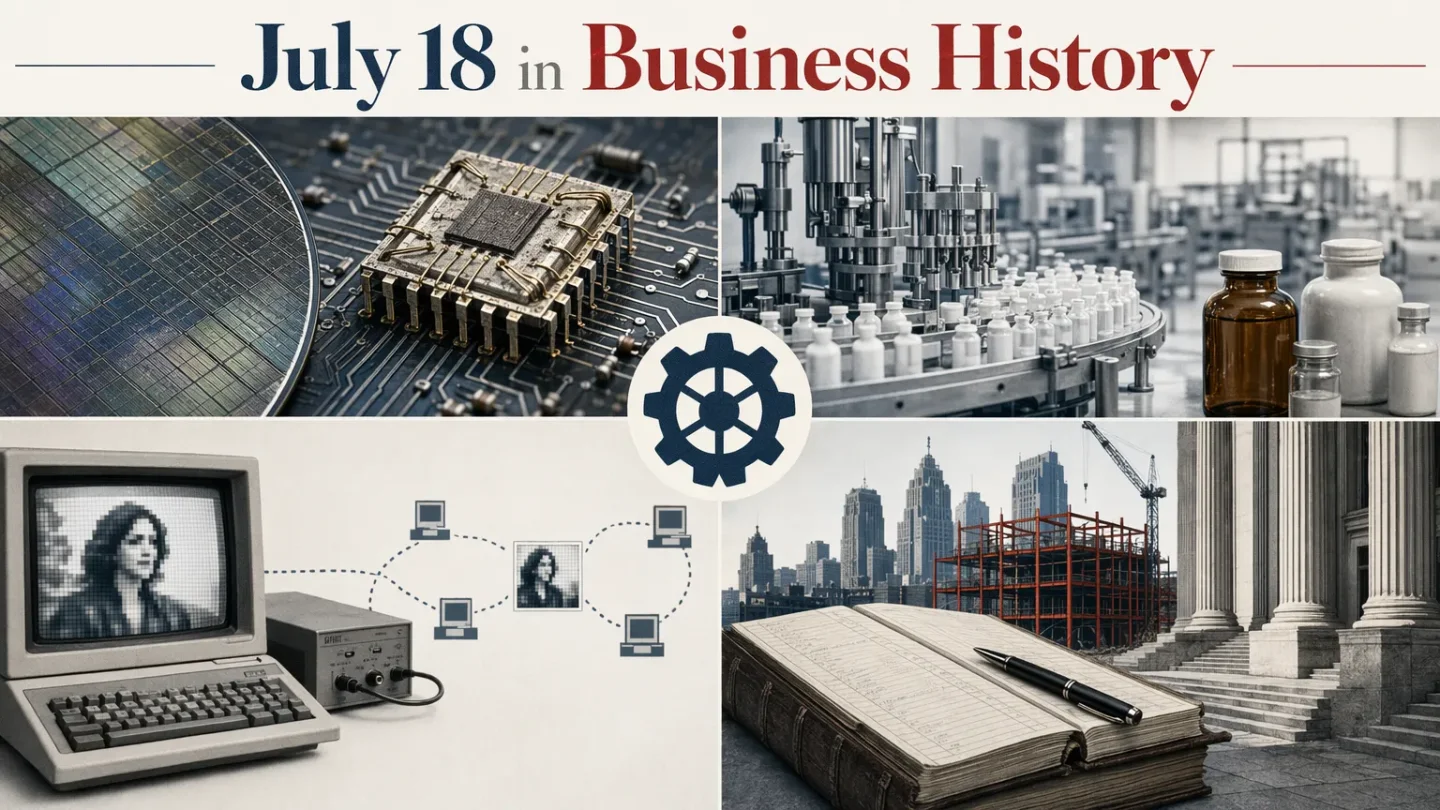
Four July 18 decisions, from Intel's research-first founding to Detroit's restructuring, show how durable outcomes come from the operating mechanism behind the headline move.
The commitment is the product
A July 18 pattern runs through four very different institutions: the founding promise matters only when management turns it into a mechanism that can survive contact with customers, capital, and time.
Intel began with a decision about what kind of company it would be, not just what it would manufacture. Galenika built a pharmaceutical business by adding production and research capacity in layers. CERN's first web photo shows how a tiny user request can expose a new distribution channel before anyone has a business model for it. Detroit's bankruptcy shows the other side of the ledger: when the operating system no longer matches the obligations, the decisive move is to restructure the system itself.
The useful question for today is not whether the plan sounds ambitious. It is whether the first commitment creates a repeatable capability.
1968: Intel chooses the research company
On July 18, 1968, Robert Noyce and Gordon Moore incorporated the venture that would become Intel after leaving Fairchild Semiconductor. Intel's own history says the founders believed Fairchild's parent was not reinvesting enough of the semiconductor business's profits in new research and development. Their new company was designed around continuous innovation rather than around being simply another semiconductor manufacturer. 1
That was a costly choice for a startup. Intel spent its first year focused mainly on research and development while it raised capital, found space, and settled on a name. The company began operations on August 1 with about a dozen engineers in a borrowed conference room. Its first product, the 3101 SRAM, arrived in April 1969, less than a year after operations began. Intel says the chip ran at twice the speed of SRAMs already on the market, even though Honeywell, the customer that had prompted the competition, chose not to use it. 2
The deeper outcome was not the 3101 by itself. Intel followed it with the 1101, the first commercial chip using a metal-oxide semiconductor process and silicon gates, and then the 4004. The 4004 began as a Busicom calculator contract, but Intel's engineers proposed a programmable architecture instead of the customer's original twelve-chip design. In May 1971, Robert Noyce repurchased most rights to the chip for the return of Busicom's $60,000 development investment. Intel's timeline later records the 4004 as the first programmable microprocessor and includes the company's 1971 IPO among the corporate steps that supported continued expansion. 3 4
Decision mirror: If your company says innovation is the strategy, where is the budget, staffing model, and decision right that protects it before revenue arrives? Intel's founding commitment became real because the organization accepted a period in which the capability came before the product.
1945: Galenika builds the factory behind the promise
Galenika was founded on July 18, 1945, with 43 employees as a small medicines workshop. The company's official history describes a sequence of capability bets: it expanded production and research capacity, established a penicillin plant in 1948, produced its first penicillin in 1949, added chemicals and hygiene products in 1952, and created an export department in 1953. 5
The important move was not a single blockbuster drug. It was the decision to stack adjacent capabilities in an order the organization could absorb: manufacturing, scientific know-how, product range, and then international distribution. That approach made the business less dependent on any one launch and gave it more ways to reuse the same technical base.
The later arc is visible in Galenika's own 2024 account. After becoming part of Brazil's NC Group at the end of 2017, the company reported 90 new products registered in Serbia and regional markets during the first seven months of 2024, an 18% increase in production, more than double the EU sales, and operations in 25 international markets. Those are company-reported figures, not an independent valuation, but they show the kind of output a long investment in capacity can support. 6
Decision mirror: When a growth plan depends on a new market, ask which capability must exist before the sales team can make the promise. A product launch is often the visible tip of a less visible sequence: quality systems, production, regulatory work, distribution, and learning. If the sequence is missing, scale turns a commercial win into an operational liability.
1992: The Web's first photo is a user request
On July 18, 1992, CERN computer scientist Silvano de Gennaro photographed the comedy band Les Horribles Cernettes, scanned the image, and turned it into an album cover. A few weeks later, Tim Berners-Lee asked for an image to test new Web features. De Gennaro sent the picture as a GIF. Guinness World Records records the original as roughly 120 by 50 pixels and says it took more than a minute to load on a typical computer. 7
The business lesson is easy to miss because the image looks trivial. The Web was not demonstrated first with a polished commercial catalog or a mass-market product. Its first widely remembered image came from an internal community and a practical request: make this new system handle something people already want to share. The test exposed a new behavior before the market had decided what the behavior was worth.
CERN's account of the Web says the original project was built so scientists at universities and institutes around the world could exchange information instantly. On April 30, 1993, CERN placed the Web software in the public domain, then issued a free-license version to maximize diffusion. 8 The adoption path followed a familiar pattern: a narrow internal use case, a simple transfer mechanism, and a licensing decision that removed friction for the next user.
Decision mirror: What is the smallest real user request that would force your new platform or workflow to prove it can travel? Do not ask only whether the technology works. Ask whether someone outside the founding team can use it to move an object, decision, or relationship that already matters to them.
2013: Detroit restructures the operating system
On July 18, 2013, Detroit filed for Chapter 9 bankruptcy protection. The Eastern District of Michigan identifies that filing as the start of the largest Chapter 9 municipal bankruptcy case in history, and the city's later account dates the beginning of the process to July 2013 under a state-appointed emergency manager. 9 10
The filing was a response to a system whose obligations had outgrown its operating base. Detroit's revenue had fallen with population and employment, while pensions, retiree health care, debt service, and financial costs remained. Negotiations with creditors and pension boards did not produce an agreement, so emergency manager Kevyn Orr used Chapter 9 to put the full structure on the table rather than renegotiate one contract at a time. The historical record estimates the debt at roughly $18 billion to $20 billion; the court later found the city eligible on $18.5 billion of debt. 11
The outcome was not a clean reset. Judge Steven Rhodes confirmed a Plan of Adjustment in November 2014. Detroit's 2026 update says the process shed approximately $7 billion in debt, restructured another $3 billion, and freed about $150 million per year for city services. It also reports that the city has since produced 12 consecutive balanced budgets and returned to investment-grade status. 10
Decision mirror: When a company is carrying obligations its current model cannot support, incremental cuts can protect the past while consuming the future. The serious question is not how to make an unsustainable system look solvent for one more quarter. It is which commitments must be renegotiated, which capabilities must be protected, and what operating surplus must be created for the system to run again.
The managerial test
These four July 18 events point to one test for today's decisions:
- Name the commitment. Is it research, production capacity, distribution, or a balance-sheet reset?
- Identify the first proof. What small result would show that the commitment is becoming a capability rather than a slogan?
- Protect the mechanism. Which budget, license, process, or governance right must survive the first period of disappointment?
- Define the reversal point. What evidence would tell you to stop funding the old system, change the architecture, or renegotiate the promise?
Intel's first year, Galenika's layered expansion, the Cernettes image, and Detroit's restructuring all make the same point from different directions: the headline decision is only the opening move. The durable advantage comes from the mechanism that makes the next move possible.
参考来源
- 1Intel's Founding
- 2Intel's First Product - the 3101
- 3The Intel 4004
- 4Explore Intel's history
- 5The history of Galenika
- 679 Years of Galenika: Growth is the Success of All Employees
- 7First photo posted to the World Wide Web
- 8The birth of the Web
- 9City of Detroit Bankruptcy Filing
- 10City of Detroit's historic bankruptcy case is closed
- 11Detroit bankruptcy
相似内容
- 登录后可发表评论。
More from this channel
- July 22 in business history: The structure is part of the bet
- July 21 in business history: The operating model decides the outcome
- July 20 in business history: The boundary is part of the bet
- July 19 in Business History: When Scale Changes the Question
- July 17 in Business History: The First Move Is Not the Whole Bet
- July 16 in Business History: Build the mechanism, then make the promise
- July 15 in Business History: Before Scale, Test the System
- July 14: distribution rewrote the market