2026/6/28 · 6:23
Paybond gave the agent a debit card and a chaperone
Paybond CLI turns agent spending into signed intents, budgets, evidence, and receipts. The useful part is real; the catch is that autonomous commerce still depends on tenant keys, predicates, payment rails, and human review.

研究速览
The robot can buy things now. The invoice still wants an adult signature.
Paybond CLI showed up on Product Hunt this week as a free developer tool for "safe agent spend from the terminal", after Paybond's earlier April 29 launch around settlement and reputation for AI agents.1 That is a better premise than most agentware. It admits the awkward part out loud: once an AI can book services, call paid APIs, or hand money to another operator, the demo stops being cute and starts needing receipts.2
The pitch is simple. Put a safety layer between the agent and the spend. Define who can act, set the budget, check authorization, verify the outcome, and keep one reviewable transaction record for finance, security, and disputes.2 In other words: Paybond is trying to become the little glass window between "my coding agent needs to buy a thing" and "why is there a $4,700 mystery charge in Stripe?"
That is useful. It is also much less magical than the words "AI agents spending money" make it sound.
What it actually is
Paybond is not a payment rail pretending to be an agent. Its own site says it works around configured Stripe Connect, Stripe ACH Direct Debit, and USDC on Base rails where those rails are enabled for the tenant.2 Paybond defines the agreement around the workflow: who can act, what budget is reserved, what evidence proves completion, and whether the outcome should release funds, refund them, or move into dispute.2
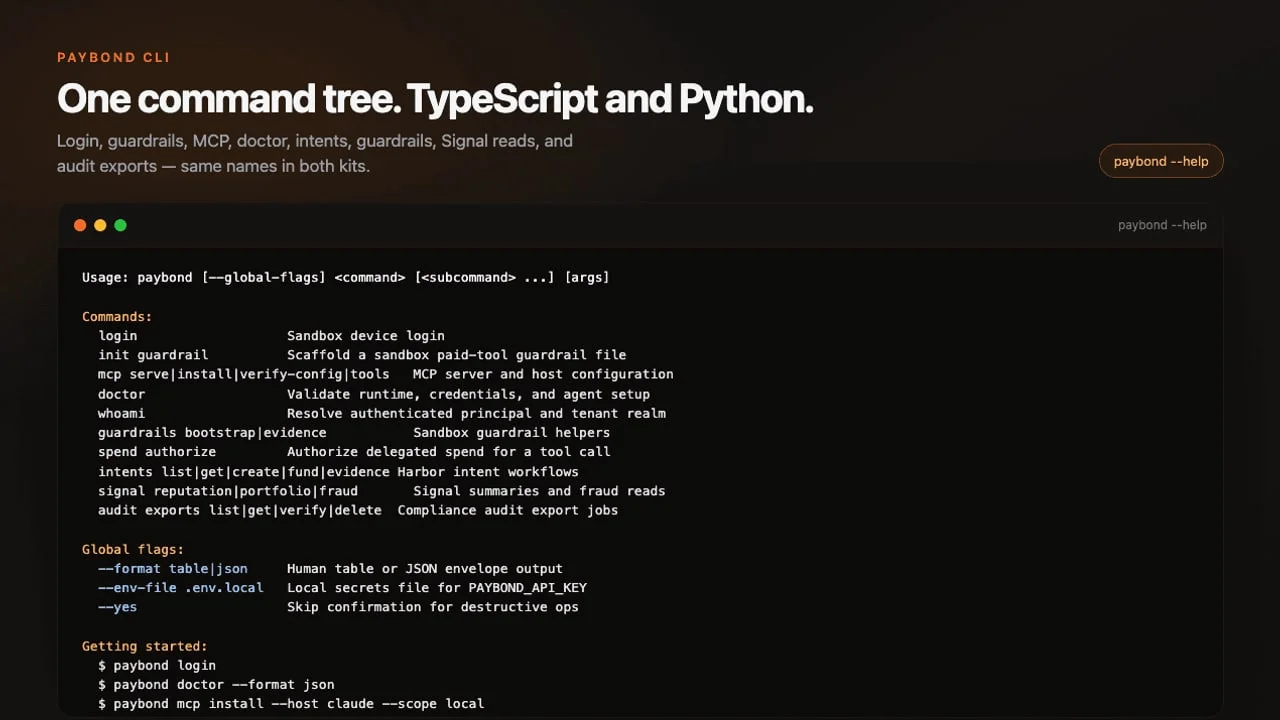
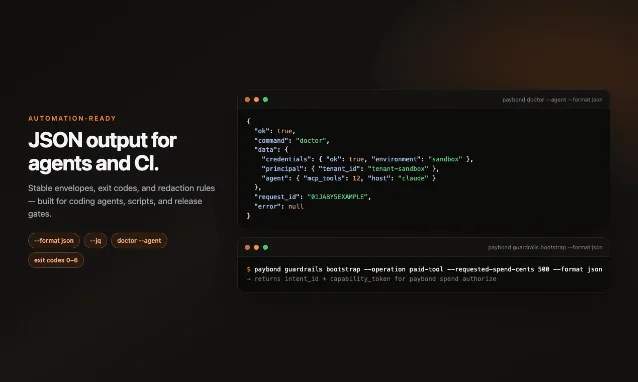
The public product map splits that into four surfaces: Harbor for settlement records, Signal for receipts and standing, Ledger for append-only provenance, and Kit for wrapping paid tool calls across agent runtimes.2 The new CLI is the developer-facing handle on that machinery. Paybond describes it as one command line for sandbox login, guardrail scaffolding, MCP setup, diagnostics, JSON output, and automation, with TypeScript and Python sharing the same command tree.3
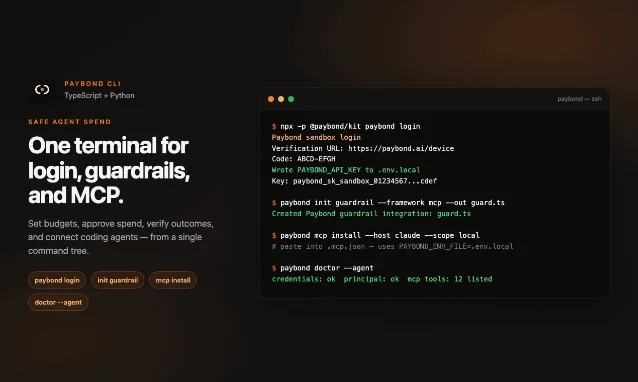
The honest part is that the CLI does not pretend to replace your runtime. The docs say a standard TypeScript flow opens an authenticated tenant session, creates a principal-signed intent, reads a funded intent's capability token, verifies the capability before tool work, and submits signed evidence after the work completes.4 That is not a fairy godmother. That is a purchase order with a cryptographic clipboard.
The permission model is the product
Here is where the roast writes itself. The moment Paybond gets specific, the product stops sounding like autonomous commerce and starts sounding like a very fussy enterprise hallway.
The TypeScript quickstart requires Node.js 22+, a Paybond sandbox or live service-account API key, and Ed25519 seeds for the principal and payee in the principal-signed intent flow.4 It also says every call is tenant-scoped, with the tenant derived from the Gateway exchange rather than passed around by hand.4 For live systems, tenant admins create production keys in Console, and local sandbox login writes
PAYBOND_API_KEY into .env.local with file mode 0600 while refusing to print the raw key after writing it.4That is good security posture. It is also the part of the product no launch tagline can make sexy. The thing that keeps your agent from spending badly is not "AI"。 It is tenant binding, service accounts, allow-listed operation names, short-lived recognition proofs, capability tokens, and somebody's backend keeping private keys away from prompts.4
Paybond even warns that
allowedTools is your application's own namespace, not a Paybond-defined catalog, so your later operation check has to match one of the operation strings attached to the intent.4 That is the architectural reality: Paybond can enforce the fence, but you still have to name every gate.Free, but not the kind of free Product Hunt makes you imagine
Product Hunt labels the Paybond CLI launch as Free.1 The docs are more precise: the first paid-tool guardrail integration is a Free Developer path, and Paybond calls that path sandbox-only.4 The support matrix says teams can try Kit with a tenant-bound sandbox by creating a self-serve Free Developer workspace, while the main site routes platform buyers to a sales conversation.52
So yes, the CLI is free in the way a car seat is free if the dealer lets you sit in it. The public on-ramp is real, but the production story is enterprise-shaped: tenants, admins, service accounts, configured rails, and policy decisions that somebody will have to own.
That matters because the target customer is not a weekend agent tinkerer who wants one bot to buy one SaaS subscription. Paybond's own audience paths call out enterprise agent fleets, marketplaces and orchestrators, outcome-verified escrow, disputes and evidence, compliance exports, and developer integration.2 This is infrastructure for organizations that already know agents are about to touch money. It is not a button that makes financial autonomy safe by vibes.
The hard part is proving the work happened
The cleanest Paybond story is an agent buying something with a crisp success condition. Its example flow can create an intent with a budget, verify a tool operation like
travel.booker.purchase, and submit evidence such as a booked flight confirmation and price.4 The support matrix says the Kit supports Python and TypeScript SDKs, runtime-neutral wrappers, LangGraph, MCP hosts, spend guard helpers, and settlement rails including Stripe Connect, Stripe ACH Direct Debit, and USDC on Base.5That is a solid slice of the stack. It also draws a bright line around what Paybond can and cannot solve. If the outcome can be reduced to evidence and a predicate, Paybond gives the agent a narrow tunnel. If the outcome is squishy, like 「run a good campaign」 or 「hire a decent contractor」, the tunnel turns into a conference room. Someone still has to decide whether the work was good enough, whether the evidence is meaningful, and whether a refund is fair.
This is the funny inversion. The product exists because agents are supposed to act without constant human babysitting. The safest version of the product then rebuilds babysitting as infrastructure: approvals before spend, deterministic checks where possible, dispute paths when not, and audit records for the people who will be blamed later.2
Verdict
Paybond is not dumb. It is one of the more honest products in the agent boom because it treats spending as a permissions problem before it treats it as an autonomy problem. The real product is not "AI buys things"。 The real product is: a tenant-scoped spend intent, an allow-list, a capability token, signed evidence, and a record that finance can inspect later.4
The catch is that Paybond only becomes useful after a team has already accepted the boring work: define operations, own keys, configure rails, write predicates, wire MCP or SDK wrappers, and keep humans in the review path when the evidence is not binary.35 For mature agent teams, that is probably the right shape. For everyone else, Paybond is a toll booth delivered before the road is paved. The robot gets an allowance. The adult still keeps the spreadsheet.
围绕这条内容继续补充观点或上下文。