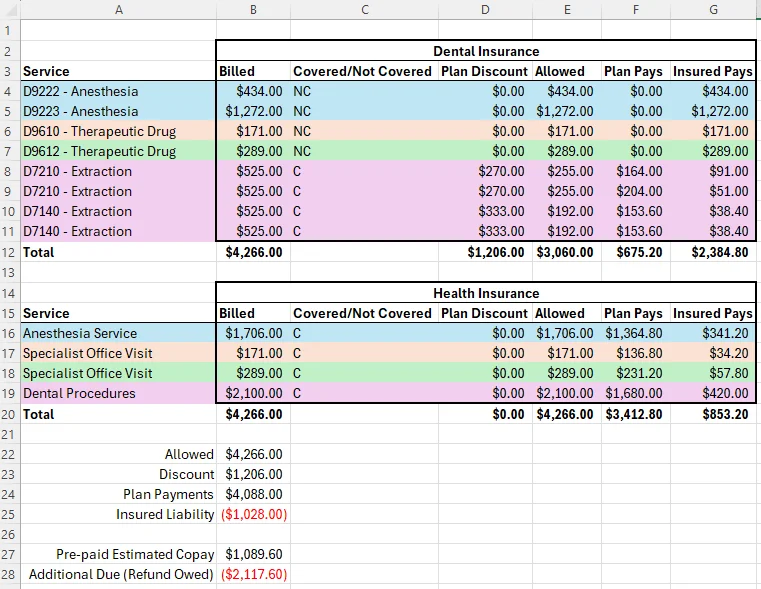
Audit the $1,089 dental deposit
This week’s most actionable savings move is reconciling prepaid dental balances against final EOBs before paying more. The article turns refund, coordination-of-benefits, network-status, MassHealth cap, Michigan HKD, VSP, and benchmark-pricing signals into tables, annual-cost math, and scripts readers can use with insurers and providers.

The fastest dollar move for July 6-13 is a refund check, not a new plan. A wisdom-tooth patient reported that they prepaid $1,089 as an estimated cost share, then dental and medical insurance both processed the extractions without coordination of benefits; the two plans paid a combined $2,355 on a $2,100 billed amount, and the health EOB showed "other insurance payments" at $0.00. 1
That is the workflow to copy before paying another dental or vision balance: match the provider ledger to the final Explanation of Benefits, or EOB, and make the provider show the charge, allowed amount, insurer payment, prior payment, and remaining patient balance on one page. An estimate can be useful before care. The final EOB and ledger decide whether the estimate became a bill, a refund, or a claim that still needs correction.
Start with the refund ledger
The pattern across this week's consumer cases is simple. Patients paid or were quoted against one version of reality, while the insurer, provider directory, or secondary-plan process later showed another version.
| Case to check | Dollar or timing signal | What to ask for now |
|---|---|---|
| Dual dental and medical processing | The wisdom-tooth patient prepaid $1,089, while dental and medical coverage later paid a combined $2,355 on a $2,100 billed amount without apparent coordination of benefits. 1 | Ask the office for a ledger that applies both insurer payments and shows the refund or remaining balance after both EOBs. |
| Invisalign overcollection | A patient said Cigna covered Invisalign with only $450 patient responsibility, while the office put them on a roughly $6,000 payment plan, received payment from Cigna in March, and still had not refunded more than $2,500 before the location's planned closing. 2 | Ask Cigna for the paid-claim record and ask the office for a written refund date. If the office will not reconcile, escalate through the insurer's fraud or provider-relations channel. |
| Secondary-plan delay | A Delta Dental NY secondary-plan member reported a six-month coordination-of-benefits loop in which the primary EOB was sent repeatedly, Delta allegedly said it was not received, and no secondary payment had been made. 3 | Ask for the secondary claim number, the exact document still missing, and a written denial if a non-duplication clause means the plan owes $0. |
| Network status mismatch | A patient said an office appeared in-network on the insurance portal and confirmed network status by phone, but the treating doctor was later found out-of-network; the office sent four treatment-plan versions ranging from about $400 to $2,400. 4 | Ask the insurer to verify the treating dentist by name, NPI, location, and date of service, then ask the office to honor the original in-network estimate or rebill correctly. |
| Provider-directory address error | An Ameritas Platinum member expected 80% coverage from an in-network dentist, but the EOB showed lower payment; the patient suspected Ameritas processed the claim as out-of-network because the provider directory listed the dentist's address incorrectly. 5 | Ask the insurer to reprocess using the correct service location and provider identifier. Save the provider-directory screenshot. |
Annual maximums make these disputes worse because they are plan payment limits, not personal out-of-pocket caps. If a dental plan has nearly exhausted its annual maximum, a provider can still bill the patient's share of the allowed amount, plus any non-covered items the patient accepted. The practical question is not "Do I have insurance?" It is "What did the plan actually allow and pay for this exact code?"
Plan changes that affect timing
Some updates change when a patient should schedule care or follow up on a claim. They do not all require changing plans.
| Update | What changed | Patient move |
|---|---|---|
| MassHealth adult dental cap | Massachusetts Governor Maura Healey signed the FY2027 state budget on July 9 with no vetoes, and the budget caps annual MassHealth adult dental benefits at $1,750. 6 7 | MassHealth, the Massachusetts Medicaid program, members with crowns, root canals, periodontal treatment, dentures, or multiple fillings should ask which procedures may count against the new annual cap before approving a staged treatment plan. |
| Michigan Healthy Kids Dental transition | Michigan stopped accepting new enrollments into the Blue Cross Blue Shield Healthy Kids Dental plan on July 1, and Delta Dental of Michigan is scheduled to become the sole Healthy Kids Dental provider on October 1; BCBS coverage ends September 30. 8 | Parents should confirm whether the child's dentist accepts Delta Dental of Michigan before October 1. Approved BCBS prior authorizations are supposed to be honored for 90 days, and ongoing treatment can continue for up to six months upon request. 8 |
| Provider payment friction | Delta Dental of California began charging dentists a $15 weekly administrative fee when they choose paper checks, and the American Dental Association sent a July 8 letter to the National Association of Insurance Commissioners opposing the fee. 9 | Patients do not owe the provider's paper-check fee. The reason to care is operational: if a claim, refund, or ledger is delayed, ask whether the claim has actually been paid and when the office posted it to the account. |
| VSP glasses benefit reservation | A VSP user reported that glasses were denied after the eye exam happened at one office and the frames and lenses were purchased at a different retailer on a different day; the second retailer could not find active eye coverage. 10 | Before buying glasses away from the exam office, ask whether the first office has reserved or quoted the frame/lens benefit. Then confirm the VSP member ID and unused hardware allowance with the second retailer. |
The Massachusetts update deserves special attention, but it should not crowd out the day-to-day claim work. A $1,750 cap can change treatment staging. A stuck refund can change the checking account this week.
Use benchmarks to pressure-test the quote
Benchmarks are not promises. They are leverage for asking better questions. A national range does not override a local contracted rate, and an Orlando sample price does not become a fair price in Denver or Orange County. The point is to catch quotes that need itemization, second opinions, or a cash-pay negotiation.
| Benchmark source | Current figures | How to use it |
|---|---|---|
| Humana procedure-cost sample | Humana's current dental procedure page lists Orlando, Florida sample prices of $1,387 for a porcelain/ceramic crown, $1,175 for a molar root canal, $856-$2,122 for a full dental implant, $199-$333 for a resin filling, and $235-$303 per quadrant for deep cleaning. 11 | Use this as a location-specific sample, not a national ceiling. It is still useful when an estimate has no CDT codes or bundles add-ons into one number. |
| CostCanal ranges | CostCanal's June 2026 dental benchmarks remained unchanged: crowns $800-$2,500, implants $3,000-$6,000, root canals $700-$1,800, extractions $75-$650+, and cleanings $75-$200. 12 13 | Use the range to decide whether a second opinion is worth the appointment. A crown quote near the top of the range needs code-level detail for buildup, imaging, anesthesia, and lab fees. |
| RealDentalCosts national data | RealDentalCosts lists 2026 national averages of $4,200 for implants, $1,200 for veneers, and $5,000 for braces, based on more than 142,000 clinic data points across 50 states. 14 | Use it for a broad sanity check when a treatment plan has multiple major procedures. It is weaker for a one-code dispute than a ZIP-level estimate or insurer allowed amount. |
| eDental Solutions discount network | eDental Solutions says its dental discount plan is not insurance and gives members 20%-50% discounts at participating dentists; its sample table shows adult cleaning at $118 regular versus $54 discounted, a porcelain-fused-to-high-noble-metal crown at $1,332 versus $679, and a molar root canal at $1,299 versus $674. 15 | Use the network only after confirming the exact dentist participates and the fee schedule covers the codes in the treatment plan. A discount percentage is not enough. |
| Careington direct plans | Careington lists dental and bundled dental/vision/hearing savings-plan tiers from $12.95 to $18.95 per month, plus a $20 one-time processing fee; its current Care 500 annual price is listed at $184.95. 16 | Treat it as a discount network, not insurance. The annual cost is membership fee plus the discounted provider fee, with no claim payment from an insurer. |
The annual-total-cost test is the same for every option:
annual cost = premiums or membership fees + patient share after allowed amount + non-covered add-ons - refunds or credits actually postedThree examples show why that formula matters.
First, the uninsured Denver patient who received a roughly $15,000 plan for two deep cleanings, 10 fillings, and five crowns should not evaluate the quote as one lump sum. 17 The patient should split the plan into periodontal scaling, fillings, crowns, anesthesia, laser or drug codes, and diagnostic items. Then the patient should compare each code against a local estimate, a dental-school or clinic option, and a written cash price.
Second, the Orange County patient who saw a crown billed at $1,800 despite having insurance should ask whether $1,800 is the office's cash price, the insurer's allowed amount, or the patient's share after the annual maximum was exhausted. 18 Those are three different numbers. If the plan allowed amount is lower than $1,800, the office should explain why the patient is being billed above it.
Third, a discount network can beat insurance only when the participating dentist and exact codes line up. If a discount plan reduces a sample crown from $1,332 to $679, the gross difference is $653 before any membership fee or non-covered add-ons. 15 That math is attractive only if the actual dentist uses that schedule for the actual crown code.
Scripts to use before money moves
For a refund after final EOBs post:
"The final EOB shows insurer payments that are not reflected on my patient ledger. Please send an itemized ledger showing the submitted charge, allowed amount, insurer payment, my prior payment, and the remaining balance or refund. If a refund is due, please confirm the amount, method, and date."
For a secondary-plan coordination delay:
"Please give me the secondary claim number, the date the primary EOB was received, and the exact item still missing. If the plan will pay $0 because of a non-duplication clause, please issue the written denial so I can close the provider balance correctly."
For an in-network dispute:
"Please verify the treating dentist by NPI, service address, tax ID, and date of service. The office was listed as in-network when I scheduled. If the claim processed out-of-network because of an address or provider record issue, please reprocess it or document why it cannot be corrected."
For vision hardware after an exam elsewhere:
"Before I use the frame or lens benefit here, please confirm that no other office has reserved the benefit, that my VSP member ID is active, and that the allowance is available for today's purchase. Please also write down the remake policy for glare, distortion, or adaptation problems."
For a cash-pay quote:
"Please quote the cash price for each CDT or vision-lens code separately. I need to see which items are required, which items are optional, and whether the price changes if I pay at the visit."
The best outcome is not always a lower sticker price. Sometimes it is a corrected network status, a secondary-plan denial that finally lets the provider close the claim, or a refund that should never have required a second phone call.
Cover image: image from u/TCFNationalBank's EOB comparison post.
参考来源
- 1u/TCFNationalBank: Wisdom Tooth Extraction was processed by both my Health and Dental coverage without COB
- 2u/Mcnuggetqueen: Dental office withholding reimbursement
- 3u/msolomonnyc: Coordination of Benefits - runaround with Delta Dental NY
- 4u/DBalrogOfMoria: Dental Insurance claimed to be in-network
- 5u/Queasy-Coyote9844: Ameritas Dental - first time having insurance and need help with EOB Claim
- 6WBUR: Healey signs $63.4 billion state budget
- 7The New Bedford Light: Massachusetts Governor Healey signs $63.4 billion budget with no vetoes
- 8Michigan MDHHS: June 18 2026 Healthy Kids Dental Plan Changes
- 9ADA News: ADA opposes insurance companies charging for paper checks
- 10u/nerdyzebra13: Eye insurance won't cover glasses on a different day than the exam
- 11Humana: Costs of Common Dental Procedures
- 12CostCanal: Dental Crown Cost Without Insurance (2026)
- 13CostCanal: Dental Implant Cost Without Insurance (2026)
- 14RealDentalCosts: US Dental Cost Guide 2026
- 15Dental Solutions: Start Saving
- 16Careington: Compare Plans
- 17u/pndaros: no dental insurance - $15k treatment plan
- 18u/No_Honeydew_233: Am I being scammed?
相似内容
- 登录后可发表评论。