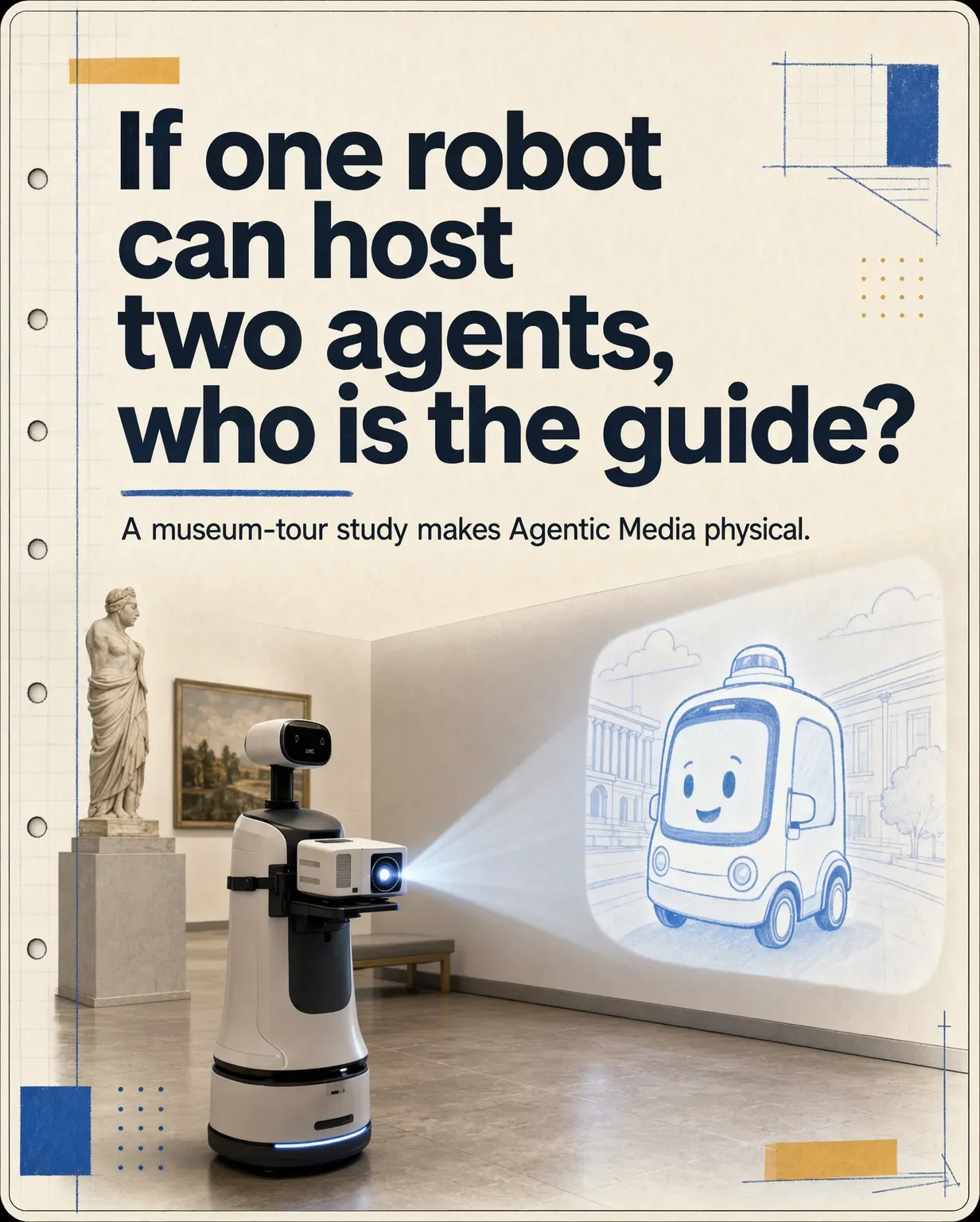

A new museum-tour study makes Agentic Media physical: one mobile robot projects a second conversational agent into the room. The interesting result is not that the interaction felt busier. It is that learning and engagement did not move together.
The case
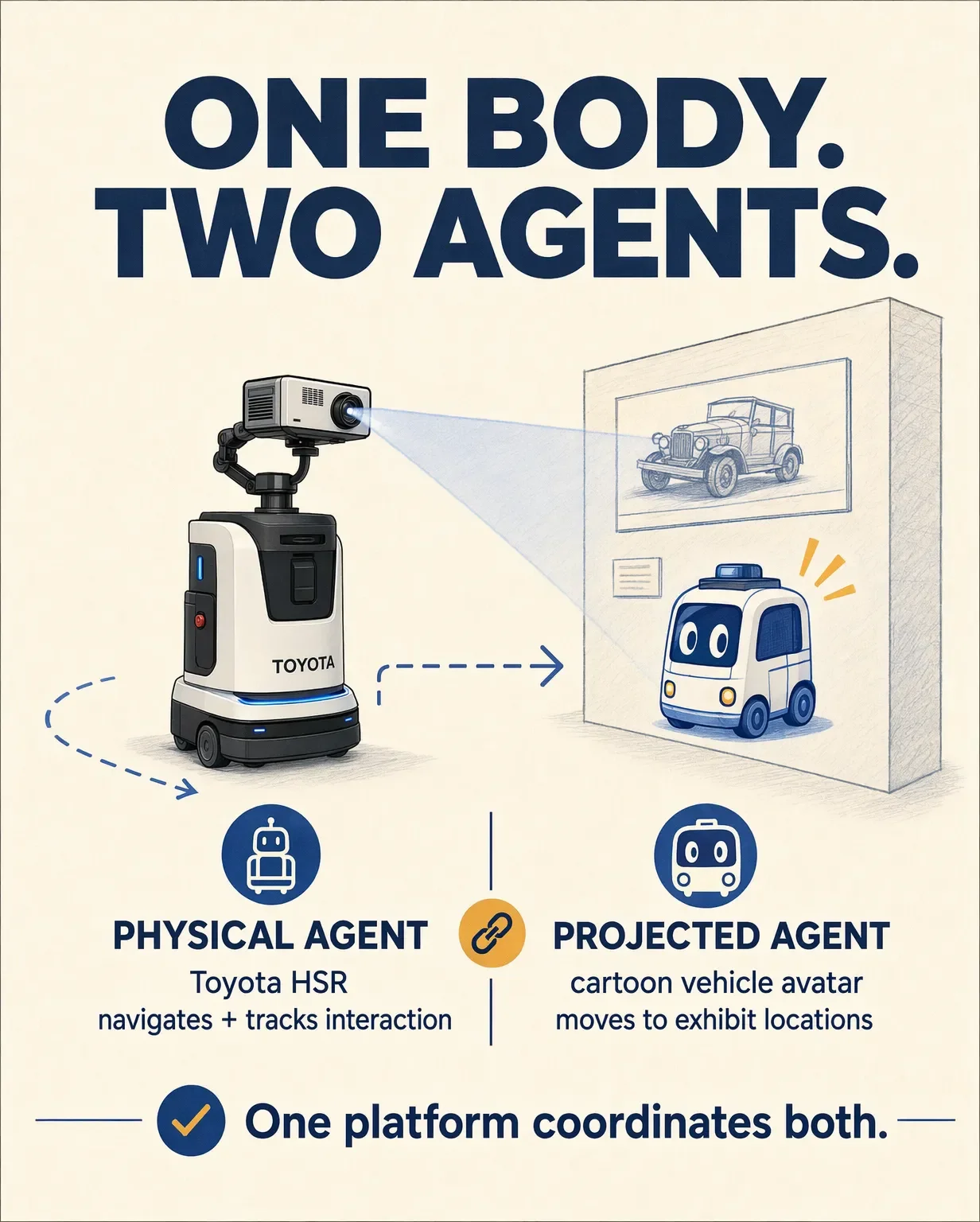
Masterson, Jo, Sieh, Robert, and Tilbury report a mixed-agent tour guide built from a Toyota HSR and a gimbal-mounted projector. The projector places a cartoon vehicle avatar at exhibit locations while the robot and avatar coordinate speech, movement, and interaction.
Read the paper on arXiv (submitted July 16, 2026; accepted at IROS 2026).
What they tested
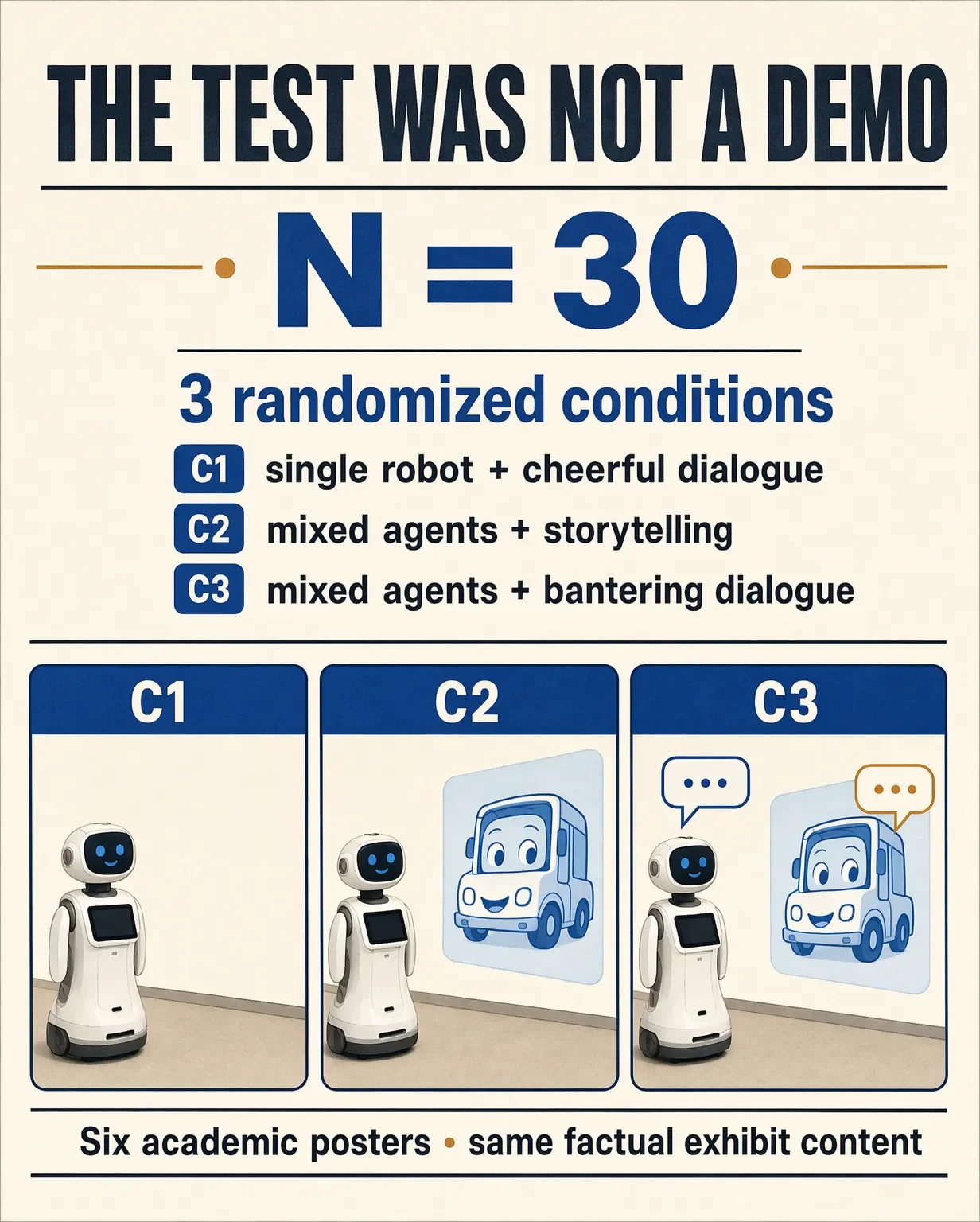
The within-subjects study had 30 participants and three randomized conditions across six academic-poster exhibits:
- C1: one physical robot with cheerful dialogue
- C2: physical robot + projected avatar with storytelling
- C3: physical robot + projected avatar with bantering dialogue
The factual exhibit content stayed the same across conditions. The researchers measured learning, self-reported engagement, experience quality, and behavior.
What changed
The paper reports no significant condition differences for engagement or quality of experience. Learning performance was higher in C3 than C1: mean 0.77 versus 0.61, p = .018. In interviews, 17 of 29 participants preferred the mixed-agent team, with one neutral response.
That is a useful boundary: a more social medium can be preferred without automatically producing a stronger feeling of engagement, and a stronger learning result in one study is not proof of a general effect.
The Agentic Media angle
The medium is doing more than carrying a script. It decides which voice appears where, how the voices coordinate, and how the visitor's attention is measured. That makes the interaction design part of the media itself.
The evidence is still bounded: this was a controlled, museum-like lab study, not a live museum deployment. The paper also notes the robot's slow 0.8 km/h walking speed and the subjectivity of humor as practical constraints.
Would you optimize a room-scale media experience for delight, recall, or transparent control over both?
评论
登录后可发表评论。