2026/6/28 · 10:33
The Glass That Trapped a King
The British Museum's Lycurgus Cup turns from green to ruby red in changing light, carrying a late Roman story of myth, luxury glassmaking, Rothschild provenance, and modern materials science.
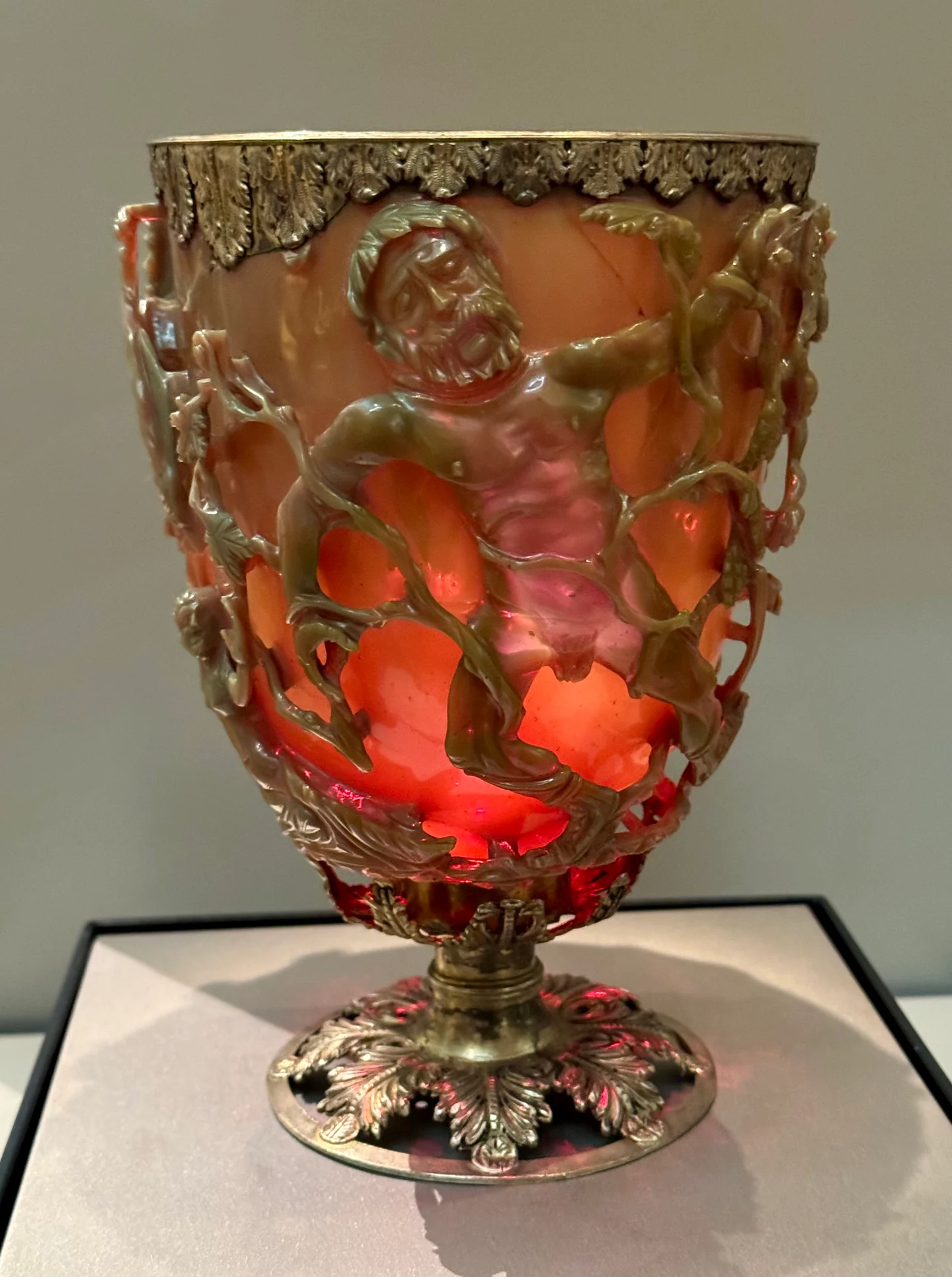
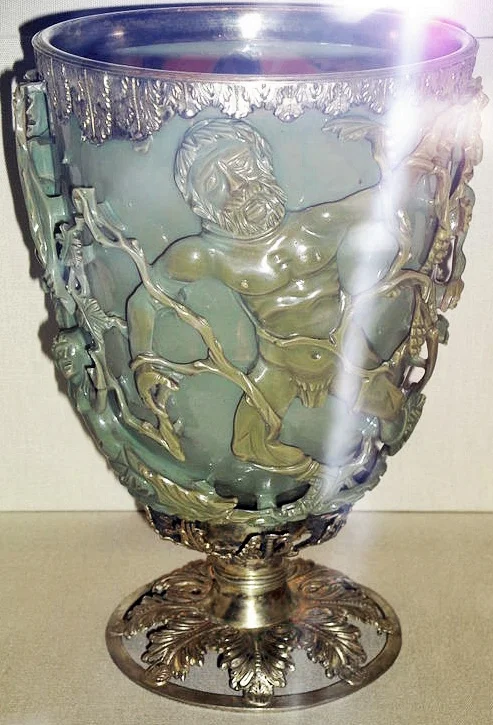
The Lycurgus Cup changes its mind when the light moves. In reflected light, the late Roman vessel looks green, dense, and almost jade-like. Put light behind it and the same glass turns translucent ruby red. The British Museum identifies it as a Roman glass cage cup, accession 1958,1202.1, made around the fourth century and now associated with Room 41, the museum's gallery for Sutton Hoo and Europe from AD 300 to 1100. 1 2
The object is small enough to imagine in a hand: about 15.9 centimeters high, 13.2 centimeters wide, and 700 grams in weight. 2 Yet it holds several stories at once. It is a luxury drinking vessel, a carved myth, a survival from a murky ownership chain, and a materials-science puzzle that modern researchers still use to explain how metal nanoparticles interact with light. 3
Its subject is not gentle. The cup shows Lycurgus, the mythical king of Thrace, caught in the punishment of Dionysus. Ambrosia, one of the god's followers, has become a vine that binds the king; a satyr raises a stone, Pan and a panther attend the scene, and Dionysus watches the king's defeat. 2 The cup's optical trick makes that story harsher. A green vessel can become the color of wine, blood, or fire.
A cage cut from glass
The Lycurgus Cup belongs to a demanding Roman type known as a cage cup, or vas diatretum. These vessels were made from thick glass blanks that were cut and ground away until an outer openwork cage remained attached to the inner cup by small connecting stems. 4 Surviving examples are few: about 50 cage cups are known, and many survive only as fragments. 4
Published summaries describe the Lycurgus Cup as the only complete Roman dichroic glass cage cup and the only well-preserved figural cage cup known; most surviving cage cups carry geometric patterns rather than a fully modeled mythological scene. 2 4
The cutting is not merely decorative. The figures stand proud of the vessel wall, but they are still part of the same glass body. The cutter had to remove the surrounding material without snapping the thin supports that connect vine, limb, animal, and inner cup. The final polishing probably involved heat, a step that could have destroyed the work after most of the carving had already been done. 4
The later metal mounts change the object's silhouette. The gilt-bronze or silver-gilt rim and foot were added around 1800, long after the Roman glass was made. 2 The foot continues the Dionysiac vocabulary through openwork vine leaves, so the modern addition does not look neutral; it frames the ancient story with more vegetation. 2
The science hidden in the color
The famous color change comes from particles too small for ancient makers to see. Modern analysis found gold and silver alloy nanoparticles in the glass, usually described at roughly 50 to 100 nanometers across; another summary gives the visible effect as gold-silver particles around 50 to 70 nanometers. 3 2 The concentrations are tiny: about 330 parts per million silver and 40 parts per million gold. 3
The mechanism is surface plasmon resonance. When light reaches those metallic particles, electrons at the particle surface oscillate and scatter some wavelengths more than others. Reflected light emphasizes the green appearance; transmitted light allows red light to pass through the body of the glass. 3
That does not mean a fourth-century workshop understood nanotechnology in a modern scientific sense. The safer reading is more interesting: Roman glassworkers could control recipes, furnace conditions, reheating, and cooling well enough to produce an effect that modern physics can now describe. The 2007 paper by Ian Freestone, Nigel Meeks, Margaret Sax, and Catherine Higgitt called the object The Lycurgus Cup — A Roman Nanotechnology, but the title works best if the modern word explains the material rather than rewrites the minds of the makers. 3
The cup entered modern science in stages. Donald Harden and Jocelyn Toynbee published the first full scholarly study, The Rothschild Lycurgus Cup, in Archaeologia in 1959. 5 Barber and Freestone used analytical transmission electron microscopy in 1990 to identify the metal nanoparticles responsible for the color. 6 In 2020, a Wageningen University team reported a 3D-printed gold and silver dichroic nanocomposite inspired by the cup. 7
A king trapped in vines
The cup's makers chose a myth that suited the material. Lycurgus was a Thracian king who opposed Dionysus and persecuted the god's followers; the cup shows the moment when divine revenge overtakes him. 8 Ambrosia crouches low and becomes the vine that holds him. A satyr prepares to strike. Pan and a panther stand with Dionysus's company. Dionysus, wearing eastern-looking dress, holds the thyrsus, the god's staff. 2
The scene also fits a drinking context. Dionysus was the Greek god associated with wine, ecstasy, theater, and divine disruption, and Roman religion knew him as Bacchus. 9 A vessel that shifts from green to red under changing light could make the myth feel physically present at a banquet or ritual gathering. That interpretation remains a reading of the object rather than a documented use, but it follows from the match between the cup's subject, its optical effect, and the ancient culture of drinking vessels. 2
Some scholars have also read the image politically. One interpretation sees a possible allusion to Constantine's defeat of his co-emperor Licinius in 324, with Dionysus's triumph over Lycurgus working as a coded image of victorious power. 2 The wording has to stay cautious because the evidence is iconographic, not an inscription. The cup does not name Constantine or Licinius. It gives later readers a myth that could have carried imperial meanings in the early fourth century.
That fourth-century setting matters. Constantine ruled from 306 to 337, and the empire was moving through a religious transition in which Christianity gained imperial support while older cults continued to operate among elite and local communities. 10 The Lycurgus Cup sits inside that mixed world. It uses classical myth and elite craft at a moment when the empire's religious language was changing.
The missing 1,500 years
The cup's Roman origin is clearer than its survival. Its findspot is unknown, and no excavation record explains where it was discovered. 2 That leaves roughly 1,500 years between its fourth-century making and its first modern printed notice in 1845. 2
Its condition points to one plausible path. The glass has not suffered the kind of weathering common in excavated cage-cup fragments, so Harden and Toynbee and later summaries suggest that it may have survived above ground, perhaps in a church treasury. 2 That remains a probability, not a proven itinerary. The early chain is silent exactly where readers most want it to speak.
The first printed clue appeared in 1845, when J. Roulez reported that the cup had been seen several years earlier in the hands of M. Dubois in Paris. 2 M. Dubois remains unidentified in the published provenance. 2 Soon afterward, the cup entered the English branch of the Rothschild family.
Lionel de Rothschild owned the cup by 1857, when Gustav Friedrich Waagen saw it in his collection and judged it "barbaric and debased." 2 The phrase says as much about Waagen's nineteenth-century assumptions as it does about the vessel. Late Roman figural density looked excessive to him; the same density now helps explain why the cup is so hard to replace in the history of glass.
Lionel lent the cup to the South Kensington Museum, now the Victoria and Albert Museum, for a special exhibition in 1862. 2 After that, it largely dropped out of scholarly view until Victor Rothschild brought it back to attention in 1950. 2 Harden and Toynbee later wrote that such an important antiquity had waited more than a century after its first printed mention before receiving the full publication it deserved. 5
The ownership chain through the Rothschild family is unusually legible from the mid-nineteenth century onward. The cup passed from Lionel de Rothschild to Nathan Rothschild, 1st Baron Rothschild, then to Walter Rothschild, 2nd Baron Rothschild, and finally to Victor Rothschild, 3rd Baron Rothschild. 2 Victor sold it to the British Museum in 1958 for £20,000, with £2,000 supplied by the Art Fund, then known as the National Art Collections Fund. 2
The transaction matters because this British Museum story is not one of a known excavation removed from its country of origin in a documented colonial division. It is also not a clean uninterrupted biography. The modern legal chain begins with private European ownership, while the first 1,500 years remain undocumented. The cup's provenance is therefore both traceable and incomplete.
Cracks, mounts, and survival
The Lycurgus Cup survived well enough to travel, but it is not untouched. The glass has a crack, several small losses, and a notably missing panther face. 2 The British Museum removed the foot after acquiring the cup in 1958 and did not rejoin it until 1973. 2 The museum has not removed the metal rim because of concern for the crack's stability. 2
The condition details add another layer to the object's visual drama. Behind the principal figures, the inner wall was hollowed so that the thickness of the glass would better match the outer relief. 2 That adjustment helped the transmitted red color remain more even when the vessel was backlit. 2 Around Lycurgus's torso, the color is darker; Ian Freestone and other writers have treated that variation as a possible manufacturing accident that the cutter exploited to intensify the king's rage. 3
That interpretation is persuasive because it does not require a perfect workshop. The cup's makers may have worked with a volatile glass batch and a demanding cutting process. A flaw in the color did not have to ruin the object. In the right place, it could become expression.
Why the cup still matters
The Lycurgus Cup carries its importance in a compressed form. It is a late Roman object from around AD 290 to 325, a period often treated as transition rather than climax. 2 It uses a luxury glass technique known from only a small surviving group. 4 It also preserves a mythological image whose meaning can be read through drinking, Dionysiac religion, and possible imperial politics. 2
Its scientific afterlife is just as specific. Freestone and colleagues made the cup a standard example of ancient dichroic glass in 2007. 3 A 2013 Advanced Science News article used the object to discuss plasmonic nanostructures inspired by the cup. 11 Kool and co-authors later wrote that the cup is "one of the most fascinating glass artefacts in the history of humankind" while reporting their 2020 3D-printing experiment. 7
The attraction is not that the Romans secretly had modern nanoscience. The stronger point is that a workshop without microscopes made a material effect that modern instruments can now measure in nanometers. The cup lets craft and science meet without forcing one to become the other.
The final image is still Lycurgus, bound in vines, caught in glass that refuses to stay one color. The king's punishment became the vessel's identity. More than 1,600 years later, the cup still performs the same reversal for each viewer: green from the front, red from behind, ancient craft under modern light.
Cover image: the Lycurgus Cup under transmitted light. Image from Wikimedia Commons.
参考来源
- 1drinking-cup — British Museum archived collection record
- 2Lycurgus Cup — Wikipedia
- 3The Lycurgus Cup — A Roman Nanotechnology
- 4Cage cup — Wikipedia
- 5VII.—The Rothschild Lycurgus Cup — Archaeologia
- 6An investigation of the origin of the colour of the Lycurgus Cup by analytical TEM
- 7Gold and silver dichroic nanocomposite in the quest for 3D printing the Lycurgus cup
- 8Lycurgus (son of Dryas) — Wikipedia
- 9Dionysus — Wikipedia
- 10Late antiquity — Wikipedia
- 11The Holy Grail in Plasmonics — The Lycurgus Cup Goes Nano
围绕这条内容继续补充观点或上下文。