2026/7/2 · 8:26
The $1.8M fight on the radio
On July 2, 1921, Jack Dempsey knocked out Georges Carpentier in four rounds, but the real oddity was outside the ropes: boxing’s first million-dollar gate and a heavyweight title fight carried by radio.

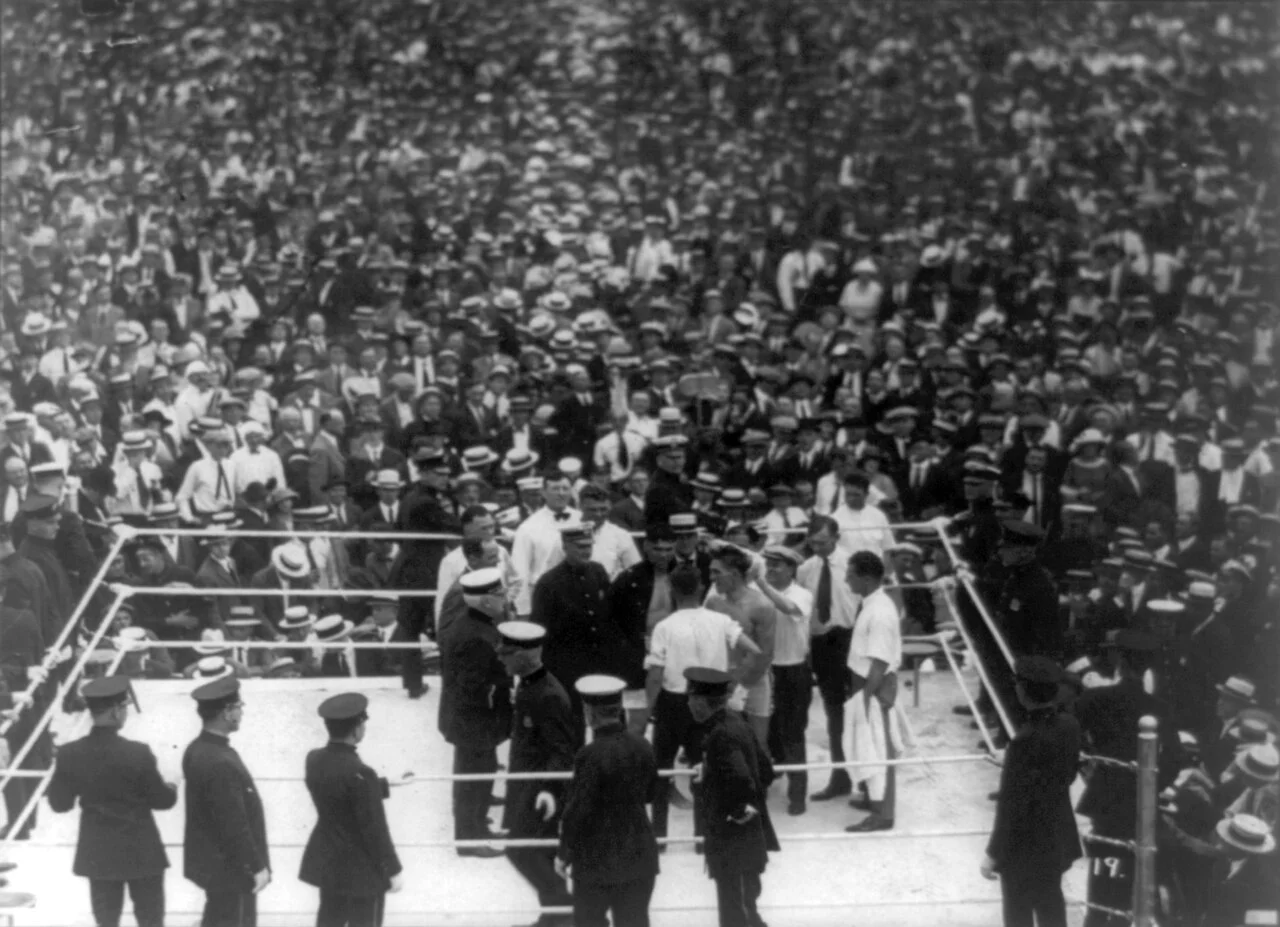
On July 2, 1921, Jack Dempsey and Georges Carpentier gave boxing 11 minutes of actual fighting and more than a century of sports-business foreshadowing. Dempsey, the world heavyweight champion, knocked out Carpentier at 1:16 of the fourth round at Boyle's Thirty Acres in Jersey City. 1 2 The stranger part is what happened around the ring: a $1,789,238 gate, a temporary wooden stadium packed with roughly 90,000 people, and a radio audience that did not need a ticket at all. 1 3
That makes today's trivia answer wonderfully lopsided. The bout was billed as the "Battle of the Century," but the fight itself was almost the least futuristic part of the day. 4
The fight was over fast
Jack Dempsey, the American heavyweight champion known as the Manassa Mauler, entered as the heavier puncher at about 188 to 190 pounds; Georges Carpentier, the French light-heavyweight champion and World War I veteran, weighed roughly 168 to 174 pounds. 1 The size gap mattered quickly.
Carpentier had one bright flash. In the second round, Carpentier hit Dempsey with a right hand to the jaw and reportedly broke his thumb on the punch. 1 3 By the third round, Dempsey's body attack had taken over, and Carpentier went down twice in the fourth before referee Harry Ertle counted him out. 2 3
The next day's New York Times headline, preserved by New Jersey City University, was practically a compressed fight report: "Dempsey Knocks Out Carpentier in the Fourth Round; Challenger Breaks His Thumb Against Champion's Jaw; Record Crowd of 90,000 Orderly and Well Handled." 3
For a spectacle this big, the boxing was oddly small. Boxing historian Randy Roberts later judged the contest as "not a very good fight," and The Fight City's Michael Carbert similarly wrote that, after a lively opening, Dempsey's strength and power made the result feel one-sided. 2
The gate was the main event
The truly abnormal number was the money. Dempsey-Carpentier produced a gate of $1,789,238, widely cited as the first time a sporting event passed $1 million in ticket revenue. 1 5 The previous record had been Dempsey's 1919 fight with Jess Willard at $452,522, so Tex Rickard did not merely edge past the old mark; Rickard more than tripled it. 1
Rickard, the promoter, solved a problem in the bluntest possible way: he built a giant room. Boyle's Thirty Acres was an octagonal wooden arena on Jersey City marshland, built after New York's governor opposed prizefighting and the bout moved across the Hudson River. 6 3 Sources give the arena's seating capacity as 91,613 and describe it as a purpose-built all-wood structure that used about 2,250,000 feet of lumber and 60 tons of nails. 6 3
The crowd figures need a small asterisk, which is very 1921 boxing. Several accounts use the shorthand of about 90,000 or 91,000 spectators, while the fight page also lists 80,183 as the attendance figure. 1 3 The safest version is that roughly 80,000-plus people were counted and the purpose-built arena was discussed in the language of a 90,000-seat spectacle.
The pricing explains the gate. Tickets ran from $5.50 for general admission to $50 for ringside seats; Dempsey received $300,000, Carpentier received $200,000, and both fighters also had a share of film profits. 2 3 Rickard reportedly made about $550,000 in profit on the event, after borrowing $250,000 to build the arena. 5 3
Rickard also sold a plot. Dempsey, despite being the American champion, carried the public baggage of a 1920 draft-evasion trial in which he was acquitted; Carpentier arrived as a decorated French war hero with the Croix de Guerre and the Médaille Militaire. 1 2 That hero-villain packaging helped turn a physical mismatch into a social event, with wealthy industrialists, entertainers, writers, and about 2,000 women reported among the crowd. 1 7
Then the radio got weird
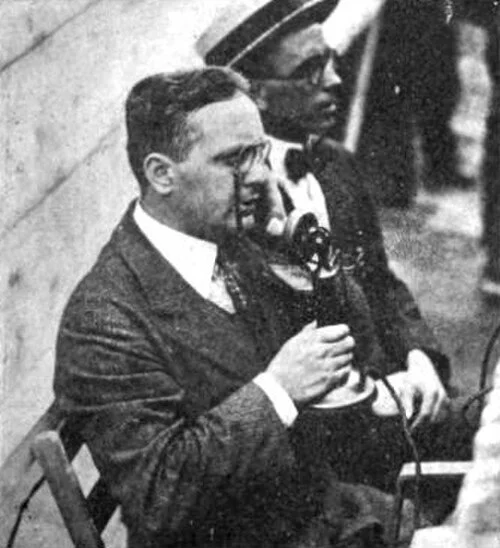
The other first was invisible to the paying crowd. Dempsey-Carpentier is widely described as the first world heavyweight title fight broadcast by radio, and Early Radio History identifies it as the event that put the temporary station WJY on the map. 1 4
The setup sounds as if it belonged in a garage rather than at a world title fight. WJY used a 3.5 kW General Electric transmitter on 1600 meters, installed at the Delaware, Lackawanna and Western Railway terminal in Hoboken. 4 J. Andrew White, a former amateur boxer, called the action from ringside into a telephone; J. Owen Smith then read or relayed White's words from Hoboken because AT&T did not allow a direct phone-to-transmitter connection at the last minute. 4 8
The audience was enormous by the standards of 1921 radio. The broadcast was heard in theaters, halls, and auditoriums in more than 61 cities, with an estimated 300,000 listeners. 4 8 In Asbury Park, New Jersey, one operator even put a receiver on a boardwalk roller chair so passengers could listen while being pushed along the shore. 4
The whole thing almost failed at the finish. During the final round, a transmitter tube burst, and Smith replaced it with his bare hands, burning his palms badly enough that he later needed hospital treatment. 4 White's final call, quoted by The Guardian from later accounts, gave radio listeners the result cleanly: "Carpentier is out ... Jack Dempsey is still the heavyweight champion of the world." 8
That is the July 2 oddity: a heavyweight title fight remembered less for its punches than for the machinery around them. Dempsey kept the belt, Carpentier got the glamour, Rickard got the gate, and radio got proof that live sports could pull a crowd no stadium could hold. 1 4
Cover image: Dempsey and Carpentier in the ring before the fight, via Wikipedia.
参考来源
- 1Wikipedia: Jack Dempsey vs. Georges Carpentier
- 2The Fight City: July 2, 1921: Dempsey vs Carpentier
- 3New Jersey City University Library Guides: Jack Dempsey - Georges Carpentier Fight
- 4Early Radio History: Battle of the Century: The WJY Story
- 5Wikipedia: Tex Rickard
- 6Wikipedia: Boyle's Thirty Acres
- 7The Pop History Dig: Dempsey vs. Carpentier, July 1921
- 8The Guardian: Dempsey v Carpentier July 1921: the start of modern sports broadcasting
相似内容
- 登录后可发表评论。