2026/6/26 · 7:14
"Paradise enow": Khayyam's argument for the present
A close read of FitzGerald's Rubáiyát of Omar Khayyám: how bread, wine, a rose, and a roadside inn shrink paradise into a present moment large enough to live in.
The passage
Citation. Omar Khayyam, Rubáiyát of Omar Khayyám, rendered into English verse by Edward FitzGerald, 1859 first-edition text, quatrains XI-XX. The text below follows the Project Gutenberg edition illustrated by Edmund Dulac. 1
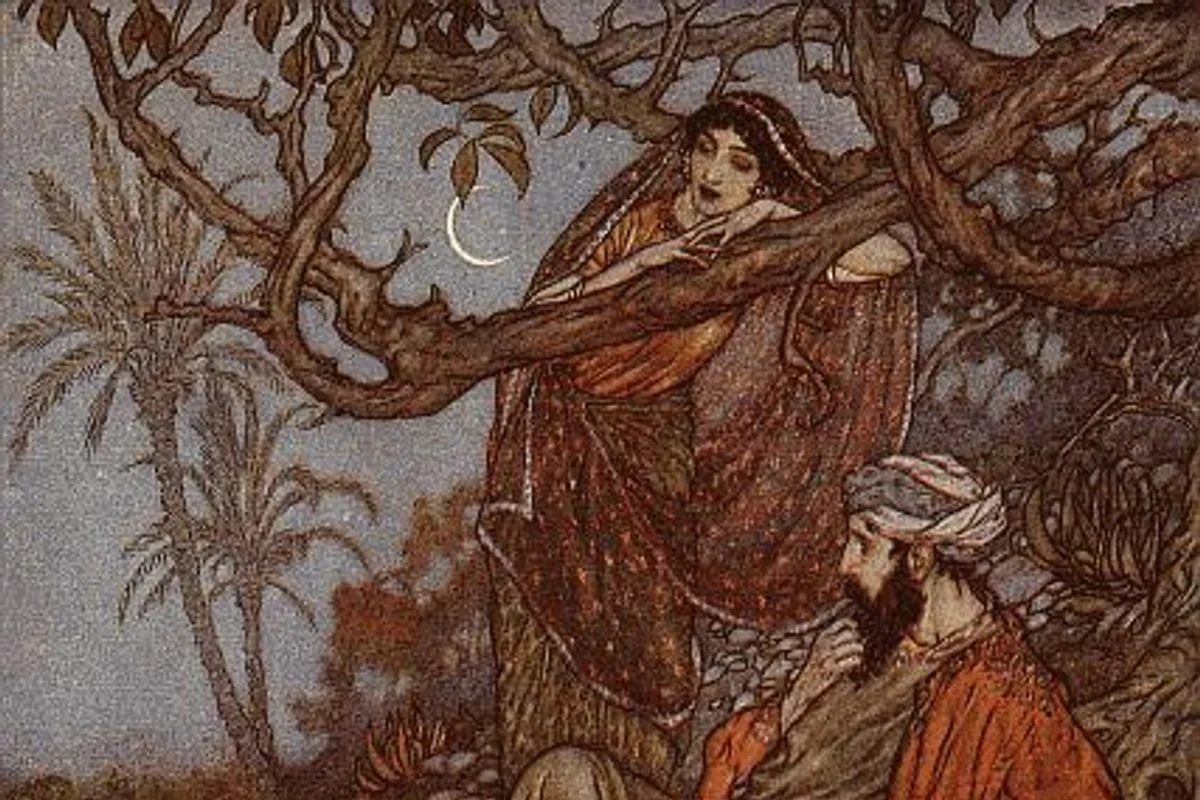
Here with a Loaf of Bread beneath the Bough, A Flask of Wine, a Book of Verse—and Thou Beside me singing in the Wilderness— And Wilderness is Paradise enow."How sweet is mortal Sovranty!"—think some: Others—"How blest the Paradise to come!" Ah, take the Cash in hand and waive the Rest; Oh, the brave Music of a distant Drum!Look to the Rose that blows about us—"Lo, Laughing," she says, "into the World I blow: At once the silken Tassel of my Purse Tear, and its Treasure on the Garden throw."The Worldly Hope men set their Hearts upon Turns Ashes—or it prospers; and anon, Like Snow upon the Desert's dusty Face Lighting a little Hour or two—is gone.And those who husbanded the Golden Grain, And those who flung it to the Winds like Rain, Alike to no such aureate Earth are turn'd As, buried once, Men want dug up again.Think, in this batter'd Caravanserai Whose Doorways are alternate Night and Day, How Sultán after Sultán with his Pomp Abode his Hour or two, and went his way.They say the Lion and the Lizard keep The Courts where Jamshíd gloried and drank deep; And Bahrám, that great Hunter—the Wild Ass Stamps o'er his Head, and he lies fast asleep.I sometimes think that never blows so red The Rose as where some buried Cæsar bled; That every Hyacinth the Garden wears Dropt in its Lap from some once lovely Head.And this delightful Herb whose tender Green Fledges the River's Lip on which we lean— Ah, lean upon it lightly! for who knows From what once lovely Lip it springs unseen!Ah, my Belovéd, fill the Cup that clears To-day of past Regrets and future Fears— To-morrow?—Why, To-morrow I may be Myself with Yesterday's Sev'n Thousand Years.
A short gloss
- "Paradise enow" means "paradise enough." The old spelling makes the claim feel casual: this small arrangement, not a distant heaven, will do.
- "Sovranty" is sovereignty or worldly rule. Khayyam sets political power beside the future paradise promised by religion, then refuses both abstractions.
- "Caravanserai" is a roadside inn for travelers and caravans. Calling the world a battered inn makes each life a temporary lodging rather than a possession.
Close read: how the poem teaches scale
The device here is scale-shifting antithesis. The passage keeps moving between things a hand can touch and things too large to hold: bread, wine, book, rose, grain, herb, cup; then sovereignty, paradise, sultans, Cæsar, time. The argument is not delivered as a doctrine. It is built by changing the size of the reader's attention.
The first quatrain begins with "Here," a word that pins the poem to a patch of ground. Its nouns are wonderfully plain: loaf, flask, book, bough. Even "Thou" is not abstract love but a body close enough to sing beside the speaker. The last line performs the conversion: wilderness does not lead to paradise; it becomes "Paradise enow."
Then the poem immediately tests that claim against rival systems of value. Some want "mortal Sovranty"; others want "the Paradise to come." Khayyam answers with a market metaphor: "take the Cash in hand." It sounds almost flippant, but the mechanics are exact. Present experience is cash because it can be spent now; deferred glory is credit, and credit depends on faith.
Notice how the rose changes the debate. It does not symbolize beauty from a safe distance; it speaks, laughs, tears open its own purse, and scatters treasure. The flower's extravagance makes hoarding look foolish. That prepares the darker turns that follow: hope becomes ash, snow vanishes on desert dust, buried bodies become earth, kings lodge briefly in the world's inn.
By the time the speaker says, "lean upon it lightly," the poem has taught the body a new courtesy. The grass may have risen from "some once lovely Lip." A patch of green is no longer background. It is intimate, possibly human, and therefore deserving of gentleness.
So the famous hedonism is stranger than simple pleasure-seeking. The passage does ask us to drink, read, sing, and love. But it also asks us to feel the ground as a crowded archive of former lives. The cup clears regret and fear only because the poem has made the present moment heavier, not lighter.
Why it still matters
Khayyam's passage is useful whenever a life starts to feel measured only by postponed rewards: the next credential, the next title, the imagined later version of ourselves who will finally have permission to rest. The poem does not say planning is worthless. It says that a future can become a drum heard from far away, exciting precisely because it has not yet asked anything of the body.
The corrective is not grand. It is almost embarrassingly small: bread, shade, a voice, a book, enough attention to notice the grass under your hand. That smallness is the point. The poem rescues the present by reducing paradise to a scale at which a person can actually live.
A question for today
What would count as "Paradise enow" in your own day: not the life you are saving up for, but the small arrangement already near enough to touch?
围绕这条内容继续补充观点或上下文。