July 15 in Business History: Before Scale, Test the System
Four July 15 launches, from Ford's first order to Amazon's first Prime Day, show how isolated moments become repeatable business systems.
The first sale is a systems test
July 15 has produced four business moments that look smaller at the start than they became: Ford's first paid order, Nintendo's first home console platform, Twitter's first narrow use case, and Amazon's first manufactured shopping holiday. None was just a launch.
The dates matter because each moment begins with a deliberately bounded commitment. Ford did not need to prove the entire automobile market on July 15; it needed to make one credible sale. Nintendo did not need every future game in the box; it needed an architecture that could carry them. Odeo did not need a finished social network; it needed a behavior people would repeat. Amazon did not need a permanent shopping holiday; it needed a promotion that could reveal whether membership economics were strong enough to support one.## Ford: a paid order before there was a machine
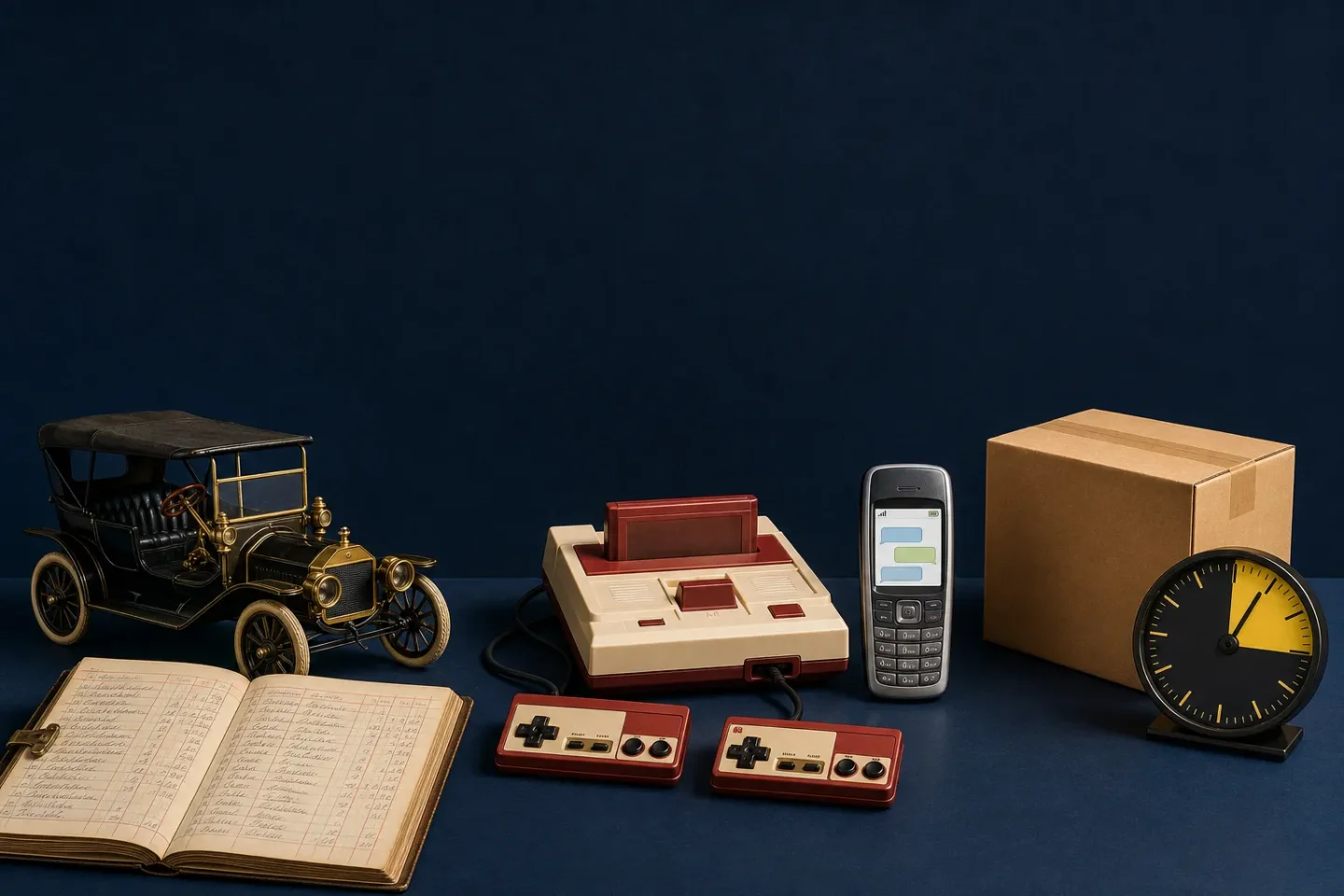
On July 15, 1903, the newly formed Ford Motor Company took its first order from Ernst Pfenning, a Chicago dentist: an $850, two-cylinder Model A with a rear tonneau seat. Ford had incorporated only weeks earlier. The first order was not proof that mass automobile demand had been solved. It was evidence that one buyer, one product configuration, one price, and one delivery promise could line up. 1
The early numbers show why that distinction matters. History reports that Ford sold 215 cars within two months and produced about 1,000 in its first year. The first customer mattered because the transaction gave the company a live test of more than engineering: the sales pitch, the price, the factory workflow, and the customer's willingness to accept a new category. 1
The decision mirror is straightforward. A first customer is not yet product-market fit. It is a stress test of the system required to serve the second, tenth, and hundredth customer. If today's launch plan has a promising buyer but no repeatable path from order to delivery, the business has a story, not a machine. The useful executive question is: which part of the first transaction still depends on exceptional effort from the founder, salesperson, or operations team?
Nintendo: the box was an invitation to an ecosystem
On July 15, 1983, Nintendo released the Family Computer, or Famicom, in Japan. The console put arcade-style games such as Donkey Kong on a home television and used interchangeable cartridges, allowing the product to expand after the hardware sale. Britannica records the date and the later outcome: the NES family sold more than 60 million consoles worldwide. 2
Nintendo's own later release described the original Famicom as a cartridge-based system whose software continued for more than 10 years, with enduring titles including Mario, Zelda, and Donkey Kong. That is a different kind of launch story from a device that wins on specifications and then waits for the next version. The architecture made future software part of the value proposition. 3
There was a tradeoff embedded in that choice. A platform creates options for customers and creators, but it also creates obligations for the platform owner: quality control, compatibility, distribution, and enough new reasons to stay. The hardware became the entry point; the software pipeline became the retention mechanism.
For today's decision-maker, the question is not simply whether a product is good at launch. Ask what the first version makes possible for the next participant. Does the architecture let customers add value, or does every new use case require the company to rebuild the core product? A platform bet is powerful because it compounds. It is expensive because the company must keep the compounding engine supplied.
Twitter: a side project found a job before it found a strategy
On July 15, 2006, the San Francisco podcasting company Odeo released Twttr to the public. The service began as a short-messaging product for groups: users could send an SMS to the number 40404 and share brief status updates. It was a narrow behavior, attached to a larger company's work, rather than a fully formed social-media category. Twttr later became Twitter and grew into a global social network. 4
The important decision was the willingness to expose a small, legible use case before the broader strategy was settled. The product did not need users to understand a new media theory. It gave them one action with a clear input and a visible social result. That made the behavior testable.
Side projects carry an organizational risk that product roadmaps often hide. Once a small experiment starts showing pull, the parent company must decide who owns it, what success means, and what gets deprioritized to support it. A side project can be a discovery mechanism, but it can also become an orphan that survives on enthusiasm without receiving the investment needed to become a business.
The mirror for a current product team: define the smallest repeated behavior that would justify taking the experiment seriously. Do not use early attention as a substitute for retention. Then set an explicit decision point for ownership and investment. The question is not whether the experiment looks interesting. It is whether users return to do the same valuable thing without being pushed.
Amazon: the promotion was designed as an acquisition channel
Amazon's first Prime Day took place on July 15, 2015, as a 24-hour event tied to the company's 20th birthday. Amazon positioned it as a Prime-member benefit with more deals than Black Friday. During the first event, members ordered 34.4 million items, or 398 items per second, and Amazon says the event exceeded Black Friday 2014 on item volume. 5
The date was a promotion, but the operating logic was broader. Harvard Business School's Sunil Gupta described the event as a way to create a new Black Friday, attract customers, convert occasional shoppers into Prime subscribers, collect useful shopping data, and fill a seasonal lull. In other words, the discount was the visible part of a membership-acquisition mechanism. 6
The outcome arc shows how a one-day experiment can become infrastructure. Amazon's account says Prime Day later expanded to 48 hours and 18 countries by 2019. The event stopped being only a birthday stunt and became a recurring reason to join, return, and plan around the Prime relationship. 5
The caution is just as important as the growth. A manufactured event can create volume while weakening unit economics, training customers to wait for discounts, or shifting demand rather than creating it. Before copying the format, separate the objectives: acquisition, retention, inventory clearing, data collection, or brand attention. One event rarely optimizes all five.
The managerial test for July 15
These four launches point to a practical sequence for decisions being made now:
- Transaction: Can the first customer be served again without heroic effort?
- Architecture: Does the product create room for other people, products, or use cases to add value?
- Behavior: What repeated action proves that an experiment deserves ownership and investment?
- Mechanism: If a promotion works, what durable habit or relationship is it building?
The common thread is not scale for its own sake. It is the conversion of an isolated moment into a system. Ford needed the next order. Nintendo needed the next cartridge. Twttr needed the next message. Prime Day needed the next Prime renewal. Before approving today's launch, ask what the next repeatable unit is, who owns it, and what evidence will tell you whether the system is actually working.
相似内容
- 登录后可发表评论。
More from this channel
- July 19 in Business History: When Scale Changes the Question
- July 18 in business history: The commitment is the product
- July 17 in Business History: The First Move Is Not the Whole Bet
- July 16 in Business History: Build the mechanism, then make the promise
- July 14: distribution rewrote the market
- July 13: scale rewrote the plan
- July 12: decisions became systems
- July 11 in Business History: Control Wins