
Your mail pile is not a filing system: 7 free fixes
A no-buy paperwork reset with seven fixes for incoming mail, action trays, shredding decisions, tax-record anxiety, and the papers that do not fit anywhere yet.

A paper pile is rarely just paper. It is unpaid bills, school forms, receipts you may return, tax documents you are afraid to toss, manuals you will never read, and one mystery envelope that keeps moving from counter to counter.
The fix is not a prettier tray. The fix is to stop treating every sheet as the same kind of problem. Use this reset when mail, forms, and documents have started spreading across the kitchen counter, entry table, or desk.
The 15-minute mail-pile reset
1. Sweep every loose paper into one working pile
Steps
- Walk through the house with a tote, laundry basket, or empty box.
- Collect mail, receipts, school papers, loose manuals, sticky notes, catalogs, and forms from every surface.
- Put the box on a table or clear patch of floor where you can spread papers out.
- Set a 15-minute timer. If the pile is huge, do one box layer today instead of trying to finish the whole backlog.
Apartment Therapy recommends gathering paper piles from around the home before sorting them piece by piece, and Good Housekeeping gives the same first move: gather every scrap of paperwork in one place before categorizing it.12
Why it works: scattered paper feels like seven separate messes. One contained pile turns it into one sorting job.
Watch out: do not read every document deeply during the sweep. If you stop to pay a bill, look up a policy, or reread a school packet, you have left the sorting job.
2. Sort by decision, not by room
Steps
- Make six labels on scrap paper: trash, recycle, shred, file, action, and other.
- Pick up one sheet at a time.
- Drop it under one label before touching the next sheet.
- Keep the action, file, and other piles small. Those are the piles that can quietly become the new mess.
Apartment Therapy's paper-clutter system uses these same six piles and specifically warns against letting file, action, and other become catchalls.1
Why it works: papers do not need the same next step. A bill needs action. A tax form needs a record home. A coupon needs a short leash. A blank envelope needs the recycling bin.
Watch out: avoid vague labels like important, later, or maybe. Those words postpone the decision you are trying to make.
3. Strip the packaging before you file anything
Steps
- Remove empty envelopes, outer mailers, duplicate inserts, expired flyers, and blank backing pages.
- Recycle product manuals that are easy to find online, unless the item is unusual, secondhand, or has safety instructions you truly need in paper form.
- Keep only the part that proves, explains, or requires something.
- If a receipt matters only until a return window closes, put it in a small temporary envelope instead of the permanent file.
Apartment Therapy recommends separating papers from mailers and recycling product manuals that can be found online; Good Housekeeping's home-office declutter guide also flags old manuals and papers you no longer need as first-round clutter.13
Why it works: most piles are padded with paper that has already done its job. Removing wrappers and duplicates makes the real decisions visible.
Watch out: do not toss instructions for safety-critical equipment, warranties you may need for an active claim, or documents tied to a current dispute.
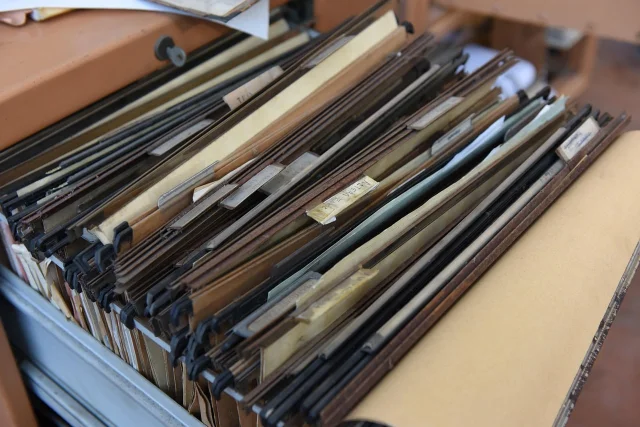
4. Give action papers a tray, then give the tray an appointment
Steps
- Put unpaid bills, forms to sign, cards to mail, returns to handle, and letters needing a reply in one action tray.
- Put the tray where you actually process admin tasks, not where mail first lands.
- Schedule one 15-minute paper appointment once or twice a week.
- During that appointment, empty the tray as far as you can: pay, sign, scan, reply, mail, or move the item to the right file.
Apartment Therapy suggests a weekly 15-minute slot for action items that cannot be handled immediately, while Good Housekeeping recommends a dedicated action tray for paperwork that still needs to be dealt with.12
Why it works: a tray without a recurring appointment is just a smaller pile. The appointment is what turns paper into movement.
Watch out: do not mix filing papers into the action tray. If nothing needs to happen, it belongs in file, recycle, shred, or other.
5. Stop keeping records because you are scared to decide
Steps
- Make one folder for current tax-year documents.
- Make one archive folder for older tax support.
- Write a simple note on the front: "Check retention before shredding."
- For U.S. federal tax records, use the IRS retention page before tossing old support documents.
The IRS says the length of time to keep a document depends on the action, expense, or event it records. For income tax returns, it lists a general three-year period in many ordinary cases, seven years for claims involving worthless securities or bad-debt deductions, six years when more than 25% of gross income was not reported, and indefinite retention for no return or a fraudulent return.4
Why it works: fear makes people keep everything. A written check-before-shredding rule slows down the risky tosses without turning every receipt into a forever document.
Watch out: tax rules are not the only rules. The IRS also notes that insurance companies or creditors may require records longer than the IRS does.4 When in doubt, keep the document and ask the relevant institution.
6. Give the "other" pile a narrow home
Steps
- Look at what landed in other: coupons, event details, project references, recipes, kids' artwork, gift cards, or sentimental notes.
- Choose one home for each type. For example: event papers in the calendar area, coupons in your bag, project references in one folder, sentimental pieces in a memory box.
- If a paper has no future place, move it to recycle or shred.
- Put a size limit on the home. When the folder or box fills, review it before adding more.
Apartment Therapy describes the other pile as papers that have crossed from communication into things and need a special home, such as a folder, box, envelope, or visible coupon spot.1
Why it works: the other pile is where paper systems usually break. Naming the category forces you to admit whether the paper has a real use.
Watch out: do not create ten micro-categories on day one. Good Housekeeping warns that overcomplicated paperwork systems become too much to remember.2
7. Change the landing rule for tomorrow's mail
Steps
- Open mail next to recycling, not on the couch or bed.
- Throw away or recycle the empty envelope immediately.
- Put sensitive discards in the shred pile.
- Put anything requiring work in the action tray.
- File only papers that are truly records.
- End with a clear surface, even if the action tray still has work in it.
Good Housekeeping frames paperwork as a continuing flow of mail that becomes stressful when it is not dealt with promptly, and Apartment Therapy's system is designed to make future incoming papers easier to identify and move before they pile up again.21
Why it works: the best paper system is not the one that clears one heroic backlog. It is the one that gives every new envelope only a few possible destinations.
Watch out: do not make the entry table the permanent action zone unless you actually pay bills and sign forms there. Mail should land briefly, then move to the place where the next step happens.
The rule to keep
If you remember only one thing, use this: paper is either trash, recycle, shred, file, action, or other. If a sheet cannot earn one of those labels, it is probably not a task. It is just paper taking up counter space.
相似内容
- 登录后可发表评论。
More from this channel
- Your nightstand is not a junk drawer: 7 free fixes
- Your camera roll is not a storage unit: 7 free fixes
- Your kitchen trash can is not self-deodorizing: 7 free fixes
- Your carry-on is not a closet: 7 free fixes
- Your fridge is not a junk drawer: 7 free fixes
- Your water bottle is not self-cleaning: 7 free fixes
- Your calendar is not a wish list: 7 free fixes for a calmer week
- Your browser tabs are not a to-do list: 7 free fixes