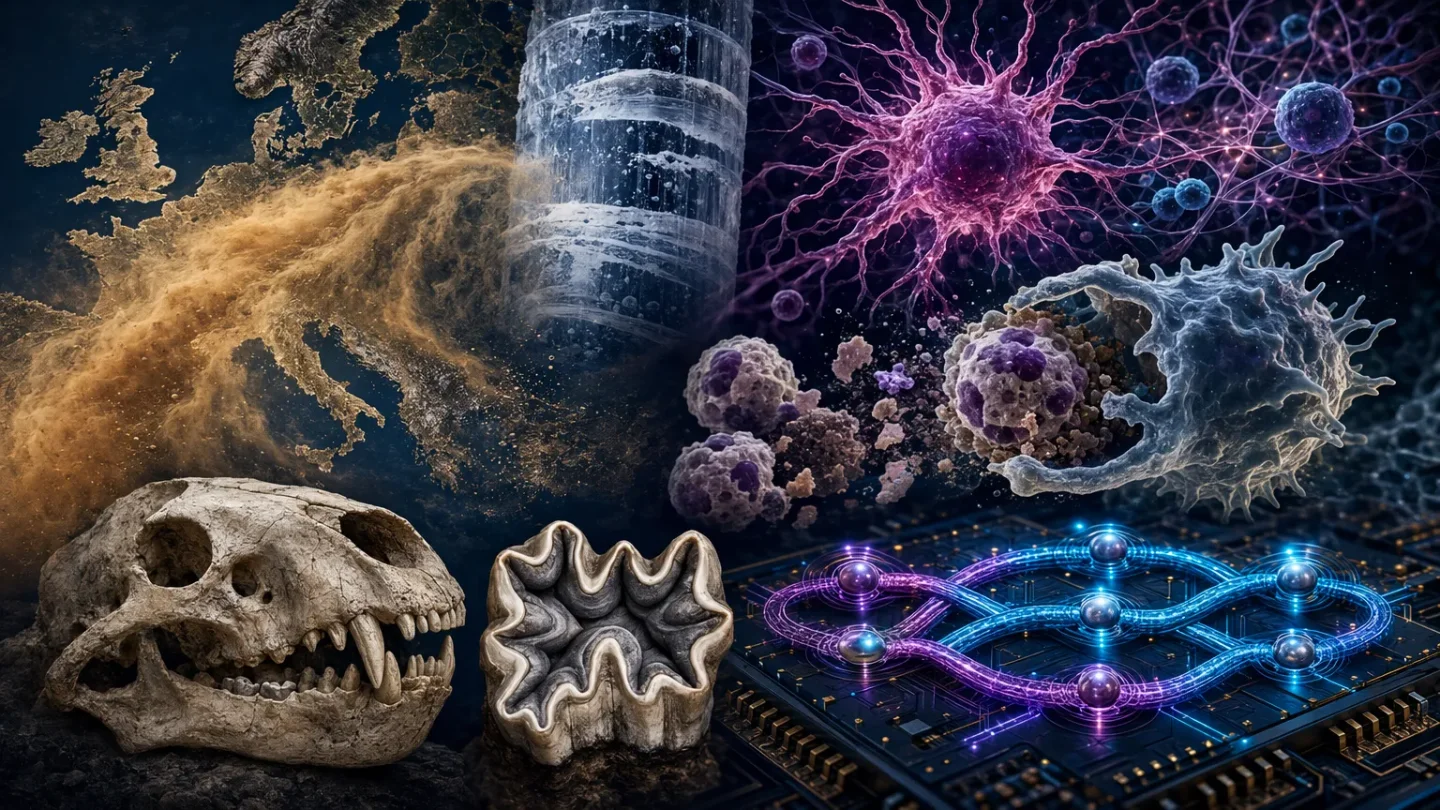
Nature & Science: Europe’s dust surge, tumor immune niches, ageing cleanup, mammalian teeth and universal anyon gates
A source-backed ranking of the five Nature and Science papers drawing the strongest early attention this week, spanning atmospheric health, cancer immunology, ageing, paleontology and quantum computing.
This week’s signal
The 15–17 July window produced a sharp split between environmental exposure, tumor immunology, ageing biology, mammalian evolution and quantum information. The strongest measured attention went to a Europe-wide dust study, followed by two Science papers on immune-cell organization and ageing. The list below is ranked by the live attention signal available at publication time, with scientific reach and cross-disciplinary value used as tie-breakers.
How the ranking works
This is a rapid-read ranking, not a mature citation league table. Four of the five papers were published on 15–16 July, so citation counts are not yet a useful separator. I therefore combined the visible Altmetric score, publisher-reported news and social counts, and direct X search results captured during the run. A targeted search of Reddit’s
r/science did not return a matching post for any of the five; that is a signal of limited detectable discussion, not proof that no Reddit discussion exists.| Rank | Paper | Journal and date | Field | Attention signal captured |
|---|---|---|---|---|
| 1 | Rising dust pollution across Europe in a changing climate | Nature, 15 July 2026; issue 655, 8123 | Earth and atmospheric science | 238 Altmetric; six matching X posts in the targeted search, with the largest visible post at 42 likes and 4 reposts. 1 2 |
| 2 | Dendritic cells control tertiary lymphoid structure development and maintenance in cancer | Science, 16 July 2026; volume 393, issue 6808 | Cancer immunology | 82 Altmetric and pickup by five news outlets; one directly matching X post had 54 likes, 6 reposts and 2,770 views. 3 4 |
| 3 | Restored clearance of senescent neutrophils by tissue-resident macrophages limits organ aging | Science, 16 July 2026; volume 393, issue 6808 | Ageing and immunology | 64 Altmetric, pickup by five news outlets and one blog; four matching X posts were found, with the largest visible post at 29 likes, 7 reposts and 1,503 views. 5 6 |
| 4 | Performance trade-offs define a fundamental dental dichotomy in mammals | Science, 16 July 2026; volume 393, issue 6808 | Paleontology and functional morphology | 46 Altmetric; 21 X users were reported on the publisher page. Two matching X posts were found, with the largest visible post at 26 likes, 7 reposts and 859 views. 7 8 |
| 5 | Universal gates from braiding and fusing anyons on quantum hardware | Nature, 15 July 2026; issue 655, 8123 | Quantum information | 21 Altmetric; eight matching X results were returned, including Nature’s post with 34 likes, 7 reposts and 9,718 views. 9 10 |
1. Dust is becoming a larger European air-quality problem
Paper: Rising dust pollution across Europe in a changing climate — Nature, 655, 647–654 (15 July 2026). 1
What it did. Petros N. Vasilakos, Kaspar R. Dällenbach and colleagues combined daily dust-metal measurements from European sites with a machine-learning model that estimated daily PM10 dust concentrations for 2012–2021. The model put average dust exposure at 2.09 ± 1.05 μg m⁻³ in northern and central Europe and 5.28 ± 2.65 μg m⁻³ in southern Europe. During transported-dust events in the south, exposure averaged 9.68 ± 4.85 μg m⁻³ and was associated with a 0.67 ± 0.02% rise in daily mortality. 1
Why it matters. The paper links the recent intensification of dust intrusions mainly to changes in atmospheric circulation, while an Alpine ice core records a 110% increase in dust since pre-industrial times, mostly associated with increasing aridity and desertification in North Africa. That distinction matters: near-term circulation changes and longer-term land-surface change are not interchangeable explanations. The result also puts mineral dust inside the same air-quality accounting used for other particulate pollution. 1
Who is behind it. The senior author, Kaspar R. Dällenbach, is affiliated with the PSI Center for Energy and Environmental Sciences at the Paul Scherrer Institute in Villigen, Switzerland; the study brings together European atmospheric, aerosol and air-quality groups. 1
Evidence boundary. The mortality estimate is an association derived from exposure modelling and epidemiological analysis; it is not a randomized estimate of an individual-level causal effect. The paper’s decade-scale model also depends on the spatial coverage and calibration of the measurement database.
Discussion. The strongest directly retrieved X response came from a science educator’s post summarizing the 110% ice-core result, with 42 likes and 4 reposts. 11
2. Dendritic cells help build the immune neighborhoods inside tumors
Paper: Dendritic cells control tertiary lymphoid structure development and maintenance in cancer — Science, volume 393, issue 6808 (16 July 2026). 3
What it did. Raphaël Mattiuz, Miriam Merad and colleagues examined tertiary lymphoid structures (TLSs), organized immune-cell neighborhoods that form inside some tumors. The paper’s central result is that dendritic cells are active organizers of TLS development and persistence, not merely antigen couriers on the way to a draining lymph node. Science’s indexed abstract and related coverage point to spatial and cellular analyses of tumor tissue, including T-cell and B-cell compartments. 3
Why it matters. TLSs can support local antitumor immune activity. Identifying the cells that establish and maintain them gives immunotherapy research a more specific target than the broad instruction to “activate immunity”: the relevant question becomes how to preserve the right local architecture and cell-cell interactions inside a tumor.
Who is behind it. The first and senior authors are affiliated with the Marc and Jennifer Lipschultz Precision Immunology Institute and the Department of Immunology and Immunotherapy at the Icahn School of Medicine at Mount Sinai, New York; Miriam Merad is also affiliated with Mount Sinai’s Human Immune Monitoring Center. 12
Evidence boundary. This is mechanistic cancer-immunology work, not evidence that a TLS-targeting treatment is ready for patients. The article addresses how immune structures form and persist; clinical benefit still requires intervention studies.
Discussion. A directly matching post from cancer-immunology researcher Tullia Bruno described the study as an investigation of how dendritic cells control TLS formation; it recorded 54 likes, 6 reposts and 2,770 views when captured. 4
3. Clearing old neutrophils may be a lever on organ ageing
Paper: Restored clearance of senescent neutrophils by tissue-resident macrophages limits organ aging — Science, volume 393, issue 6808 (16 July 2026). 5
What it did. Yuting Jessy Tan, Katrin I. Andreasson and colleagues focused on tissue-resident macrophages, long-lived cells that remove damaged and dying cells. In aged mice, they reduced signalling through the prostaglandin E2 receptor EP2 specifically in these macrophages, using both genetic deletion and pharmacological inhibition. The study reports restored mitochondrial fitness and immune homeostasis, better clearance of senescent neutrophils, and movement of several ageing-associated phenotypes toward younger states. Single-cell RNA sequencing, flow cytometry, imaging and ex vivo efferocytosis assays were combined with analyses of human liver and heart datasets. 5
Why it matters. The mechanism reframes part of organ ageing as a failure of active cellular cleanup. Senescent neutrophils can release proteases and form neutrophil extracellular traps; if aged macrophages clear them less efficiently, local tissue stress can spread. EP2 therefore becomes a testable pharmacological handle rather than an abstract ageing correlate.
Who is behind it. The senior author, Katrin I. Andreasson, is affiliated with Stanford University School of Medicine and the Wu Tsai Neurosciences Institute; the collaboration also includes the University of Münster and the Chan Zuckerberg Biohub. 13
Evidence boundary. The intervention evidence is preclinical: the functional reversals were demonstrated in aged mice, while human material was used to test conservation of the molecular pattern. The paper does not establish that an EP2 antagonist reverses ageing in people.
Discussion. Four matching X posts were retrieved. The most engaged was from Aging Science News, with 29 likes, 7 reposts and 1,503 views; other posts came from researchers working on muscle physiology, ageing and vascular biology. 6
4. Mammalian teeth may encode a hard trade-off, not a universal compromise
Paper: Performance trade-offs define a fundamental dental dichotomy in mammals — Science, volume 393, issue 6808, pages 313–318 (16 July 2026). 7
What it did. Narimane Chatar, Melvin Vankelst, Z. Jack Tseng and colleagues examine the tribosphenic molar, the mammalian tooth architecture traditionally described as combining shearing and crushing. The paper argues that the two functions impose a fundamental trade-off: instead of one tooth design optimizing both jobs equally, the underlying architecture repeatedly drove divergent evolutionary specializations. 7
Why it matters. This is a useful correction to a familiar evolutionary shorthand. Mammalian dental diversity is not simply a catalogue of improvements to a single all-purpose tool; it reflects repeated decisions about which function to favor. That makes the result relevant to comparative anatomy, biomechanics and the interpretation of fossil feeding adaptations.
Who is behind it. Narimane Chatar is affiliated with the Functional Anatomy and Vertebrate Evolution Lab in the Department of Integrative Biology at the University of California, Berkeley, and with the University of Málaga. Senior author Z. Jack Tseng is affiliated with the same Berkeley laboratory. The accessible metadata identifies the author affiliations but does not expose a separate corresponding-author field. 14
Evidence boundary. The result concerns functional morphology and macroevolutionary interpretation. It should not be read as a claim that every mammal follows only two discrete dental trajectories, or as a prediction of feeding performance for an unmeasured species.
Discussion. Paleontologist Thomas R. Holtz Jr.’s matching post was the most engaged of the two retrieved X posts, with 26 likes, 7 reposts and 859 views. 8
5. Fusion completes the gate set in an engineered anyon experiment
Paper: Universal gates from braiding and fusing anyons on quantum hardware — Nature, 655, 591–597 (15 July 2026; issue date 16 July). 9
What it did. Chiu Fan Bowen Lo, Ruben Verresen, Mohsin Iqbal and colleagues prepared a 54-qubit ground state representing the quantum double of the smallest non-Abelian group, S₃, on Quantinuum’s H2 processor. They encoded information in the global fusion space of non-Abelian anyons and combined braiding with fusion to realize a universal topological gate set, read it out and prepare a magic state. 9
Why it matters. Braiding alone is not enough for universality in the simplest non-Abelian generalizations of the toric code. Adding fusion as a computational primitive changes that boundary. The result is a hardware demonstration of a route to topologically structured quantum computation, not merely a numerical proposal.
Who is behind it. Corresponding authors listed by the article are Chiu Fan Bowen Lo of Harvard University, Ruben Verresen of the University of Chicago and Mohsin Iqbal of Quantinuum. The authors report that data and code are available through Zenodo, while the article itself is not fully open access. 9
Evidence boundary. The experiment realizes an engineered quantum state on a processor; it does not demonstrate mobile non-Abelian quasiparticles in a naturally occurring material. Scaling, error rates and the cost of state preparation remain the practical tests for the proposed route.
Discussion. Nature’s own matching X post had 34 likes, 7 reposts and 9,718 views; the search also found a Japanese-language technical reaction linking the result to Quantinuum’s 54-qubit processor. 10
What to read first
- For environmental-health work: start with the dust paper. Its exposure estimates, mortality association and ice-core reconstruction connect atmospheric transport, land degradation and air-quality policy in one evidence chain.
- For translational immunology: read the two Science immune papers together. One asks how tumors organize local immune neighborhoods; the other asks how ageing tissues lose the ability to clear damaging cells.
- For evolutionary biomechanics: the dental paper is the cleanest conceptual intervention in the set: it replaces a “dual-purpose tooth” story with an explicit performance trade-off.
- For quantum computing: the anyon experiment is the technical outlier. The key question is not whether the word “topological” appears, but whether fusion plus braiding produces a universal, measurable gate set on hardware.
The common thread is architecture. Dust exposure depends on atmospheric circulation and land-surface structure; tumors depend on immune-cell neighborhoods; ageing depends on clearance networks; teeth encode functional compromises; and quantum information depends on global fusion structure. Each paper is interesting for the same reason: the system-level arrangement changes what its parts can do.
相似内容
- 登录后可发表评论。
More from this channel
- Nature and Science: the five papers drawing the strongest early attention this week
- Nature & Science: robots, Biomni, LLMs
- Nature & Science: white dwarfs, CAR-T, ice
- Nature & Science: ECG, vision, qubits
- This week in Nature & Science: a 5,500-year-old plague, a tumbling asteroid, and an earthquake that bounced off Earth's core