
Ben Horowitz:别追随热情,追随你的贡献
本期来自 a16z Show 重新发布的 Ben Horowitz 哥伦比亚大学工程学院 2015 年毕业演讲。Apple Podcasts 页面显示,本集于 2026 年 7 月 6 日发布,时长 19 分钟,主题是 Ben 反对常见的「follow your passion」职业建议,转而主张从独立思考、个人优势与对世界的贡献出发。1
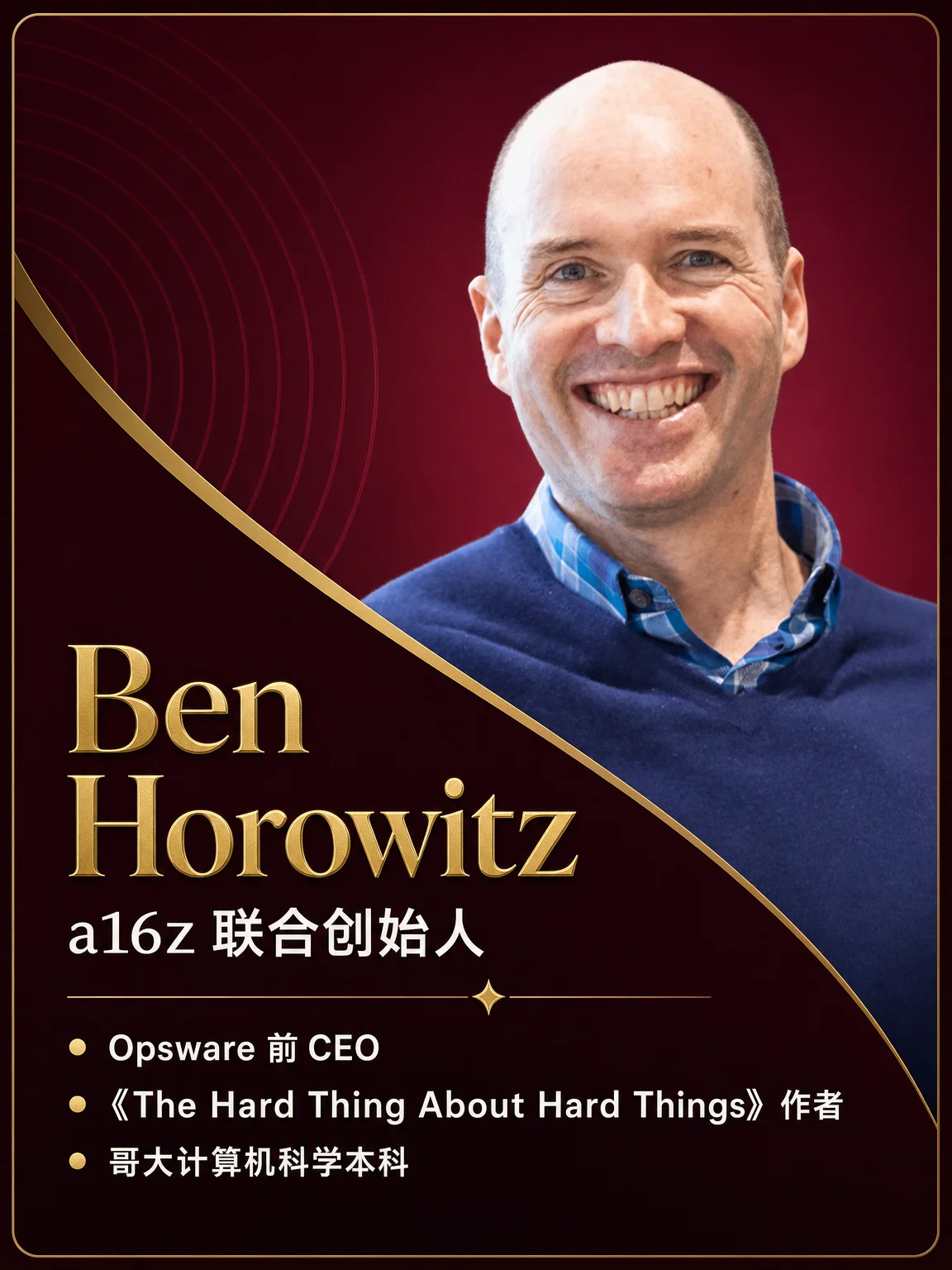
Ben Horowitz 是 Andreessen Horowitz 的联合创始人与普通合伙人,曾任 Opsware(前身 Loudcloud)联合创始人兼 CEO,Opsware 于 2007 年被 Hewlett-Packard 以 16 亿美元收购;他也是《The Hard Thing About Hard Things》和《What You Do Is Who You Are》的作者,并拥有 UCLA 计算机科学硕士与哥伦比亚大学计算机科学学士学位。2
图集导读
- 封面:本集的主张不是「找到热情」,而是「追随贡献」。
- 嘉宾卡:Ben Horowitz 的创业、投资与写作背景,解释为什么这段演讲对创业者和 builder 有参考价值。
- 独立思考卡:真正有价值的想法,往往是你相信而别人还不信的事。
- 职业选择卡:热情不一定是起点,能力与贡献更可操作。
- 技术机会卡:互联网把「图书馆」放进口袋,让更多人有机会贡献原创想法。
顺序要点整理
1. 节目方导语:反常识职业建议
节目开头把演讲的核心问题摆出来:毕业生最常听到的建议是「follow your passion」,但 Ben Horowitz 认为这句话把因果关系说反了。热情常常不是起点,而是精通、贡献和成就之后的结果。1
2. 从哥大课堂到计算机科学:不要只听身边人的判断
Ben 回忆自己在哥大读书时第一次听到 Alan Turing 和「图灵机」的概念。1984 年,计算机还不是大众熟悉的通用工具;他却被「一台理论上可以完成任何计算的机器」击中,于是决定主修计算机科学。朋友的反应是:这是他听过最蠢的选择,因为在哥大应该读「真正的」学科,而不是像职业培训一样学计算机。
Ben 从这件事里得到的第一课是:不要听朋友的。更一般地说,是要学会自己思考。不是因为朋友必然错,而是因为身边人的共识很容易把你推回「大家已经相信的事」。
3. 独立思考为什么困难
Ben 说,人天然希望被喜欢。最简单的被喜欢方式,就是告诉别人他们想听的话;而人最想听的,通常是自己已经相信的东西。原创想法最难提出,正因为它经常会冒犯或挑战既有信念。
他的判断是:只有那些「你相信、周围人不相信、且你最终是对的」事情,才真正创造新价值。其他东西大家已经知道,只是照常运转。
4. 创投视角:秘密比好主意更重要
Ben 把这个原则放到投资里。他说,如果有人拿着「让手机电池更耐用」这样的想法来融资,这当然是好主意,但不会让他兴奋,因为所有人都知道这是好主意,Google、Apple、Samsung 这样资源充足的公司也会去做。
相反,他提到 Brian Chesky 早年提出 Airbnb 的想法:把自己公寓里的充气床垫租给别人,像「air bed and breakfast」。Ben 起初觉得这很糟糕,因为谁会去陌生人家里租床垫?但 Chesky 的秘密是,他已经做过实验,并发现真的有人愿意租,而且这些人不是危险人物。进一步地,他研究了旅馆连锁出现之前的住宿历史,意识到互联网可以把过去「小旅馆和 B&B 的不确定性」变得透明,从而结合酒店连锁的可靠性与 B&B 的个性化。
这就是 Ben 所说的价值来源:不是所有人都认同的显而易见好主意,而是少数人基于实验、历史和洞察看到的秘密。
5. 「别追随热情」的四个理由
Ben 给毕业生的第一个反常识建议是:不要追随你的热情。
第一,热情很难排序。你到底更热爱数学还是工程?更热爱历史还是文学?更热爱电子游戏还是 K-pop?这些并不容易比较。相对而言,判断自己更擅长数学还是写作,要具体得多。
第二,21 岁热爱的东西,不一定是 40 岁仍然热爱的东西。热情会变。
第三,你未必擅长自己的热情。喜欢唱歌,不代表应该成为职业歌手。
第四,也是最重要的一点:只追随热情,是一种非常以自我为中心的世界观。人生里真正重要的,不是你从世界拿走多少,而是你把什么放进世界。
他的替代建议是:follow your contribution。找到你真正擅长的事,把它放进世界,帮助别人,让世界变好。
6. 世界不是正在变坏,机会才是前所未有
毕业演讲常见套路是说这一代人面对前所未有的挑战。Ben 承认世界确实有 ISIS、全球变暖、国会僵局等问题,但他认为,从历史尺度看,更显著的不是挑战,而是机会。
他列出了一组乐观数据:极端贫困人口处于历史低位;童工大幅下降;工作时长比 19 世纪末大约减半;收入中用于食物的比例自 1960 年以来下降约一半;1990 到 2012 年间预期寿命增加了 6 年;儿童死亡率自 1990 年以来下降一半;全球战场死亡人数相比 1940 年代下降约 20 倍;美国凶杀率相比 1970 年代末下降一半;核武器数量自 1990 年以来下降近 5 倍;2014 年碳排放首次在 40 年里持平。以上数据均来自演讲中的口述。1
7. 口袋里的图书馆:技术扩大了原创想法的入口
Ben 最后把机会落到技术上。他回忆自己读大学时没有互联网,想查一个想法,只能去图书馆;还要带证件、学习卡片目录和杜威十进分类法,查资料要花几个小时。
今天,只要有智能手机,一个人就拥有了口袋里的国会图书馆。Ben 的想象是:一个在孟加拉国长大的女孩,今天可以拥有比 20 年前哥大或哈佛学生更好的资料入口。她会产生什么想法?她会贡献什么?
他把答案交给毕业生:世界仍然不平,仍有能源、水、食物和平权问题;但如果这一代人能贡献所长、独立思考,就可能成为「释放人类潜能」的一代。
金句精译
"Thinking for yourself sounds both simple and trivial, but in reality, it's extremely difficult and it's profound."独立思考听起来既简单又平常,但现实中,它极其困难,也极其深刻。
"The easiest way to be liked is to tell people what they want to hear."想被喜欢,最简单的方法就是告诉别人他们想听的话。
"Those are the only things, things that you believe, that everybody around you doesn't believe, when you're right, that create real value in the world."只有那些你相信、身边所有人都不相信、而你最终是对的事,才会在世界上创造真正的价值。
"Everything else, people already know. There's no value created. It's just business as usual."其他事情,大家早就知道了;那里没有新价值,只是照常运转。
"Don't follow your passion."不要追随你的热情。
"Following your passion is a very me-centered view of the world."追随热情,是一种非常以自我为中心的世界观。
"Follow your contribution. Find the thing that you're great at, put that into the world, contribute to others, help the world be better."追随你的贡献。找到你真正擅长的事,把它放进世界,贡献给他人,帮助世界变得更好。
"Everybody who has a smartphone... has the Library of Congress in their pocket."每个拥有智能手机的人,口袋里都装着一座国会图书馆。
逐句全文翻译
说明:以下基于本集完整音频转写,按演讲语义顺序合并为可读句群。节目开头导语与片尾平台提示已在前文来源说明中交代;演讲主体不做摘要删减,按原始顺序保留。
开场与哥大回忆
EN: Thank you, thank you so much. That was a beautiful speech, very nice work. I'm going to take my hat off if that's okay with you guys because I don't want to get too excited and have it spill. Even though it is an awesome hat.
中译: 谢谢,非常感谢。刚才那段致辞很精彩,做得很好。如果各位不介意,我先把帽子摘下来,因为我不想一激动就让它掉下来,虽然这确实是一顶很棒的帽子。
EN: First of all, thank you, Class of 2015, for inviting me to speak. It's such a great honor. When I got the invitation, I started thinking back to when I was at Columbia.
中译: 首先,感谢 2015 届同学邀请我来演讲。这是非常大的荣幸。收到邀请时,我开始回想自己在哥伦比亚大学的日子。
EN: I remember getting to Columbia and being immediately super stressed out because I realized that I now had to figure out what I was going to do with my life. That was super scary. Some of you might be going through that now a little bit.
中译: 我记得刚到哥大时立刻变得非常焦虑,因为我意识到自己迟早必须想清楚这一生要做什么。这真的很吓人。你们当中有些人现在可能也正在经历一点这种感觉。
EN: I remember when I first got a clue of what I might do. I was taking a class in the Mudd building, and they were talking about Alan Turing.
中译: 我记得自己第一次隐约知道未来可能做什么,是在 Mudd 楼上一门课的时候。课上讲到了 Alan Turing。
EN: They explained that Turing had proved that if you built what he called a Turing machine, it was theoretically impossible to build a machine that was computationally more powerful.
中译: 老师解释说,Turing 证明了:如果你构建出他所谓的图灵机,那么从理论上说,就不可能再构建出计算能力更强的机器。
EN: It melted my mind, because it was 1984 and computers were not really a thing. The idea of a machine that could do anything felt unbelievably far-fetched.
中译: 这让我脑子都炸开了。那是 1984 年,计算机还不算真正普及。一个可以做任何事情的机器,在当时听起来极其不可思议。
EN: Our machines were all special-purpose machines. We had one for math called a calculator, one for word processing called a typewriter, and one for video called a television set.
中译: 当时我们的机器基本都是专用机器。做数学的是计算器,处理文字的是打字机,看视频的是电视机。
EN: Then here was the idea that a machine could do absolutely anything, and someone had figured that out forty years earlier. It felt like the secret to the universe.
中译: 而现在有人告诉你,一台机器可以完成几乎任何事情,而且早在 40 年前就有人想清楚了。这听起来就像宇宙的秘密。
EN: At that point I knew what I was going to do: I was going to major in computer science.
中译: 就在那一刻,我知道自己要做什么了:我要主修计算机科学。
EN: I ran over to tell my friends, thinking they would be excited for me. I said, guys, I'm going to major in computer science. One friend said, wow, that's the stupidest thing I've ever heard.
中译: 我跑去告诉朋友,以为他们会替我兴奋。我说,伙计们,我要主修计算机科学。一个朋友说,哇,这是我听过最蠢的事。
EN: He said, you're at Columbia University. That's like a trade. You can learn that at DeVry. You should major in something real.
中译: 他说,你可是在哥伦比亚大学。这东西像一门手艺,你去职业学校也能学。你应该读点真正的学科。
EN: I was thinking, I'm talking about a limitless machine, and you're talking about a washing machine. I was so frustrated I could not even explain why.
中译: 我心想,我说的是一台没有边界的机器,而你说得像是洗衣机。我非常沮丧,甚至说不清楚为什么。
EN: At that height of frustration, I learned the most valuable lesson I learned at Columbia: don't listen to your friends.
中译: 就在那种极度沮丧中,我学到了在哥大最有价值的一课:不要听朋友的。
独立思考
EN: The more generalized case of don't listen to your friends is: think for yourself. Thinking for yourself sounds both simple and trivial, but in reality, it's extremely difficult and profound.
中译: 「不要听朋友的」更一般化的表达就是:独立思考。独立思考听起来简单又平常,但事实上,它极其困难,也极其深刻。
EN: As human beings, we want to be liked. It's anthropological. If people didn't like you in caveman days, they would just eat you.
中译: 作为人类,我们都希望被喜欢。这是人类学层面的本能。在穴居时代,如果别人不喜欢你,他们可能就会把你吃掉。
EN: So we have a natural built-in instinct to want to be liked, and the easiest way to be liked is to tell people what they want to hear.
中译: 所以,我们天生就有想被喜欢的本能。而想被喜欢,最简单的方法就是告诉别人他们想听的话。
EN: What does everybody want to hear? What they already believe to be true.
中译: 每个人最想听什么?他们已经相信为真的东西。
EN: The last thing they want to hear is an original idea that contradicts their belief system. So it's very hard to even bring that kind of stuff up.
中译: 他们最不想听的,就是一个会挑战其信念系统的原创想法。所以,光是把这种想法说出口都很难。
EN: But those are the only things: things that you believe, that everybody around you doesn't believe, when you're right, that create real value in the world.
中译: 但也只有这些事情:你相信、身边所有人都不相信、而你最终是对的事情,才会在世界上创造真正的价值。
EN: Everything else, people already know. There's no value created. It's just business as usual.
中译: 其他事情,大家已经知道了。那里没有新价值,只是照常运转。
EN: So it's incredibly important to think for yourself. I see this in my business every day. My business is funding people who have companies.
中译: 所以,独立思考极其重要。我每天都在自己的工作里看到这一点。我的工作,就是投资那些创办公司的人。
EN: When you come to me with an idea, the biggest thing I will look for is whether you have thought for yourself. Is it something you know that nobody else knows, or something everybody knows?
中译: 当你带着一个想法来找我时,我最看重的是:你有没有独立思考?这是你知道而别人不知道的事,还是所有人都知道的事?
Airbnb 案例与「秘密」
EN: If you came to me and said you had an idea to make batteries in cell phones last longer, I would say that's a pretty good idea, but I would not fund it.
中译: 如果你来找我说,你有一个让手机电池续航更久的想法,我会说这是个不错的想法,但我不会投资。
EN: Everybody thinks that's a good idea. Because everybody thinks it is good, companies like Google, Apple, and Samsung, with tons of resources, will build it.
中译: 因为所有人都知道这是好主意。既然所有人都知道,Google、Apple、Samsung 这些资源雄厚的公司自然会去做。
EN: Contrast that with an idea that came to me about five years ago. A young man named Brian Chesky had an idea to rent an air mattress in his apartment to people, an air bed and breakfast.
中译: 与之相反,大约五年前有个想法来到我面前。一个叫 Brian Chesky 的年轻人想把自己公寓里的充气床垫租给别人,做成一种「air bed and breakfast」。
EN: I thought it was a horrible idea. Who would want to rent an air mattress out of somebody's apartment? Probably a serial killer.
中译: 我当时觉得这主意糟透了。谁会想在别人公寓里租一个充气床垫?大概只有连环杀手吧。
EN: But Brian had a secret. First, he had run the experiment. He had actually tried it, and a lot of people wanted to rent that air mattress, and they were not serial killers.
中译: 但 Brian 有一个秘密。首先,他做过实验。他真的试过,发现很多人愿意租那个充气床垫,而且他们不是连环杀手。
EN: Then he studied the history of hotel chains and found that hotel chains were a relatively new concept. Before hotel chains, people stayed at inns and bed and breakfasts.
中译: 然后他研究了连锁酒店的历史,发现连锁酒店其实是相对较新的概念。在连锁酒店出现之前,人们住的是小旅馆和 B&B。
EN: The problem with inns and bed and breakfasts was that they were like a box of chocolates. You had no idea what you were going to get.
中译: 小旅馆和 B&B 的问题在于,它们像一盒巧克力:你不知道自己会拿到什么。
EN: With the internet, he thought, we can make every one of those little chocolates in the box transparent. You can know what you're getting.
中译: 他想到,有了互联网,我们可以让盒子里的每一颗巧克力都变得透明。你可以提前知道自己会得到什么。
EN: Then you get all the greatness of the bed and breakfast and all the goodness of the hotel chain in one.
中译: 这样,你就能同时拥有 B&B 的好处和酒店连锁的可靠性。
EN: That secret was interesting because everybody in the world had probably known it at one point, but they had all forgotten. Everybody had forgotten why we had hotels.
中译: 这个秘密有意思之处在于,世界上可能每个人曾经都知道它,但大家后来都忘了。大家忘记了我们为什么会有酒店。
EN: It ended up with Airbnb renting more nights every night in New York than Hilton, and it was all based on him believing something nobody else believed.
中译: 最后,Airbnb 在纽约每晚出租的住宿数量超过了希尔顿酒店;这一切都建立在 Brian 相信一个别人不相信的判断之上。
不要追随热情
EN: In that spirit, I would like to give a few unconventional graduation thoughts. I title them: do not follow your passion; the world is not going to hell in a handbasket; and the Class of 2015 is not required to save it.
中译: 基于这个精神,我想给出几条反常识的毕业建议。我把它们命名为:不要追随你的热情;世界并没有迅速滑向毁灭;2015 届毕业生也并不被要求去拯救它。
EN: Don't follow your passion. You are probably thinking that's a really dumb idea, because successful people all say they love what they do.
中译: 不要追随你的热情。你可能会想,这真是个很蠢的想法,因为成功人士都会说他们热爱自己做的事。
EN: The broad conclusion is that if you do what you love, you will be successful. But we are engineers, and we know that might be true; it also might be that if you are successful, you love what you do.
中译: 通常的结论是:如果你做自己热爱的事,你就会成功。但我们是工程师,我们知道这可能是真的;也可能是因为你成功了,所以才爱上自己做的事。
EN: The first tricky thing about passions is that they are hard to prioritize. Which passion is it? Math or engineering? History or literature? Video games or K-pop?
中译: 热情的第一个麻烦在于,它很难排序。到底是哪一种热情?数学还是工程?历史还是文学?电子游戏还是 K-pop?
EN: On the other hand, what are you good at? Are you better at math or writing? That's a much easier thing to figure out.
中译: 另一方面,你擅长什么?你更擅长数学还是写作?这就容易判断得多。
EN: The second tricky thing is that what you are passionate about at 21 is not necessarily what you will be passionate about at 40.
中译: 第二个麻烦是,你 21 岁热爱的东西,不一定是你 40 岁还会热爱的东西。
EN: The third issue is that you are not necessarily good at your passion. Just because you love singing doesn't mean you should be a professional singer.
中译: 第三个问题是,你未必擅长自己的热情。喜欢唱歌,并不意味着你应该成为职业歌手。
EN: Finally and most importantly, following your passion is a very me-centered view of the world.
中译: 最后,也是最重要的一点:追随热情,是一种非常以自我为中心的世界观。
EN: What you take out of the world over time, whether money, cars, stuff, or accolades, is much less important than what you put into the world.
中译: 随着时间推移,你从世界拿走什么,无论是金钱、汽车、物品还是荣誉,都远不如你向世界放入什么重要。
EN: My recommendation would be: follow your contribution. Find the thing that you're great at, put that into the world, contribute to others, help the world be better. That is the thing to follow.
中译: 我的建议是:追随你的贡献。找到你真正擅长的事,把它放进世界,贡献给他人,帮助世界变得更好。那才是值得追随的东西。
世界并没有那么糟
EN: This is generally the point in a graduation speech where I should say the Class of 2015 faces unprecedented challenges: ISIS, global warming, congressional gridlock.
中译: 通常在毕业演讲的这个位置,我应该说 2015 届同学面临前所未有的挑战:ISIS、全球变暖、国会僵局。
EN: I think those things are true, but what is remarkable from a historical standpoint is not the unprecedented challenges. It is the unprecedented opportunities.
中译: 我认为这些问题都是真实存在的,但从历史角度看,真正惊人的并不是前所未有的挑战,而是前所未有的机会。
EN: The number of people living in extreme poverty today is the lowest in the history of the world and one fifth of what it was in 1900.
中译: 今天生活在极端贫困中的人数处于世界历史最低水平,只有 1900 年的五分之一。
EN: Child labor is in steep decline and fell one third between 2000 and 2012.
中译: 童工正在大幅减少,2000 年到 2012 年之间下降了三分之一。
EN: Compared to the late nineteenth century, the number of hours one has to work has fallen roughly in half.
中译: 与 19 世纪末相比,一个人需要工作的时长大约减少了一半。
EN: The percentage of income spent on food has fallen in half since 1960.
中译: 自 1960 年以来,人们收入中用于食物的比例下降了一半。
EN: Life expectancy increased six years between 1990 and 2012. Child mortality has fallen in half since 1990.
中译: 1990 年到 2012 年之间,预期寿命增加了 6 年。自 1990 年以来,儿童死亡率下降了一半。
EN: Worldwide battlefield deaths are down twenty-fold since the 1940s. The homicide rate in the United States is down half since the late 1970s.
中译: 自 1940 年代以来,全球战场死亡人数下降了约 20 倍。自 1970 年代末以来,美国凶杀率下降了一半。
EN: The global supply of nuclear weapons is down nearly five-fold since 1990, and 2014 was the first year in 40 years that carbon emissions were flat.
中译: 自 1990 年以来,全球核武器存量下降近 5 倍;2014 年是 40 年来碳排放首次持平的一年。
EN: So it's not that bad.
中译: 所以,情况并没有那么糟。
口袋里的图书馆
EN: The biggest opportunity is one we have only begun to measure. To explain this, I would like to go back to when your parents and I were in college.
中译: 最大的机会,是一个我们才刚开始衡量的机会。为了解释它,我想回到你们父母和我读大学的年代。
EN: When we were in college, we did not have the internet. If we had an idea and wanted to find out about it, we could not Google it.
中译: 我们读大学时没有互联网。如果我们有一个想法,想查清楚它,我们不能 Google。
EN: We did have a search engine. It was called a library. It kind of sucked.
中译: 我们确实有一种搜索引擎。它叫图书馆。说实话,它不太好用。
EN: You could not access it from your dorm room. It was not in cyberspace; it was in actual space. You had to walk there and bring your credentials.
中译: 你不能从宿舍访问它。它不在网络空间里,而在真实空间里。你必须走过去,还要带证件。
EN: It was based on old technology called the Dewey Decimal System, and the user interface was called a card catalog. It was so bad they had to train you to use it.
中译: 它基于一种叫杜威十进分类法的老技术,用户界面叫卡片目录。它难用到你必须接受培训才能使用。
EN: The result was that looking stuff up was discouraging. It took hours, even if you were a Columbia student with a good library like Butler.
中译: 结果就是,查资料这件事令人沮丧。即便你是哥大学生,拥有 Butler 这样好的图书馆,也要花几个小时。
EN: Imagine a student who did not go to Columbia, or someone growing up in Bangladesh or Sudan, with great ideas but no access and no way to contribute them to the world.
中译: 想象一个没有读哥大的人,或者一个在孟加拉国、苏丹长大的人,明明有很棒的想法,却没有资料入口,也没有办法把原创想法贡献给世界。
EN: Fast forward to now. Everybody who has a smartphone, which is pretty soon going to be everybody in the world, has the Library of Congress in their pocket.
中译: 快进到今天。每一个拥有智能手机的人,而很快世界上几乎每个人都会拥有智能手机,都把国会图书馆装进了口袋。
EN: A girl growing up in Bangladesh now has a better library than a student at Columbia or Harvard had twenty years ago.
中译: 今天,一个在孟加拉国长大的女孩,拥有的图书馆可能比 20 年前哥大或哈佛学生拥有的还要好。
EN: What might her idea be? What might she contribute?
中译: 她会产生什么想法?她会贡献什么?
EN: I think that is going to be a lot up to you, because the world still isn't flat. There are issues with power, water, food, and equal rights.
中译: 我认为,这在很大程度上取决于你们,因为世界仍然不是平的。能源、水、食物和平等权利仍然存在问题。
EN: But if you contribute, if you put your contribution into the world, if you think for yourself, then I believe you will be the greatest generation.
中译: 但如果你们贡献自己的所长,把贡献放进世界,并且独立思考,那么我相信你们会成为最伟大的一代。
EN: When we look back 50 years from now, 100 years from now, 500 years from now, you will be the generation that unlocked human potential.
中译: 当我们在 50 年后、100 年后、500 年后回望,你们会是释放人类潜能的那一代。
EN: Congratulations, Columbia Class of 2015, and thank you for inviting me.
中译: 恭喜哥伦比亚大学 2015 届毕业生,也感谢你们邀请我。
评论
登录后可发表评论。