AI Compliance Impact Map — Week of June 12–19, 2026
2026/6/12 · 17:23

AI Compliance Impact Map — Week of June 12–19, 2026

This opening issue of the June 12–19 week covers NSPM-12 (signed June 12), which empowers the NSA Director with emergency directive authority over all National Security Systems including classified AI workloads, setting four staggered compliance deadlines through October 2026 in coordination with NSPM-11. Additional coverage: Colorado SB 26-189's broader ADMT standard (effective Jan 1, 2027); Canada OPC's Grok/PIPEDA enforcement ruling; Australia's December 2026 ADM transparency mandate; EU-Brazil Digital Partnership signed June 12; China's National Human Rights Action Plan AI commitments; state governor windows (Illinois SB 315 at day 21, Missouri SB 1019 with ~14 days remaining); and Bartz v. Anthropic at 30 days without a ruling. Full 18-row compliance deadlines table through January 2027. 29 inline citations.

This week's immediate action items — opening June 12, 2026:
  1. EFFECTIVE June 15 — Florida Rule 2.515(d)(2): attorneys must certify legal citations exist and are accurate. Three days remaining.
  2. DEADLINE July 12 — NSPM-12: CNSS Directive 900 revision due 30 days from signing (June 12). First compliance deliverable under the new NSS cybersecurity governance framework.
  3. EFFECTIVE July 1 — 19 days — China Decree 837 (Outbound Investment Regulations): no implementation guidance published. Article 13 gap assessments should be underway now.
  4. EFFECTIVE July 15 — 33 days — China CAC No. 21 (AI Anthropomorphic Interaction Services): no implementation guidance published.
  5. GOVERNOR WINDOW ~July 28–30 — Illinois SB 315 (AISM Act): 60-day clock running. No Pritzker signature as of June 12.
  6. GOVERNOR WINDOW ~June 29 — Missouri SB 1019 (therapy chatbot ban): 45-day window expires. No Kehoe action as of June 12.

This is the opening issue of the week of June 12–19, 2026. The previous issue covered the full June 5–12 window. This 13-hour delta issue (June 12 09:00–22:00 UTC) captures one signed presidential memorandum — NSPM-12 — plus analysis of contextual items that carry direct compliance implications for multinational AI companies.

US federal: NSPM-12 extends cybersecurity mandates to classified AI workloads

NSPM-12 signed: NSA gains emergency directive authority over all National Security Systems

President Trump signed National Security Presidential Memorandum NSPM-12 on June 12, 2026, re-establishing the Committee on National Security Systems (CNSS) and empowering the NSA Director as National Manager for National Security Systems (NSS). 1 The memorandum rescinds NSD-42 (July 5, 1990) and NSM-8 (January 19, 2022), replacing 35-year-old NSS governance with a new CNSS structure whose binding directives reach every NSS owner and operator across the federal government.
The CNSS membership includes the Secretary of War (via DOW CIO), the Director of National Intelligence (via IC CIO), the OMB Director (via Federal CIO), and the NSA Director as National Manager. Section 5(a)(ii) authorizes the NSA Director to issue emergency directives directly to agency heads for threat mitigation — authority that applies to AI systems running on NSS. Section 5(e) assigns the National Manager personnel to the Office of the Federal CIO to oversee FCEB agency compliance. 1
The White House Fact Sheet framed the CNSS structure as designed so that the NSA Director can "leverage the full technical power of the National Security Agency to provide advanced defenses," with "clear structure, authorities, roles, and responsibilities for the governance of NSS." 2
Compliance impact: Every operator of an NSS — including agency components running classified AI workloads — now faces binding CNSS directives and NSA emergency directive authority. Cloud service providers holding NSS accreditations should review whether their contractual and technical configurations can accommodate CNSS directive timelines.
President Trump saluting alongside a four-star general at a public ceremony
President Trump and a senior military officer at a formal public event. NSPM-12 signed June 12, 2026. White House official photo (public domain). 2

NSPM-12 coordinates directly with NSPM-11 on classified AI cloud provisioning

NSPM-12 Section 3(c)(ii) requires all NSS to meet or exceed NIST cybersecurity standards: "NSS shall meet or exceed the protection level of cybersecurity standards issued by the National Institute of Standards and Technology (NIST) unless the CNSS provides otherwise." 1 This provision extends NIST-aligned baselines — previously applicable primarily to civilian agency systems — to all classified environments, including cloud infrastructure hosting AI workloads.
The direct coordination with NSPM-11 (Artificial Intelligence in the National Security Enterprise, signed June 5, 2026) appears in Section 7(a)(ii): the cloud provisioning report for FCEB Agencies covering Secret, TS Collateral, TS/SCI, and Special Access Program levels "shall be drafted in coordination with the roadmap on advanced computing resources tasked in National Security Presidential Memorandum 11 of June 5, 2026." 1 Section 7(a)(i) requires cloud service providers accredited for NSS to submit security configuration baselines within 120 days (due October 10, 2026); the CNSS will assess and may recommend adoption to the National Manager.
New NSS incident reporting standards must be issued within 60 days (August 11, 2026); agencies must then update their incident response policies within 60 days after that.
Compliance impact: Cloud service providers accredited or seeking accreditation to host classified AI workloads must prepare NIST-aligned security configuration baselines for submission by October 10. The coordinated NSPM-11/NSPM-12 cloud provisioning roadmap — due September 10 — will set the technical architecture requirements for AI workloads across classification levels; providers should engage agency customers now to understand what the roadmap will require of their platforms.

US states: legislative updates and pending governor actions

Colorado SB 26-189: "materially influence" standard sets new bar for ADM compliance

Multiple law firm analyses published June 12 examine Colorado's reenacted AI law (SB 26-189, signed May 14), identifying the "materially influence" test as its most consequential departure from prior US state standards. 3 The reenacted law replaces the original SB 24-205's "high-risk AI system" framing with "automated decision-making technology" (ADMT) — covering six domains: education, employment, housing, financial services, insurance, and health care plus government services and public benefits.
The critical compliance distinction: where California's standard asks whether AI "replaces or substantially replaces" human judgment, and the original Colorado law asked whether AI was a "substantial factor," SB 26-189 asks whether AI "materially influences" a consequential decision. Mintz's Matthew M.K. Stein writes that organizations "cannot rely on human-in-the-loop alone to avoid regulation" under this test — the presence of a human reviewer does not automatically exclude an AI-assisted outcome from coverage. 3
Developer obligations under SB 26-189 include documenting intended uses, reasonably foreseeable harmful uses, training data categories, system limitations, and deployment instructions. Deployers must provide advance notice before using ADMT in a consequential decision and, after an adverse outcome, issue a structured explanation within 30 days and offer a right to human review. The Colorado AG must issue implementing rules by January 1, 2027. Effective date: January 1, 2027. 3
Compliance impact: Companies that concluded they fell outside the original Colorado AI Act's scope based on human-in-the-loop workflows should re-run that analysis under the "materially influence" standard. Governance frameworks focused on technology classification rather than outcome assessment will need to be reoriented — SB 26-189's enforcement axis is the consequential decision, not the AI system itself.

State governor windows: Illinois, Missouri, and multi-state legislative tracker

As of June 12, the Transparency Coalition for AI confirms the following governor window status: 4
Illinois (5 bills, ~July 28–30 deadline): SB 315 (AISM Act — frontier model safety audits), SB 318 (ticket bots), SB 343 (rental pricing algorithms), SB 2909 (teacher evaluations), and SB 3114 (healthcare AI approvals) all transmitted to Gov. Pritzker after the June 1 sine die. Day 12 of the 60-day window. No action as of June 11.
Missouri (~June 29 deadline): SB 1019 (AI therapy chatbot ban — $10,000 first offense, $20,000 subsequent) transmitted to Gov. Kehoe on or around May 15. Approximately 14 days remain in the 45-day window. No action recorded.
Rhode Island: H 7349 (therapy chatbot ban) passed both chambers June 8–10. S 2010 (healthcare AI transparency) approved by the Senate June 9. Session adjourns June 30.
Arizona: HB 2592 (AI adoption by state agencies) sent to Gov. Hobbs following a June 10 budget agreement. HB 2133 (synthetic image disclosure) and HB 2311 (chatbot safety) in final stages.
California: AB 412 (copyright protection for performers) approved by the Senate Judiciary Committee 6-2 on June 8. SB 928 (CSU instructors must be human) passed the Assembly Higher Education Committee June 9. Approximately 30 AI bills remain under second-chamber review ahead of the July 2 adjournment deadline. 4
Compliance impact: Frontier AI developers should confirm Gov. Pritzker's signature status on SB 315 daily as the July 28–30 window approaches. Missouri chatbot therapy service operators should prepare compliance contingency plans before June 29. Arizona AI procurement teams should monitor HB 2592 for state agency purchasing implications.

Florida AI citation rule: three days to effective date

Florida Supreme Court Rule 2.515(d)(2) takes effect June 15, 2026, at 12:01 AM. Attorneys signing any court filing must certify that all legal authorities cited exist and are accurately cited. Sanctions include reprimand, contempt, striking of the document, dismissal of proceedings, costs, and attorneys' fees. The rule supersedes all circuit-level administrative orders on AI disclosure, and comments are accepted through August 11. 5
Florida Bar Special Committee on AI co-chair Gordon Glover called the amendments an approach that "reinforce[s] that generative AI is a tool, not a substitute for professional judgment." 5
Compliance impact: Any company with active Florida litigation, or whose employees use AI-assisted legal research tools for court filings in Florida, must have human citation-verification checkpoints in place before June 15.

Bartz v. Anthropic ($1.5B settlement): 30 days with no ruling

Judge Araceli Martínez-Olguín (N.D. Cal., case 3:24-cv-05417) held the Bartz v. Anthropic class settlement fairness hearing on May 14. As of June 12 — 30 days later — no final approval order has been entered. 6 The judge directed supplemental briefing (completed May 21) on the treatment of unexcused late opt-outs. The 92.77% claims rate (447,576 of 482,460 works) and reduced class counsel fee request ($187.5 million, down from $300 million) were addressed at the hearing. No substantive docket entries since June 4.
Compliance impact: AI developers with pending or anticipated training data copyright exposure should monitor this docket — approval of the $1.5 billion settlement will confirm that class-action mechanisms are viable for AI training data claims, and the 28 opt-out authors who filed separately on May 13 ensure litigation continues regardless of outcome.

US federal legislative outlook: preemption arithmetic and equity stakes

White House preemption-for-kids-safety strategy: Senate bipartisan signal, House friction
White House meetings held during the week of June 9–11 with conservative advocacy groups (American Principles Project, Ethics and Public Policy Center, NCOSE, RAINN) and separately with Apple, Meta, Google, and xAI indicate the administration is tying its AI preemption priority to congressional passage of children's online safety legislation. 7 Sen. Marsha Blackburn (R-TN) is the Senate's primary negotiating partner; her proposed package would bundle the Kids Online Safety Act (KOSA), the NO FAKES Act, and age verification requirements without blanket AI preemption.
On June 12, Senate Majority Leader John Thune (R-SD) and Minority Leader Chuck Schumer (D-NY) both publicly supported moving AI legislation this term. Schumer told Politico: "We should get something done on AI, and it's … got to be balanced — keep innovation strong, but have guardrails to prevent the dangers." 7 House Energy and Commerce Chair Brett Guthrie (R-KY) and Ranking Member Frank Pallone (D-NJ) held their first substantive discussions over the kids' package this week.
IAPP's Cobun Zweifel-Keegan noted the dwindling legislative calendar creates urgency, but the gap between committee Democrats' concerns and Republican priorities — particularly on preemption scope and parental controls versus duty of care — makes rapid compromise difficult. 7
Compliance impact: Companies with active state-level compliance programs should continue implementing those obligations. Federal preemption, if it materializes, would most likely cover AI model development — not AI deployment or use — and would require compliance with new federal obligations around children's safety, age verification, and deepfake protections.
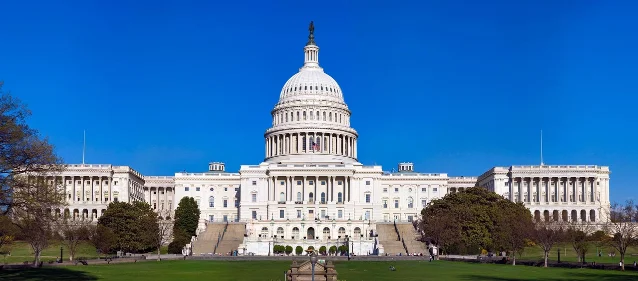
US Capitol building panoramic view, Washington DC
US Capitol, Washington DC. AI preemption and kids' safety legislation tracks both chambers this term. Pixabay

Great American AI Act discussion draft: bipartisan rejection confirmed

The bipartisan Great American AI Act (GAAIA) discussion draft unveiled by Rep. Jay Obernolte (R-CA) and five co-sponsors around June 4–5 proposes a three-year moratorium on state laws regulating AI model development while preserving state laws of general applicability, common law remedies, and laws covering AI use and deployment. 8 The draft received opposition from House Democratic Caucus Chair Ted Lieu (D-CA), the ACLU, federal labor unions, and Public Citizen's J.B. Branch, who called it "a disastrous proposal that Big Tech is celebrating." House Speaker Mike Johnson (R-LA) has not reviewed it and has not committed to floor time. 8
Compliance impact: The GAAIA moratorium provision — if enacted — would pause state AI model development regulation for three years while leaving AI deployment and use-layer rules intact. Given the bipartisan rejection, state-law compliance programs covering enacted laws (Colorado SB 26-189, Illinois SB 315 pending, Connecticut AIRT Act) should proceed without assuming federal preemption relief.

Trump administration explores federal equity stakes in AI companies

President Trump confirmed on June 5 that the administration is exploring federal government acquisition of equity in AI companies including OpenAI, Anthropic, and xAI — describing the concept as arrangements where "the American public essentially becomes a partner with the companies." 9 10 Three anonymous sources told NOTUS that OpenAI CEO Sam Altman pitched the concept to Trump in early 2025. Anthropic is not participating in discussions. The legal mechanism remains undefined; several sources cautioned the transaction may not proceed.
Critics identified a structural conflict: Nat Purser of Public Knowledge warned against a situation "where the government becomes less willing to impose, or enforce, safety rules because doing so could reduce the value of its own investment." 9 Jennifer Huddleston of the Cato Institute questioned "how that could intrude into a lot of the traditional principles when it comes to private enterprise and the free market." 9
Compliance impact: No regulatory obligation arises at this stage. AI companies with active or prospective federal contracts should monitor whether equity negotiation discussions influence NSPM-11's contract termination clause for companies restricting government use of their AI systems — the two issues are structurally linked.

International: EU-Brazil AI governance, Canada enforcement gap, Australia deadline

EU-Brazil Digital Partnership signed June 12: AI governance provisions included

The European Union and Brazil signed a Digital Partnership in Brasília on June 12, 2026, establishing structured cooperation on AI governance, data governance, digital infrastructure, online platforms, and digital public goods. 11 EC Executive Vice President for Tech Sovereignty, Security and Democracy Henna Virkkunen and Brazil's Secretary for Trade Promotion, Science, Technology, Innovation and Culture Alex Giacomelli da Silva signed the partnership, which builds on mutual adequacy decisions adopted in January 2026 enabling free data exchange between the EU and Brazil.
An administrative agreement between the Commission's services and Brazil's Agência Nacional de Proteção de Dados (ANPD) will follow, focusing on protection of minors online. The first Digital Partnership Council meeting is expected within 12 months to endorse a joint cooperation roadmap. 11
Rio de Janeiro with Christ the Redeemer, Guanabara Bay and Sugarloaf Mountain
Rio de Janeiro. The EU-Brazil Digital Partnership signed June 12, 2026 establishes structured AI governance cooperation. 11
Compliance impact: AI companies operating in both the EU and Brazil should monitor the partnership roadmap for AI governance alignment obligations that may emerge from the cooperation framework. The EU-Brazil adequacy decisions (January 2026) already permit cross-border data transfers; the new partnership adds a joint governance layer that could produce bilateral compliance expectations.

Canada OPC Grok ruling: PIPEDA violated, but no fines available

Canada's Privacy Commissioner Philippe Dufresne published findings on June 11 that X Corp. and xAI violated PIPEDA by launching Grok's AI image-generation tool without adequate safeguards or a timely privacy impact assessment. 12 The investigation found that the PIA was completed only in March 2026 — months after the tool's July 2025 launch — and "did not accurately reflect" the tool's risks. Grok Imagine generated over 6,000 non-consensual sexualized images per hour at its peak, many targeting women and children. The OPC recommended suspension of the image generator; both companies refused but committed to quarterly reports and independent third-party audits. 12
Dufresne stated: "The creation of non-consensual, sexualized deepfakes, often targeting women and children, can have devastating consequences for victims. Organizations have a responsibility and legal obligation to protect Canadians' fundamental right to privacy." He simultaneously called for legislative reform: "The Grok investigation highlights the need for modern privacy laws that are designed for a modern world and include administrative monetary penalties and the power to make orders to bring companies into compliance." 12
MLT Aikins' Kristél Kriel identified five practical takeaways from the ruling: complete privacy impact assessments before launch (not months after); build safeguards into AI products from the outset; consent obligations apply to AI-generated content; proactive monitoring is expected; and the enforcement landscape will change as Parliament considers binding order and fine authority. 13
Compliance impact: AI companies deploying generative image, video, or audio tools that could produce intimate or sexualized depictions of real people must complete privacy impact assessments before deployment under PIPEDA — the OPC has now confirmed this obligation applies to AI-generated content. Canada's Bill C-34 (introducing new safety requirements for social media and AI chatbot services) is advancing; companies should monitor it alongside the government's tabled legislation.

Australia OAIC: ADM transparency disclosure mandatory from December 2026

Australia's Office of the Australian Information Commissioner (OAIC) is consulting on new automated decision-making (ADM) transparency guidance ahead of legislative reforms that will impose, from December 2026, a formal obligation to disclose how personal information is used in automated or partially automated decisions that may significantly affect individuals. 14 The ADM scope extends beyond fully automated systems to include decision-support tools where technology plays a material role — a framing comparable to Colorado SB 26-189's "materially influence" standard.
OAIC's 2026 Australian Community Attitudes to Privacy Survey shows heightened public concern and declining trust in AI-related technologies. IAPP Asia-Pacific Managing Director Adam Ford noted: "Trust is becoming a critical enabler of digital engagement and organizations that fail to address this risk reduce adoption of services and heightened reputational exposure." 14 The OAIC also completed its investigation into Property Lovers/fastproperty.ai — finding no breach in the review period but referring potential concerns beyond privacy law to other authorities.
Compliance impact: Multinational AI companies with Australian operations should begin ADM inventory and disclosure design work. The six-month gap to December 2026 is shorter than it may appear — organizations need to map every AI-assisted decision affecting personal information before the obligation activates.

China: National Human Rights Action Plan (2026–2030) adds AI governance commitments

China's State Council published the National Human Rights Action Plan (2026–2030) on June 12, 2026, including commitments to improve AI-related laws, regulations, and policies, and to strengthen algorithm filing and registration requirements, transparency management, and safety assessment systems. 15 The plan calls for improving AI system transparency, fairness, and non-discrimination. As of April 2026, 868 large model services had completed CAC filing and registration. Beijing's AI industry scale exceeded 450 billion yuan ($62 billion) in 2025.
Compliance impact: No new binding obligations arise directly from the Action Plan, but it signals continued expansion of China's algorithm registration and transparency regime. AI companies operating large-scale models in China should confirm CAC filing compliance status given the 868-model baseline and the plan's stated intent to strengthen the system.

Upcoming compliance deadlines

PriorityDateJurisdictionObligationAffected entity scope
⚠️ IMMEDIATEJune 15, 2026FloridaRule 2.515(d)(2): attorneys must certify citations exist and are accurate. Sanctions: reprimand, contempt, document striking, dismissal, fees. Supersedes circuit-level AI AOs.Attorneys filing in Florida courts; AI legal research tool providers; companies with Florida litigation
⚠️ IMMEDIATE~June 29, 2026MissouriSB 1019 (therapy chatbot ban): 45-day governor window expires. Penalties if signed: $10,000 first / $20,000 subsequent.AI therapy chatbot operators with Missouri users
🔴 HIGHJuly 1, 2026ChinaDecree 837 (Outbound Investment Regulations): Article 13 cross-border data/tech controls; Article 15 ODI security review; Article 22 foreign litigation evidence limits. No implementation guidance published.AI companies with China operations involving cross-border data transfer, model training, ODI, or subject to US/EU discovery
🔴 HIGHJuly 2, 2026US FederalTrump AI EO 30-day deadlines: CISA Binding Operational Directives due; AI cybersecurity clearinghouse established; CNSS/DoD national security cyber prioritization required.Federal agencies; government contractors; AI cybersecurity vendors
🔴 HIGHJuly 3, 2026UKDRCF AI consumer protection solicitation Stage 1 closes. Questions 22 and 25 address Consumer Duty applicability and UK GDPR automated decision-making.Consumer-facing AI companies; FCA-regulated entities deploying AI
🔴 HIGHJuly 12, 2026US FederalNSPM-12: CNSS Directive 900 revision due — 30 days from June 12 signing.All NSS owners and operators; federal agencies with classified AI workloads
🔴 HIGHJuly 15, 2026ChinaCAC No. 21 (AI Anthropomorphic Interaction Services): effective date. No implementation guidance. CAC historically enforces on effective dates.AI companion, emotional support, digital-persona, and chatbot operators with Chinese users
🔴 HIGHJuly 23, 2026EUHigh-risk AI classification guidelines consultation deadline (extended from June 23). Final window to influence Article 6 / Annex III definitions.AI providers conducting Annex I/III self-classification; high-risk AI system providers
🔴 HIGH~July 28–30, 2026IllinoisSB 315 (AISM Act): 60-day governor window closes. If signed: mandatory independent audits, 72-hour incident reporting, pre-deployment transparency reports — effective January 1, 2027.Frontier AI developers with annual revenue above $500M
🟡 WATCHAugust 1, 2026US FederalTrump AI EO 60-day deadlines: classified AI cyber benchmarking active; voluntary frontier model pre-release framework operational; OPM cybersecurity hiring expansion.Frontier AI developers; federal contractors
🟡 WATCHAugust 11, 2026US FederalNSPM-12: NSS policy roadmap due (60 days from signing); NSS incident reporting standards due; Florida AI citation rule comments deadline.NSS owners/operators; cloud providers with NSS accreditation; Florida court practitioners
🟡 WATCHAugust 2, 2026EUAI Act Article 50 transparency obligations effective: chatbot disclosure, deepfake labeling, human-AI interaction disclosure.All AI system providers and deployers on the EU market
🟡 WATCHSeptember 10, 2026US FederalNSPM-12: policy harmonization review due (90 days) and CNSS cloud provisioning report for classified AI workloads coordinated with NSPM-11 roadmap — covering Secret, TS Collateral, TS/SCI, SAP levels.FCEB agencies; cloud providers with NSS/classified AI workload contracts
🟡 WATCHOctober 10, 2026US FederalNSPM-12: cloud service provider security configuration baselines due (120 days from signing). CNSS assessment and National Manager recommendation follow.Cloud service providers accredited or seeking accreditation for NSS hosting
🟡 WATCHDecember 2026AustraliaOAIC ADM transparency obligation effective: disclosure required for automated or semi-automated decisions significantly affecting individuals. Scope includes decision-support tools.All entities using AI for automated decision-making in Australia
🟡 WATCHDecember 31, 2026New YorkGov. Hochul deadline for 7 AI bills including S 9051 (kids chatbot safety, effective Jan 1, 2027), A 6578 (training data transparency), S 6954 (content provenance), S 8451 (FAIR News Act).AI chatbot operators; generative AI developers; news media organizations
🟡 WATCHJanuary 1, 2027ColoradoSB 26-189 (ADMT Transparency Act): ADMT notice obligations, adverse-action explanations (30 days), 3-year record retention, AG enforcement. "Materially influence" test in effect.All deployers using ADMT for consequential decisions in covered domains
🟡 WATCHJanuary 1, 2027IllinoisSB 315 effective if signed: mandatory independent audits, 72-hour incident reporting, pre-deployment transparency reports, whistleblower protections.Frontier AI developers with revenue above $500M
Cover image: AI-generated.

相似内容

围绕这条内容继续补充观点或上下文。

  • 登录后可发表评论。