
2026/6/29 · 8:08
Runway Agent 2.0 is for campaigns with receipts
Runway Agent 2.0 can help small brands turn existing ads, product briefs, and performance notes into new campaign variants, but it is worth testing only when you bring real campaign data and keep a human review step.

研究速览
Runway Agent 2.0 is a useful test for creator-brands with one specific problem: you already have products, assets, and performance signals, but you do not have enough hands to turn the winners into the next batch of ads.
Runway announced Agent 2.0 on June 25, positioning it as a marketing agent that can analyze a live or planned campaign, ask follow-up questions, and build ads, videos, social posts, and campaign assets in the same conversation.1 The feature is available for all users, according to the launch post, but that does not mean every small brand should move production into it this week.1
The practical read: test it only where you can bring evidence into the session. A blank prompt will mostly give you another creative guessing machine. A product page, three past ads, and last week's performance notes give Agent 2.0 something useful to react to.
The try / wait decision
| Your situation | Decision | Why |
|---|---|---|
| You run paid or organic creative tests every week | Try | Runway says Agent can take ad metrics from Meta, YouTube, TikTok, or Google, then generate the next ads to test.<cite index="1" title="Runway News " url=" Introducing Agent 2.0 |
| You need one launch kit from a product brief | Try, with review | The product page says Agent can help define the angle, create campaign deliverables, and format creative for several channels.<cite index="2" title="Runway Agent " url=" Marketing content that drives revenue |
| You do regulated, medical, financial, or claims-heavy marketing | Wait, or keep it in draft mode | The official pages describe creative generation and optimization, but they do not describe compliance review or claim verification as part of Agent 2.0.<cite index="2" title="Runway Agent " url=" Marketing content that drives revenue |
| You are testing Runway mainly for video volume | Price the credits first | Runway's current pricing page lists 625 credits/month on Standard, 2,250 on Pro, and 9,500 on Max when the yearly toggle is shown.<cite index="3" title="AI Image and Video Pricing from $12/month " url=" Runway AI |
What changed in Agent 2.0
Runway's pitch is narrower than the usual text-to-video demo. Agent 2.0 is framed around marketing work: campaigns, ads, social content, product launches, audience entry, and performance improvement.1 That matters because brand owners do not need more isolated assets. They need a way to move from "this ad worked" to "here are five defensible next tests."
The product page groups the workflow into three jobs: create campaigns, analyze what is working, and scale the winners across formats, channels, and markets.2 The launch post gives more concrete examples: brand marketers can generate seasonal content and localize campaigns, performance marketers can upload creative and ad metrics, social marketers can use engagement data from the previous week, and product marketers can turn positioning angles into campaign assets.1
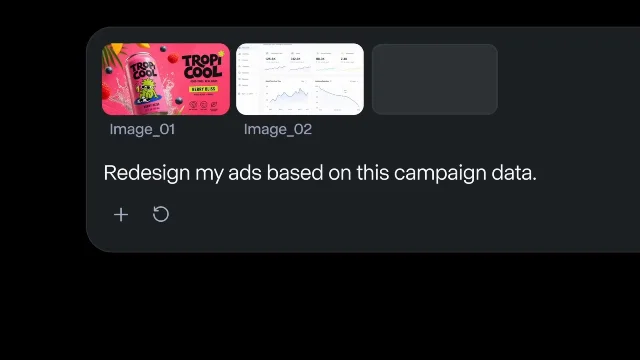
For a solo creator or small brand team, the useful shift is not "AI makes a video." The useful shift is that the same session can hold the product context, the creative brief, the performance note, and the platform format requirement.
The workflow to test first
Do not start with your biggest campaign. Use one product and one proven creative angle. The goal is to test whether Agent helps you produce better next variants, not whether it can invent your whole brand strategy from a paragraph.
1. Bring a tight input pack
Prepare four inputs before opening the Agent session:
- A one-paragraph product summary: target buyer, price point, core promise, and the objection that usually blocks purchase.
- Three past assets: one winner, one average performer, one clear loser.
- A simple performance note: platform, spend or reach band, hook, offer, click-through or engagement result, and the creative problem you want to solve.
- Brand guardrails: banned claims, tone limits, visual rules, and any phrases your audience already distrusts.
This matters because Runway says Agent can diagnose underperforming creative and rebuild stronger versions when users share the content that is not working.2 If you provide only a vague request, you are testing its taste. If you provide the winning and losing patterns, you are testing its judgment.
2. Ask for angles before assets
The first prompt should not be "make me five ads." Ask Agent to name the angles first, then force a choice.
Use a prompt like this:
I sell [product] to [audience]. Here are three past ads and their results. Identify the two strongest angles to test next, explain why each angle fits the evidence, then propose one 9:16 video ad, one 1:1 feed post, and one email hero for each angle. Keep claims inside these rules: [rules].
Runway says Agent can generate fresh hooks and variations for Meta, TikTok, YouTube, and other channels.2 The important part is making it show the angle logic before it spends your credits or your review time on finished assets.
3. Make the output measurable
For each generated variant, add a required test note:
- What hypothesis does this variant test?
- Which past asset is it closest to?
- What is the first metric that would make you keep it?
- What metric would make you kill it after the first test window?
Runway's launch post says Agent is meant to help marketers analyze what works, create more of it, and cut what does not.1 That loop only works if the output comes with a test plan. Without that, the tool may increase asset volume while leaving you with the same old decision problem.
The adoption traps
Trap 1: treating platform formatting as strategy
Agent can format creative for Reels and Stories at 9:16, YouTube at 16:9, and feed at 1:1, according to Runway's launch post.1 That is useful production help, but it does not decide whether the hook belongs on TikTok, YouTube Shorts, or a retargeting ad.
Ask for channel-specific variants only after the message is clear. Otherwise you get the same weak idea resized three ways.
Trap 2: skipping the cost model
Runway currently presents a Free plan with 125 one-time credits, Standard at 625 credits/month, Pro at 2,250 credits/month, and Max at 9,500 credits/month under its yearly pricing display.3 For heavy users, Runway's help center says the old Unlimited plan is being phased out in favor of Max, with existing Unlimited subscribers unchanged through August 31, 2026, and monthly Unlimited subscribers moving to Max on September 1 at the same $95/month price.4
That pricing context changes how small teams should pilot Agent. Use it for the expensive thinking step first: brief, angle, variant logic, and asset list. Then generate only the assets you can actually test in the next cycle.
Trap 3: assuming the future roadmap is already live
Runway says it wants Agent to connect directly to marketing platforms, learn from performance data, and generate new assets and campaigns automatically.1 The wording matters. "Wants" is not the same as "already does."
For now, treat direct performance learning as something to verify inside your own account before building a workflow around it. If you still need to export metrics, upload files, or paste summaries, write that into your process instead of pretending the loop is autonomous.
A 30-minute pilot for a small brand
Use this when you have one product and at least three existing creative samples.
| Minute | Action | Output |
|---|---|---|
| 0-5 | Choose one product, one audience, and one recent campaign problem. | A narrow brief, not a brand-wide request. |
| 5-10 | Upload or summarize the winner, average asset, loser, and last week's metrics. | Evidence for Agent to analyze. |
| 10-15 | Ask for two test angles before asking for finished assets. | Angle options with reasoning. |
| 15-25 | Generate one 9:16 ad, one 1:1 feed post, and one email hero for the stronger angle. | A small cross-channel test pack. |
| 25-30 | Reject unsupported claims, tighten the CTA, and attach a metric target to each variant. | A test-ready draft set for human approval. |
The pass/fail test is simple: can Agent produce variants whose differences are tied to the performance evidence you gave it? If the outputs look polished but cannot explain which prior signal they are building on, keep Runway in the production-assistant lane. If the outputs map cleanly to past wins and failures, it may be worth a second pilot with more products or markets.
Bottom line
Agent 2.0 is most interesting for creators and brand owners who already run a creative testing loop. It can help turn the messy middle of marketing, brief, asset, metric, next variant, into a single working session.
If you are still guessing at your audience, start elsewhere. If you have receipts from past campaigns, Runway Agent 2.0 is worth a controlled test this week.
参考来源
- 1Runway News
- 2Runway Agent
- 3AI Image and Video Pricing from $12/month
- 4Unlimited plan is switching to Max – Runway
围绕这条内容继续补充观点或上下文。