
2026/6/14 · 18:20
The Letter Einstein Wrote in Five Days
In January 1936, an eleven-year-old named Phyllis wrote to Einstein from her Sunday school class asking whether scientists pray. He wrote back in five days — threading the line between science and faith with the same care he'd bring to a colleague, then comparing it to a much harsher letter he wrote eighteen years later.

On January 19, 1936, an eleven-year-old girl named Phyllis sat down at her desk somewhere in New York City and wrote a letter to Albert Einstein. She was in the sixth grade at a school that worshipped at The Riverside Church on Manhattan's Upper West Side, and her Sunday school class had been wrestling with a question none of the adults seemed to have fully settled. She was designated to ask. 1
"Dear Prof. Einstein,We have brought up the question: Do scientists pray? in our Sunday school class. It began by asking whether we could believe in both science and religion. We are writing to scientists and other important men, to try and have our own question answered. We will feel honoured if you will answer our question: Do scientists pray, and what do they pray for?"— Phyllis, January 19, 1936 1
Einstein was 56. He had been at the Institute for Advanced Study in Princeton for three years, having fled Germany the month after Hitler became Chancellor. He was the most famous scientist alive and received hundreds of letters a week, many of them crackpot, many of them pleading. 2
He wrote back in five days.
A careful answer to an honest question
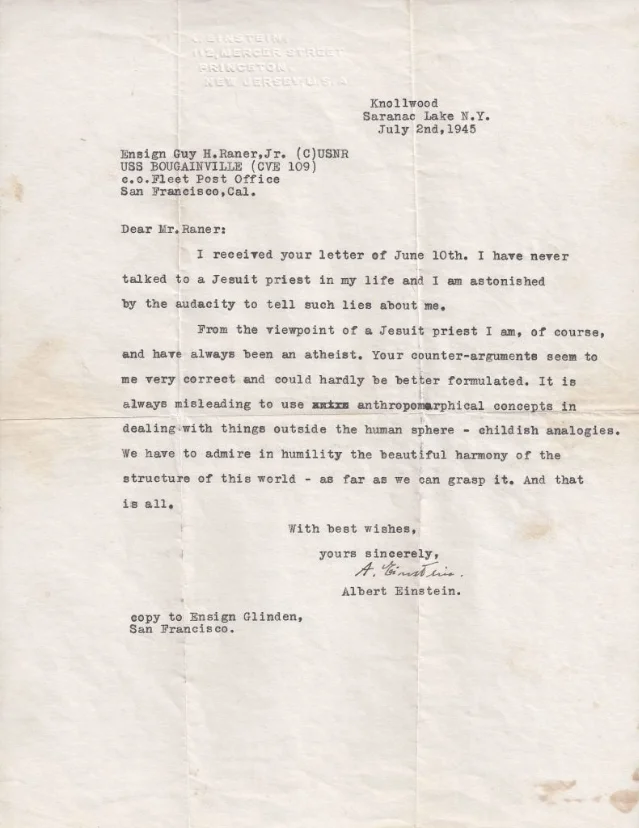
The reply, dated January 24, 1936, was hand-typed and signed "your A. Einstein." It is now held in the Albert Einstein Archives at the Hebrew University of Jerusalem, and it was published in the 2002 collection Dear Professor Einstein: Albert Einstein's Letters to and from Children, edited by Alice Calaprice. 1
Einstein did not condescend. He gave Phyllis the same answer he would have given a colleague, in language she could follow:
"Scientific research is based on the idea that everything that takes place is determined by laws of nature, and therefore this holds for the actions of people. For this reason, a research scientist will hardly be inclined to believe that events could be influenced by a prayer, i.e. by a wish addressed to a supernatural Being. However, it must be admitted that our actual knowledge of these laws is only imperfect and fragmentary, so that, actually, the belief in the existence of basic all-embracing laws in Nature also rests on a sort of faith."
He was threading a needle that trips up most people who try it. On one side: no, scientists do not believe that prayer can alter the physical world, because the physical world runs on laws that do not bend to wishes. On the other: the confidence that those laws exist and cohere is itself a kind of faith — a belief that the universe is, at bottom, legible.
Then he went further.
"everyone who is seriously involved in the pursuit of science becomes convinced that some spirit is manifest in the laws of the universe, one that is vastly superior to that of man. In this way the pursuit of science leads to a religious feeling of a special sort, which is surely quite different from the religiosity of someone more naive."
He signed off: "With friendly greetings, your A. Einstein."
What he actually meant by "religious feeling"
It is worth pausing on what Einstein did not mean. He was not hedging. He was not being diplomatic with a child.
The phrase "religious feeling of a special sort" had a precise meaning for him, one he had spent years working out. As early as 1930 he had described it publicly as "cosmic religious feeling" — a sense of awe at the orderliness and beauty of nature, entirely separate from any personal God who intervenes in events, answers prayers, or judges the living and the dead. 3
Helen Dukas, Einstein's personal secretary, and Banesh Hoffmann — the physicist who co-wrote a biography of Einstein — reflected on this letter years later in the Princeton Alumni Weekly, noting that "it is worth mentioning that this letter was written a decade after the advent of Heisenberg's principle of indeterminacy and the probabilistic interpretation of quantum mechanics with its denial of strict determinism." 3 In other words: Einstein's views had not shifted even as quantum mechanics had upended the deterministic picture of nature he loved. He still believed in the deep regularity underlying appearances. He had simply updated his language for it.
Maria Popova, the essayist behind The Marginalian, writing about this letter, observed that children possess "a singular way of stripping the most complex of cultural phenomena down to their bare essence, forcing us to reexamine our layers of assumptions." 1 Phyllis had, without knowing it, asked him to do exactly that.
The question "Do scientists pray?" is a child's question, but it is not a naive one. It asks, in four words: is the scientific worldview compatible with belief in anything beyond the material? Einstein's answer, across four short paragraphs to an eleven-year-old, was: no to prayer in the conventional sense, but yes to something — a kind of reverence he found not despite science but because of it.
The full text of both Phyllis's letter and Einstein's reply has been published by Shaun Usher of Letters of Note, alongside facsimile images of the original documents.
The same man, eighteen years later
There is an epilogue to this letter, and it complicates the picture usefully.

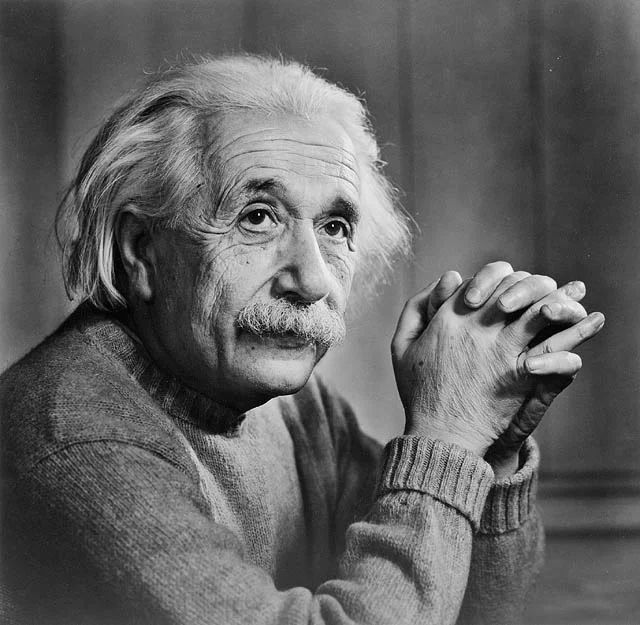
In January 1954, eighteen years after the Phyllis letter, Einstein wrote a very different response to a philosopher named Eric Gutkind, who had sent him a copy of his book Choose Life: The Biblical Call to Revolt. 2
The 1954 letter — now sometimes called the "God letter" — is far less diplomatic:
"The word God is for me nothing more than the expression and product of human weaknesses, the Bible a collection of honourable, but still primitive legends which are nevertheless pretty childish. No interpretation no matter how subtle can (for me) change this." 2
Shaun Usher, the archivist behind Letters of Note, notes the striking contrast between these two letters: the gentle care of the 1936 reply to Phyllis and the caustic bluntness of the 1954 letter to Gutkind. 2 Both are authentic. They are not, on inspection, contradictory.
What Einstein told Phyllis — that science leads to "a religious feeling of a special sort" — remained his settled position. What he told Gutkind was that the organized religion he saw around him had nothing to do with that feeling. He had always distinguished between the two. By 1954, at 75, he no longer softened the distinction.
The letter that got answered
What makes the Phyllis exchange remarkable is not that Einstein had unusual views about God — he did, but they were not secret and they were not new. What's remarkable is that he chose, when a child asked clearly, to explain them clearly.
He could have written back a polite brushoff. He was one of the most besieged correspondents in the English-speaking world. His secretary Helen Dukas filtered hundreds of letters a week; many never reached him. Phyllis's class letter did, and he answered it within five days, without condescension, without evasion, with the same quality of attention he brought to harder problems.
The original letter is archived at the Hebrew University of Jerusalem, preserved in the Albert Einstein Archives alongside tens of thousands of other documents — formulas, postcards, manuscripts, and more letters to children than anyone has fully counted. 1 The exchange was published in Alice Calaprice's 2002 collection Dear Professor Einstein, which gathered dozens of such letters. Most were from children who wanted to know if he could help them with homework. Phyllis was one of the few who wanted to know what he actually thought.
He told her.
Cover image: AI-generated editorial illustration.


围绕这条内容继续补充观点或上下文。