2026/6/28 · 7:28
June 28: four assets under pressure
This June 28 business-history briefing covers the Spooner Act, the Daimler-Benz merger, the Fort Knox gold depository order, and OPEC’s 1979 price hike. The common practitioner lesson is how control over scarce assets can create leverage, but also trigger backlash, substitution, or integration risk.
This June 28 edition is about control under pressure. Congress authorized the U.S. purchase of the French Panama Canal concession, equipment, and partial excavation in 1902. 1 Daimler-Motoren-Gesellschaft and Benz & Cie. merged into Daimler-Benz AG in 1926. 2 President Franklin D. Roosevelt and Treasury Secretary Henry Morgenthau Jr. ordered the Fort Knox gold depository in 1935. 3 The Organization of the Petroleum Exporting Countries, better known as OPEC, raised its benchmark crude price to $18 a barrel in 1979. 4 Each case started with scarcity; each became a lesson in who gets to set the terms.
1902 — The U.S. buys the canal option France could not finish
On June 28, 1902, Congress enacted the Spooner Act, formally the Panama Canal Act, authorizing President Theodore Roosevelt to buy the French Panama Canal concession, equipment, and partial excavation for up to $40 million. 1 Roosevelt signed the act on June 29, and the purchase reversed a long U.S. preference for a Nicaragua route after the French company cut its asking price from about $109 million to $40 million. 5
The asset was cheap because the first builder had failed badly. Ferdinand de Lesseps's French company had spent about $287 million, lost an estimated 22,000 workers to disease and accidents, and gone bankrupt in 1889 with the canal roughly two-fifths complete. 6 The U.S. later paid Panama $10 million plus a $250,000 annual annuity under the Hay-Bunau-Varilla Treaty and formally took control of the Canal Zone on May 4, 1904. 7
The outcome arc was enormous. The Panama Canal opened to commercial traffic on August 15, 1914, with the transit of the SS Ancon. 8 It cut the New York-to-San Francisco route from about 13,000 miles around Cape Horn to about 5,200 miles through Panama. 9
Decision mirror. Distressed assets are not automatically bargains. The Spooner Act worked because the U.S. was buying excavation, equipment, a railroad-adjacent corridor, and a geopolitical opening at once. The managerial question is whether the discount comes with a controllable path to completion, or only with someone else's sunk-cost story.
1926 — Mercedes-Benz makes merger a brand system
On June 28, 1926, Daimler-Motoren-Gesellschaft and Benz & Cie., the world's two oldest automobile manufacturers, signed the merger agreement that created Daimler-Benz AG; the Mercedes-Benz Public Archive records the date as June 28/29 because legal formalities extended to June 29. 2 The two companies had already signed a May 1, 1924 Agreement of Mutual Interest that pooled economic interests while keeping legal independence. 10
The pressure was structural, not cosmetic. Deutsche Bank director Emil Georg von Stauß chaired the ten-person committee overseeing the 1924 arrangement and helped orchestrate the full merger. 11 The combined company used the Mercedes-Benz name because Gottlieb Daimler had already licensed the Daimler name to other companies, including the Daimler Motor Company in the United Kingdom and Austro-Daimler. 12
The brand architecture solved a real constraint. The Mercedes name came from Mercédès Jellinek, daughter of Austrian auto entrepreneur Emil Jellinek, and the name was trademarked on June 23, 1902. 13 The combined logo put DMG's three-pointed star inside Benz's laurel wreath, a shared trademark registered on February 18, 1925, before the full merger. 14
The later comparison is useful. Daimler-Benz's 1998 merger with Chrysler was valued at $38 billion and was unwound in 2007 when Chrysler was sold to Cerberus Capital Management. 15 The 1926 deal endured because it aligned manufacturing consolidation, banking pressure, founder transition, and a brand system that customers could recognize.
Decision mirror. M&A does not integrate itself. The 1926 deal had a transition vehicle, a shared economic logic, and a brand answer before the legal close. A merger without those operating answers is only a transaction waiting to become an argument.
1935 — Fort Knox turns state gold into public theater
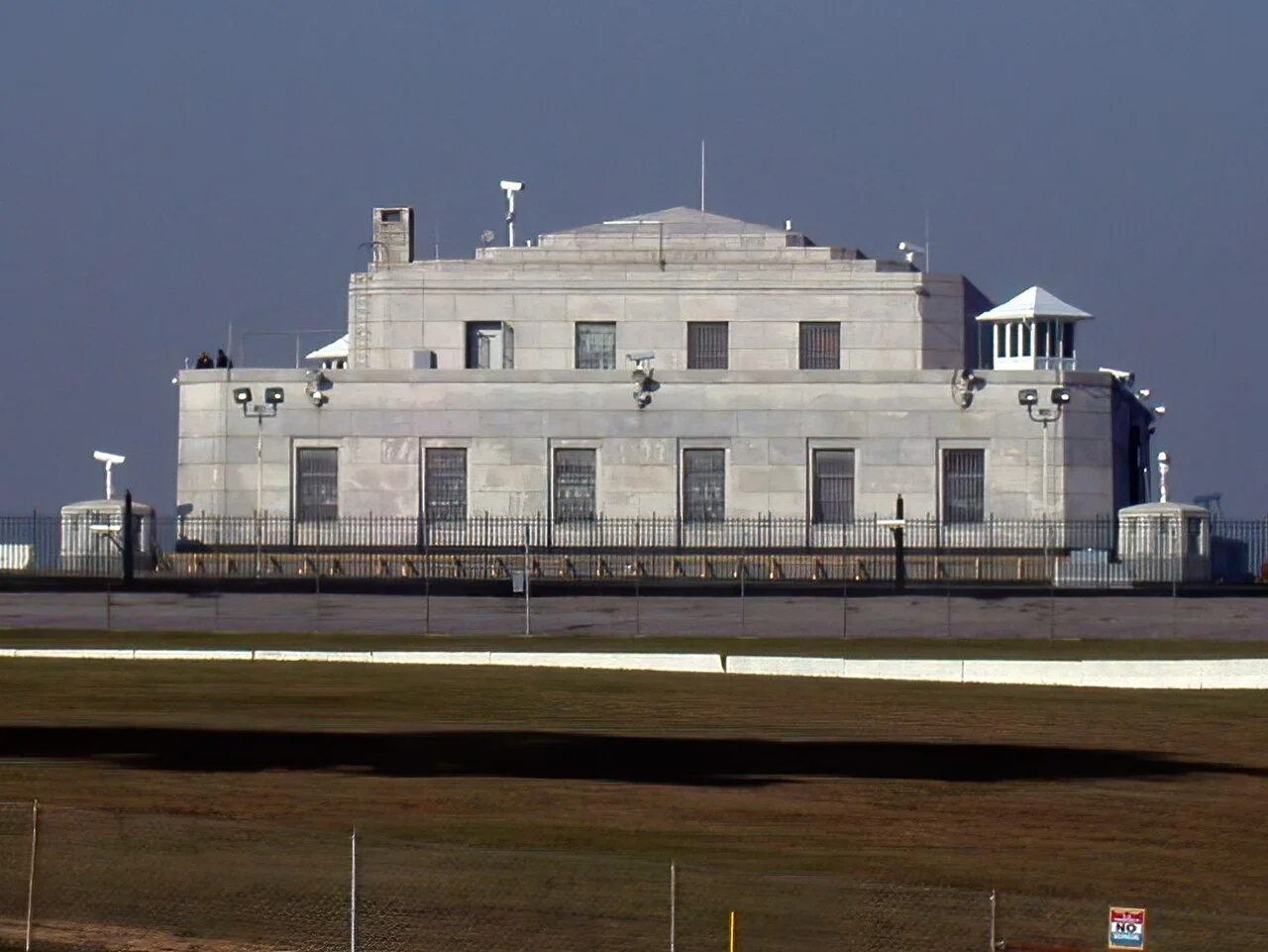
On June 28, 1935, President Franklin D. Roosevelt and Treasury Secretary Henry Morgenthau Jr. ordered construction of the United States Bullion Depository at Fort Knox, Kentucky. 3 The plan moved gold away from coastal cities to an inland Army post, and reporting at the time described a rush construction order for a subterranean vault at Fort Knox. 16
The paradox is the point. Roosevelt had signed Executive Order 6102 on April 5, 1933, forbidding the hoarding of gold coin, gold bullion, and gold certificates above limited exemptions. 17 The Gold Reserve Act of January 30, 1934 transferred ownership of all U.S. monetary gold to the Treasury and revalued gold from $20.67 an ounce to $35 an ounce. 18
The vault was completed in December 1936 at a cost of $560,000, after an initial plan capped the building at $450,000. 19 U.S. gold reserves peaked in October 1941 at 651.4 million troy ounces, and Fort Knox later became the public symbol of state-held gold even after the U.S. ended domestic gold convertibility in 1933-34 and international dollar-gold convertibility in 1971. 20
Decision mirror. Trust sometimes needs physical evidence even after the operating model has changed. Fort Knox did not restore private gold ownership. It gave the state a visible architecture for reserve credibility. Institutions should ask whether their control systems only work internally, or whether stakeholders can see enough to believe them.
1979 — OPEC finds the limit of cartel pricing
On June 28, 1979, OPEC met in Geneva and raised its benchmark crude price to $18 a barrel, about 24% above the prior level, while allowing some members to add surcharges and setting an upper ceiling of $23.50 a barrel. 4 The Washington Post's June 29 report described the two-tier system and noted Saudi Arabia, Qatar, and the United Arab Emirates at the $18 price. 21
The physical shock was smaller than the market reaction. The Iranian Revolution cut Iranian production from about 6 million barrels a day to about 1.5 million barrels a day, reducing global output by about 4.8 million barrels a day before other producers partly offset the loss. 22 Brookings analyst Samantha Gross later wrote that panic buying more than doubled the actual shortage and that spot-market oil sold for as much as $50 a barrel. 23
The macro arc followed quickly. Paul Volcker became Federal Reserve chair in August 1979 and pushed the federal funds rate from about 11% to roughly 19-20% by 1981. 24 The U.S. entered recession from July 1981 to November 1982, and unemployment reached nearly 11% by late 1982. 24 The longer commodity response cut the other way: non-OPEC production rose by 5.6 million barrels a day from 1979 to 1985, global oil demand fell about 10% from 1979 to 1983, and OPEC's market share shrank to about 29% by 1985. 25
Decision mirror. Pricing power can plant the seed of substitution. OPEC's 1979 move monetized scarcity, but the high-price regime accelerated conservation, non-OPEC supply, and monetary tightening. Any business with temporary pricing power should model the second-order response, not just the next quarter's margin.
The June 28 pattern is simple enough to use. Control is valuable when the system is under stress, but control also invites response. A canal concession draws geopolitical backlash. A merger needs operating design. A vault can signal trust while policy changes underneath it. A cartel price can make customers and rivals move faster than the cartel expects.
Cover image: Fort Knox Bullion Depository exterior, via Wikipedia: United States Bullion Depository.
参考来源
- 1Wikipedia: Spooner Act
- 2Mercedes-Benz Public Archive: Birth of Daimler-Benz AG
- 3CBS News: Almanac, Fort Knox
- 4The Indian Express: Forty Years Ago, June 29, 1979: OPEC raises price
- 5Encyclopedia.com: Spooner Act
- 6Wikipedia: History of the Panama Canal
- 7U.S. Department of State: Building the Panama Canal
- 8Wikipedia: Panama Canal
- 9MyDello: Panama Canal Shipping
- 10Initiative Kulturgut Mobilität: Benz & Cie. und Daimler-Motoren-Gesellschaft bilden 1924 Interessengemeinschaft
- 11Wikipedia: Emil Georg von Stauss
- 12Wikipedia: Mercedes-Benz Group
- 13Mercedes-Benz Group: Mercedes, the brand name that shines out for over 120 years
- 14Mercedes-Benz Group: The story of the Mercedes star
- 15Encyclopaedia Britannica: Daimler AG
- 16The New York Times: Treasury to Build a Gold Vault At an Army Post in Kentucky
- 17The American Presidency Project: Executive Order 6102
- 18Federal Reserve History: Gold Reserve Act of 1934
- 19CoinWeek: The National Gold Bullion Depository at Fort Knox
- 20Wikipedia: United States Bullion Depository
- 21The Washington Post: The OPEC Decision
- 22Federal Reserve History: Oil Shock of 1978-79
- 23Brookings: What Iran's 1979 revolution meant for US and global oil markets
- 24Federal Reserve History: Recession of 1981-82
- 25Wikipedia: 1980s oil glut
围绕这条内容继续补充观点或上下文。