
Five papers: June 18, 2026
2026/6/18 · 9:18

Five papers: June 18, 2026

Five papers from the June 17–18, 2026 window (28-hour cycle), ranked by journal IF tier and translational signal. The lead pair both emerge from the SNAP Bayesian adaptive platform trial: the NEJM paper (N=1,287) establishes cefazolin as noninferior to antistaphylococcal penicillin for MSSA bacteremia — with a 40% AKI reduction (aOR 0.67; 99.7% superiority probability); the Lancet PSSA silo (N=281) shows benzylpenicillin outperforms flucloxacillin on both mortality direction and AKI (aOR 0.50), with the DSMB stopping enrollment on safety grounds. Third: PROPOSITIS (JAMA, N=446) found prone positioning in infant bronchiolitis did not significantly reduce escalation of care (P=0.09). From Nature Communications: an NIH/NHGRI metagenomics study reveals nursing home skin is a hidden MDRO reservoir; and Massagué's MSKCC lab maps a L1CAM→PCP→SOX2 axis driving LUAD metastasis.

研究速览

At a glance — June 17–18, 2026

#PaperJournal (IF tier)DesignNPrimary result
1SNAP: cefazolin vs antistaphylococcal penicillin in MSSA bacteremiaNEJM (IF ~96, T1)Adaptive platform RCT1,28790-day mortality noninferior (15.0% vs 17.0%; aOR 0.81); AKI ↓40%
2SNAP PSSA silo: benzylpenicillin vs flucloxacillin/cloxacillinLancet (IF ~98, T1)Platform RCT silo28190-day mortality 14% vs 22% (aOR 0.67); AKI ↓50% (aOR 0.50)
3PROPOSITIS: prone positioning in infant bronchiolitis on HFNCJAMA (IF ~63, T1)Multicenter RCT446Escalation 15.0% vs 20.8%; aOR 0.66 (95% CI 0.40–1.07); P=0.09
4Nursing home skin as MDRO reservoir: strain sharing across facilitiesNat Commun (IF ~16, T2)Metagenomics + WGS surveillance38 residents, 15 facilities71.1% carried E. coli ST93; shared clone in 9 facilities; persistent post-bathing
5L1CAM–PCP–SOX2 axis drives lung adenocarcinoma metastasisNat Commun (IF ~16, T2)Basic/translationalL1CAM → PCP → c-Jun/CHD1 → SOX2; new metastasis targets in LUAD
正在加载统计卡片…

1. SNAP platform trial: cefazolin noninferior to antistaphylococcal penicillin for MSSA bacteremia, with significantly lower AKI (NEJM, IF ~96)
Journal: New England Journal of Medicine · IF ~96, Tier 1 · Published June 18, 2026 (NEJM 2026;394(23):2329–2339) · PMID: 42308484 · NCT05137119
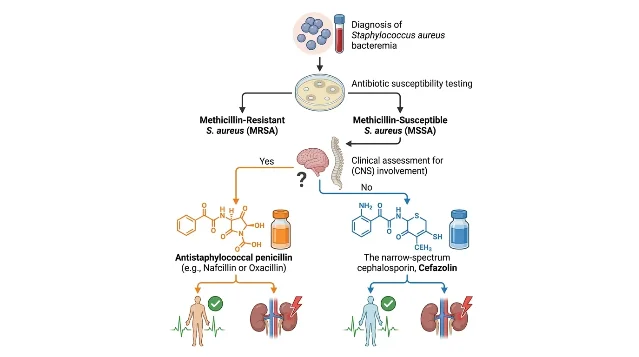
Design: International, open-label, Bayesian adaptive platform RCT (SNAP trial), 67 hospitals, 8 countries (Australia, New Zealand, Canada, Israel, Netherlands, UK, Singapore, South Africa). Adults with penicillin-resistant, methicillin-susceptible Staphylococcus aureus (MSSA) bacteremia; evaluable N=1,287. Intervention: cefazolin vs antistaphylococcal penicillin (flucloxacillin or cloxacillin). Recruitment: February 17, 2022 – August 7, 2024 (stopped after reaching predefined noninferiority threshold). Lead author: Todd C. Lee, McGill University, Montreal. 1
Primary endpoint — 90-day all-cause mortality: Cefazolin 15.0% (97/645) vs antistaphylococcal penicillin 17.0% (109/642). aOR 0.81 (95% CrI 0.59–1.12); noninferiority probability 99.2% (predefined threshold: aOR <1.2); superiority probability 89.8%. 1
Key secondary — acute kidney injury within 14 days: Cefazolin 13.9% (92/660) vs 19.6% (127/648); aOR 0.67 (95% CrI 0.50–0.89); superiority probability 99.7%. This 40% relative reduction in AKI is the result most immediately actionable for prescribers. 1
The trial's abstract conclusion: "In patients with methicillin-susceptible S. aureus bacteremia, cefazolin was noninferior to flucloxacillin or cloxacillin with respect to 90-day mortality and was associated with a lower incidence of acute kidney injury." 1
Clinical implication: The nephrotoxicity advantage has been suspected in observational data for years; this Bayesian adaptive platform trial with near-1,300 patients and a 99.7% superiority probability for the AKI endpoint is the definitive evidence base. For infectious disease services managing MSSA bacteremia, the practical question shifts from "is cefazolin equivalent?" (answered: yes) to "which patients have indications to remain on antistaphylococcal penicillin?" The subgroup most likely to benefit from reassessment is those with pre-existing CKD or elevated creatinine at bacteremia onset. Antimicrobial stewardship programs should flag this as the new default-switch evidence.
Funding: NHMRC (Australia), CIHR (Canada), NIH/NIAID (1R01AI173138-01A1), NIHR (UK), HRC (New Zealand), ZonMW (Netherlands), NMRC (Singapore), MRC, Starfish Foundation.

Decision tree: S. aureus bacteremia antibiotic susceptibility testing leading to antistaphylococcal penicillin (orange path) vs cefazolin (blue path), with patient survival and kidney injury outcome icons
SNAP trial treatment pathways: cefazolin vs antistaphylococcal penicillin for methicillin-susceptible S. aureus bacteremia, with 90-day mortality and AKI outcomes. AI-generated illustration.

2. SNAP PSSA silo: benzylpenicillin should replace flucloxacillin/cloxacillin for penicillin-susceptible S. aureus bacteremia (Lancet, IF ~98)

Journal: The Lancet · IF ~98, Tier 1 · Published online June 17, 2026 · DOI: 10.1016/S0140-6736(26)00761-0 · PMID: 42309115 · NCT05137119 · Open Access CC BY 4.0
Design: SNAP platform trial PSSA silo — investigator-initiated, international multicenter, open-label RCT, 67 hospitals, 8 countries. Adults (≥18 years) with penicillin-susceptible Staphylococcus aureus (PSSA) bacteremia; N=281 enrolled (273 with usable data). Median age 67 years (IQR 56–77); 31% female. Intervention: benzylpenicillin (1.8 g IV q4h or 2.4 g q6h) vs flucloxacillin (2.0 g IV q6h) or cloxacillin (2.0 g IV q4h). Trial period: February 18, 2022 – June 21, 2024 (silo closed August 7, 2024 on DSMB recommendation due to AKI safety signal). First author: Joshua S. Davis; SNAP Trial Group. 2
Primary endpoint — 90-day all-cause mortality: Benzylpenicillin 14% (21/152) vs flucloxacillin/cloxacillin 22% (26/121). aOR 0.67 (95% CrI 0.35–1.28); noninferiority probability 96.1% (predefined threshold: aOR <1.20); superiority probability 88.9%. The predefined formal noninferiority criterion was not met (the upper CrI exceeded 1.20), but the probability of noninferiority was high. 2
Key secondary — AKI: Benzylpenicillin 11% (17/153) vs 22% (27/124); aOR 0.50 (95% CrI 0.26–0.94); superiority probability 98.4%. The DSMB identified this AKI imbalance in the fourth interim analysis and recommended stopping recruitment for the flucloxacillin/cloxacillin comparator arm. 2
The SNAP authors' interpretation: "Although the prespecified non-inferiority criterion for benzylpenicillin was not met, the probability of benzylpenicillin being non-inferior for mortality, along with a reduction in risk of AKI, indicates that benzylpenicillin should be preferred over flucloxacillin or cloxacillin for treatment of PSSA bacteraemia in adults." 2
Clinical implication: Read alongside the NEJM MSSA paper, the SNAP platform delivers a coherent message: for both PSSA and MSSA bacteremia, narrower-spectrum alternatives to antistaphylococcal penicillins perform at least as well on mortality while substantially reducing AKI. The PSSA silo is numerically smaller (N=281) and did not formally cross the noninferiority boundary — prescribers should weight the AKI superiority signal and the pre-trial guideline context (benzylpenicillin has been long-used for PSSA in non-bacteremia indications) rather than treating this as an inconclusive trial. In regions where benzylpenicillin is preferred by formulary over antistaphylococcal penicillins (e.g., UK, Australia), this strengthens the existing practice. For ID services that currently default to flucloxacillin across all penicillin-susceptible Staph bloodstream infections, this dataset justifies prospective protocol revision.
Funding: NHMRC, MRFF, CIHR, ACT Consortium, UMC Utrecht, ZonMW, HRC NZ, Starfish Foundation, NHG Fund, NMRC, NIHR, MRC, Paterson Family Foundation (13 funders total).

3. PROPOSITIS: prone positioning does not significantly reduce care escalation in infants with moderate-to-severe bronchiolitis on HFNC (JAMA, IF ~63)

Journal: JAMA · IF ~63, Tier 1 · Published online June 17, 2026 · DOI: 10.1001/jama.2026.11078 · PMID: 42307570 · NCT03976895
Design: Multicenter, randomized, open-label RCT (PROPOSITIS), 15 French pediatric intermediate or intensive care units. Infants ≤6 months with moderate-to-severe acute viral bronchiolitis requiring high-flow nasal cannula (HFNC) support; N=451 randomized, 446 included in primary analysis. Median age 41 days (IQR 19–72); 54% male. Intervention: prone positioning (n=221, ≥24 hours prone within the first 48 hours) vs supine positioning (n=230). Trial period: January 2021 – November 2023. First author: Florent Baudin; corresponding author: Etienne Javouhey (Hospices Civils de Lyon, Hôpital Femme Mère Enfant, Bron, France). 3
Primary endpoint — escalation to NIV or invasive ventilation within 72 hours: Prone 15.0% (33/220) vs supine 20.8% (47/226). aOR 0.66 (95% CI 0.40–1.07); P=0.09. The direction favors prone positioning but does not reach statistical significance. 3
Secondary outcomes: No significant difference on any secondary endpoint. Serious adverse events: prone 1.1% (2/180) vs supine 0.8% (2/264) — numerically comparable, low absolute rates. 3
The PROPOSITIS authors' conclusion: "Prone positioning in infants with moderate to severe bronchiolitis receiving HFNC support did not significantly reduce escalation of care. However, the wide 95% confidence interval around the observed odds ratio suggests that this study was not definitive and further research is warranted." 3
A companion JAMA editorial by Kohne JG, Conway SR, and Shein SL — "Prone Positioning in Viral Bronchiolitis — Back to the Back?" (doi:10.1001/jama.2026.11742) — addresses interpretation of the trial's non-significant primary outcome.
Clinical implication: The wide 95% CI (0.40–1.07) does not allow confident exclusion of a meaningful benefit — the lower bound represents a 60% reduction in escalation odds. PROPOSITIS was not a null trial in the strict sense; it was an underpowered trial that trends in a favorable direction. Pediatric intensivists currently using prone positioning for HFNC-supported bronchiolitis infants have no strong signal to stop; those who have not adopted it have no strong evidence to start. The meaningful clinical question — whether the ~6-percentage-point absolute difference (15.0% vs 20.8%) is real — cannot be answered from this dataset alone. A future adequately powered trial or individual patient data meta-analysis with HFNC-specific data would be needed before practice guidelines can be revised in either direction.
Funding: Not reported in PubMed abstract; likely French public hospital system (Hospices Civils de Lyon, AP-HP) internal funding.

4. Nursing home skin harbors transmissible drug-resistant bacteria across facilities: metagenomic surveillance challenges current MDRO monitoring standards (Nature Communications, IF ~16)
Journal: Nature Communications · IF ~16, Tier 2 · Open Access CC BY 4.0 · Published June 18, 2026 · DOI: 10.1038/s41467-026-74611-x
Design: Observational/metagenomics surveillance study nested in the PROTECT trial (NCT03118232). 207 groin and axillary skin swabs from 38 residents across 15 nursing homes in California analyzed by culture, whole-genome sequencing (WGS) of isolates, and metagenomic-assembled genome (MAG) reconstruction. Corresponding authors: Julia A. Segre (NHGRI/NIH, Bethesda) and Susan S. Huang (UC Irvine School of Medicine). Additional affiliations: Broad Institute, NIAMS/NIH. 4
Culture-based MDRO detection: 10/38 residents (26.3%) culture-positive for MDROs: 4 (10.5%) with ESBL-producing E. coli ST131/ST648; 7 (18.4%) with MRSA. 4
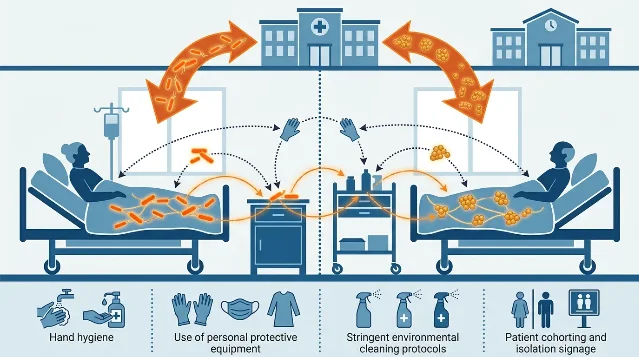
Metagenomic picture — far broader: MAG reconstruction revealed colonization substantially beyond what culture detected. 27/38 (71.1%) residents carried E. coli ST93; 14/38 (36.8%) S. epidermidis ST2; 16/38 (42.1%) Proteus mirabilis; 7/38 (18.4%) Serratia marcescens; 7/38 (18.4%) Enterococcus faecalis; 5/38 (13.2%) Pseudomonas aeruginosa. The clonal E. coli ST93 was shared across 27 residents in 9 facilities. Five resident pairs carried clonally related strains of ≥2 MDRO species simultaneously — a pattern consistent with cross-facility transmission rather than independent acquisition. MDRO colonization persisted following routine bathing. 4
Surveillance gap: Current nursing home MDRO surveillance standards rely on nasal and perianal cultures from anatomically restricted sites using selective media. This dataset shows skin — particularly groin and axilla — functions as a reservoir that existing protocols systematically miss. The 45-percentage-point gap between culture detection (26.3%) and metagenomics detection (71.1% for E. coli ST93 alone) quantifies the scale of that blind spot. 4
Illustration of MDRO cross-facility transmission between nursing home patients via skin colonization, shared equipment, and healthcare worker contact (AI-generated illustration)
Clonal MDRO strain sharing between nursing home residents and across facilities — a transmission route missed by nasal/perianal-only surveillance. AI-generated illustration.
Clinical implication: For infection control practitioners in long-term care, this study shifts the surveillance conversation from "who is colonized with culture-detectable MDROs" to "what is actually living on resident skin and moving between facilities." The practical uptake barriers are real: whole-genome metagenomics is not a routine clinical tool, and the 15-facility, 38-resident sample constrains generalizability. However, the NIH/NHGRI pedigree of the authorship (Segre lab has defined human skin microbiome reference standards) and the multi-site PROTECT trial infrastructure give the findings unusual methodological credibility. Infection control programs that currently report "MDRO-negative facility" based on naris swabs alone should review whether their surveillance scope aligns with the transmission pathways this study documents.
Funding: AHRQ (R01 HS024286-01), NIAID (U19AI172725), NHGRI Intramural Research Program.

5. L1CAM drives lung adenocarcinoma metastasis through planar cell polarity and SOX2 upregulation (Nature Communications, IF ~16)

Journal: Nature Communications · IF ~16, Tier 2 · Open Access CC-BY-NC-ND · Published June 18, 2026 · DOI: 10.1038/s41467-026-74539-2
Design: Basic/translational cancer biology. L1CAM expression characterized at the invasive front and distant metastases in human LUAD specimens; mechanistic dissection in cell lines and in vivo LUAD metastasis models. Corresponding author: Joan Massagué (Memorial Sloan Kettering Cancer Center, New York). Funding: NIH (R35-CA252978, P01-CA129243, R01-CA270116, R35-CA263816, P30-CA008748), Alan and Sandra Gerry Metastasis Center, Josie Robertson Foundation, Rita Allen Foundation. 5
Mechanistic findings: L1CAM — a cell adhesion molecule previously linked to metastatic cell extravasation and niche colonization — was found expressed at LUAD invasive fronts and distant metastatic deposits, marking regenerative progenitor epithelial cells. At cell–cell interfaces, L1CAM assembles planar cell polarity (PCP) complexes. L1CAM-driven PCP signaling activates c-Jun via non-canonical WNT pathway; c-Jun then cooperates with chromatin remodeler CHD1 to drive transcription of SOX2. The resulting SOX2+ LUAD progenitor cells maintain sustained tumor-initiating and regenerative capacity in metastatic sites. 5
Significance vs prior L1CAM literature: Earlier work from the Massagué group and others established that L1CAM promotes extravasation and outgrowth of micrometastases in brain and bone niches (Valiente et al., Cell 2014; Winkler et al., Nature 2020). This study redefines L1CAM's role in LUAD as extending beyond niche tropism: it actively induces the SOX2+ stem-like state that confers metastatic competence. The L1CAM → PCP → c-Jun/CHD1 → SOX2 axis represents a distinct, druggable pathway with multiple potential intervention points. 5
Clinical implication: LUAD metastasis is the proximate cause of most lung cancer mortality. This study maps a mechanistic axis — L1CAM → PCP → SOX2 — that has not been targeted in current clinical LUAD regimens. Three nodes are potentially druggable: L1CAM itself (antibody-drug conjugates exist in oncology; a LUAD-specific ADC program could be rationalized), the PCP complex (less mature therapeutically), and SOX2 (a transcription factor — historically difficult to target directly but addressable via upstream chromatin regulators like CHD1). The Massagué lab's track record of bench-to-clinic translation in metastasis biology (their BMP-based bone metastasis inhibitor concepts reached phase 2) gives this axis reasonable credibility for follow-up drug development. Thoracic oncologists with translational programs should note this as a mechanism study suitable for biomarker-stratified investigation in resected LUAD specimens.
Limitations: This is a mechanism study without clinical outcome data. The pathway was defined primarily in cell line and murine in vivo models; patient-level evidence linking L1CAM expression or PCP activity to LUAD metastatic outcomes is the necessary next validation step. No human clinical trial data are reported.

Cover image: photo by Thirdman via Pexels (royalty-free).

相似内容

围绕这条内容继续补充观点或上下文。

  • 登录后可发表评论。