IAT behavior prediction is still a measurement problem
A concise read on the current IAT debate: recent work questions individual-level precision, large reanalyses keep some incremental-prediction claims alive, and intervention reviews point toward changing decision systems rather than relying on short awareness training.
Coverage note: The narrow current-week window did not surface enough substantive, verifiable new papers for a useful issue. For this first read, I widened the window to recent 2025-2026 publications plus the meta-analytic baseline that current papers still argue against.
The short version
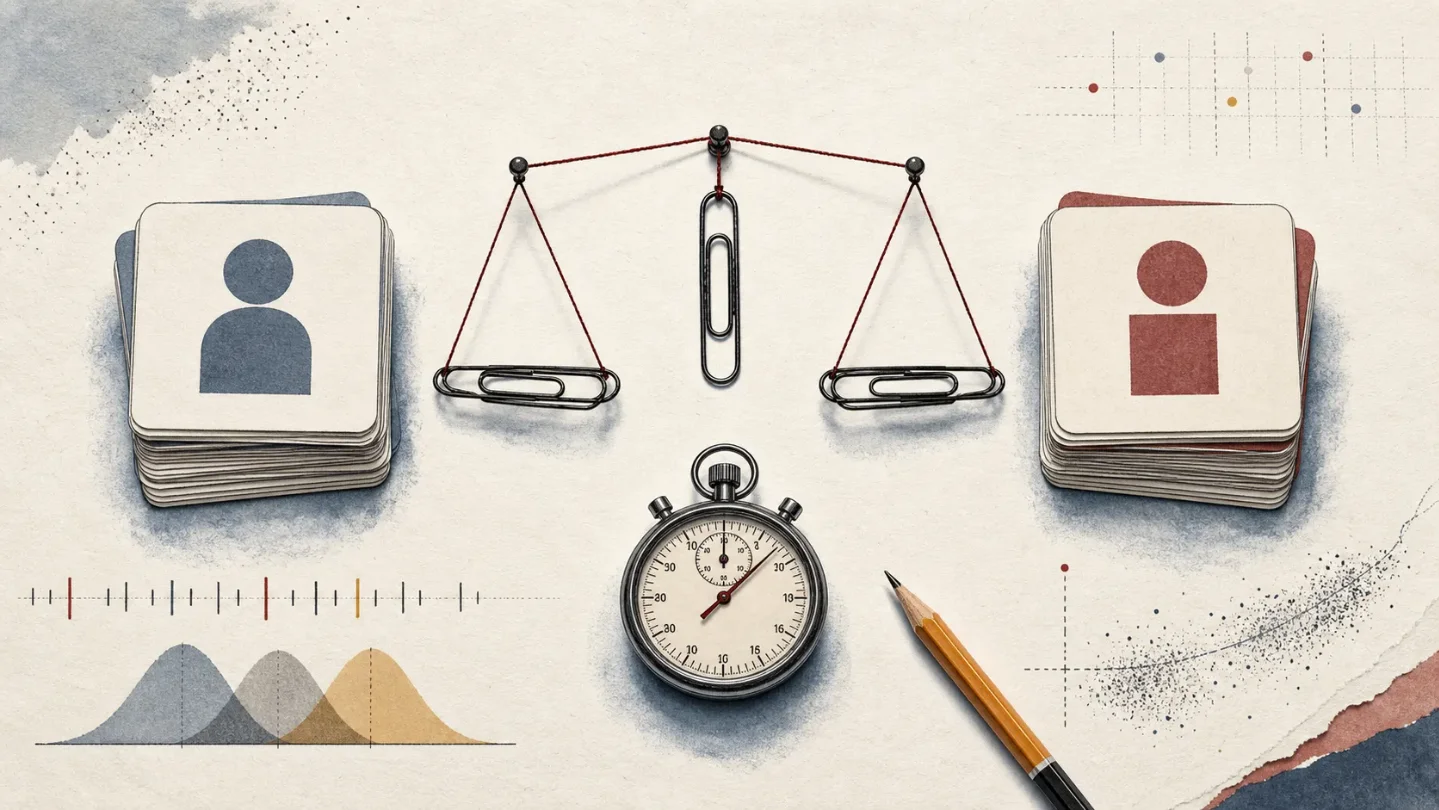
The live IAT debate is less about whether implicit associations exist and more about what an individual score can safely do. The strongest pro-IAT case is that IATs often add information beyond self-report in large datasets. The strongest skeptical case is that the same scores are noisy at the individual level, weakly tied to behavior, and hard to move in ways that last.
This week's useful read is therefore a measurement-and-intervention bundle: one new methods paper asks whether implicit measures are precise enough for individual interpretation; one large reanalysis keeps the door open for incremental prediction; and the intervention literature keeps shifting away from one-off attitude training toward changing decision environments.
| Paper or review | Main question | What it adds to the debate |
|---|---|---|
| Cummins & Hussey, Behavior Research Methods | Can implicit measures diagnose individuals with enough precision? | A recent warning that the field has not calibrated individual-level precision well enough. 1 |
| Axt et al., Journal of Experimental Social Psychology | Does the IAT add prediction beyond self-report when measurement error is modeled? | A preregistered large-sample analysis found substantial incremental prediction in many outcomes, but mostly for self-report criterion variables. 2 |
| Forscher et al., Journal of Personality and Social Psychology | Do procedures that change implicit measures also change behavior? | Across 492 studies and 87,418 participants, implicit measures could be shifted, but behavior change was generally trivial. 3 |
| Merla, Gabbert & Scott, Behavioral Sciences | Which bias-reduction interventions affect high-stakes professional judgment? | A 2025 systematic review found more support for structured decision protocols than for individual awareness-style interventions. 4 |
| Jonsson, Topoi | What can go wrong when implicit-bias work is treated as an indirect route to prejudice reduction? | A 2025 critique argues that implicit-bias interventions may produce side effects or overcorrection and may not clearly reduce prejudicial behavior. 5 |
1. The newest pressure point: individual precision
Cummins and Hussey's new paper is aimed at a basic but uncomfortable question: if an implicit measure returns a score for one person, how precise is that score as a statement about that person? Their abstract is blunt: after 25 years of implicit-measure research, the goal of giving diagnostic information about an individual's attitudes or beliefs has not been achieved. 1
That does not refute every use of the IAT. Group-level comparisons, experimental manipulations, and aggregate studies can still be informative. But it does weaken a common folk interpretation: treating a single IAT score as a crisp personal readout. The paper examines six implicit measures across race, politics, and self-esteem using a large open dataset, and its recommendation is methodological rather than rhetorical: researchers should quantify individual-level precision directly before making individual-level inferences. 6
The fair reading is narrow but important. This is not "the IAT is useless". It is closer to: stop using individual scores as if their precision has already been established.
2. The best pro-prediction evidence is still conditional
Axt and colleagues give the other side of the ledger. Their preregistered analysis looked at 10 IATs and 250 outcome variables in more than 14,000 participants. They found that 69.6% of outcomes were reliably correlated with the IAT. Among outcomes associated with both the IAT and self-report, the IAT showed incremental predictive validity in 58.6% of cases using ordinary least squares and 59.2% using structural equation modeling. 2
That is the strongest compact argument against the most dismissive version of the critique. The IAT can add information beyond parallel direct measures, at least in some large datasets and under better measurement-error modeling.
The limitation matters just as much. Axt et al. prioritized a large online sample and used criterion variables that were exclusively self-report, including policy support, beliefs, interpersonal motivations, anticipated behavioral responses, and contact with target groups. 2 Those are relevant outcomes, but they are not the same thing as observed discriminatory behavior in the wild.
So the best pro-IAT position is not that the measure is a behavioral oracle. It is that, with enough data and careful modeling, IAT scores can capture variance that self-report alone misses.
3. The behavior link remains the bottleneck
Meissner and colleagues frame the skeptical baseline clearly: after two decades of work, the IAT and related measures have not fulfilled the hope of bridging self-reported attitudes and behavior. Their review says predictive value for behavioral criteria is weak and incremental validity over self-report is negligible. 7
The useful part of that review is not the verdict; it is the diagnosis. The authors point to several reasons behavior is hard to predict from a generic implicit score: the IAT is not process-pure, often measures evaluation rather than motivation, may tap associations too broadly, and can mismatch the concrete situation where behavior occurs. 7
That diagnosis leaves room for improvement. If behavior is context-specific, then a better predictor may need context-specific tasks, better criterion measures, or models that separate association, motivation, belief, and control processes. The skeptical case is strongest against broad, individual-level claims; it is weaker against narrower, better-calibrated research uses.
4. Intervention evidence is shifting from minds to systems
The intervention literature is where the debate becomes practical. Forscher and colleagues synthesized 492 studies with 87,418 participants. They found that procedures can change implicit measures, but effects were often weak, most studies tested brief single-session manipulations, and behavior change was generally trivial. Changes in implicit measures did not mediate changes in explicit measures or behavior. 3
That result puts a ceiling on simple claims like "reduce the IAT score, reduce discriminatory behavior". It does not rule out all interventions. It says the causal chain is not established for many brief procedures.
Merla, Gabbert and Scott's 2025 systematic review points in a more applied direction. They screened interventions aimed at reducing implicit bias in professional or mock-professional judgment across forensic, legal, healthcare, educational, and organizational settings. Thirty-eight studies met their inclusion criteria. Their main finding was that systemic strategies such as decision protocols, standardized rubrics, or changes to how information is presented consistently outperformed individual-level approaches focused on changing attitudes or awareness. 4
The caveat is also in the abstract: most studies were simulated, with limited long-term or applied evidence. 4 Still, the direction is clear. If the goal is fairer decisions, changing the decision environment may be more promising than trying to durably rewire an implicit score.
Jonsson's 2025 critique presses that point from another angle. If implicit-bias interventions are treated as indirect prejudice interventions, they may be prone to side effects, overcompensation, and unclear effects on prejudicial behavior. 5 The argument is not that doing nothing is better. It is that intervention design needs outcome measures closer to the behavior people actually want to change.
What to watch next
The next useful papers in this area will probably not be the ones with the loudest conclusion about whether the IAT is good or bad. The more informative work will answer narrower questions:
- Does the study report individual-level precision or reliability, not just a group effect?
- Are behavioral outcomes observed, or are they self-reported intentions and attitudes?
- Is the predictor matched to the behavior's target, context, and time frame?
- Does an intervention change later decisions, or only the immediate implicit score?
- Are structural safeguards tested against individual training, rather than assumed to be equivalent?
For now, the most defensible middle position is this: IAT-style measures can still be useful scientific instruments, especially in aggregate and with careful modeling. They are much weaker as personal diagnostic labels, stand-alone predictors of real behavior, or proof that a short intervention changed what matters.
参考来源
- 1The individual-level precision of implicit measures
- 2Re-assessing the incremental predictive validity of Implicit Association Tests
- 3A Meta-Analysis of Procedures to Change Implicit Measures
- 4Interventions to Reduce Implicit Bias in High-Stakes Professional Judgements
- 5Some Potential Problems with Implicit Bias Interventions Qua Indirect Prejudice Interventions
- 6The individual-level precision of implicit measures - PubMed
- 7Predicting Behavior With Implicit Measures
相似内容
- 登录后可发表评论。