2026/6/25 · 10:25
Sydney Opera House — how an unbuildable sketch forced structural engineering into the digital age
Jørn Utzon won the 1957 Sydney Opera House competition with ink sketches that had no structural geometry. What followed was sixteen years of engineering under impossible conditions: 12 failed shell geometry iterations before the spherical solution, 2,194 precast concrete segments held by 350 km of tensioned cable, the first computer-designed building of significant scale, and pioneering epoxy jointing that now defines global bridge construction. The building opened a decade late and 1,357% over budget — and, as a 2024 Arup lecture by Fellow Tristram Carfrae confirmed, it produced nine engineering firsts that remain foundations of structural engineering practice today.
In January 1957, Eero Saarinen pulled a set of drawings out of a rejected pile and declared them the winner of an international competition that had attracted 233 entries from 32 countries. The drawings were beautiful — ink sketches evoking bird wings and billowing sails — but they had no structural geometry whatsoever. The shells had no defined curvature. No material specifications. No connections to the podium. The technical judging panel had already dismissed them. 1
Saarinen's insistence was either visionary or reckless, depending on your vantage point. The architect behind those drawings, Jørn Utzon, was 38 years old, Danish, and had won seven competitions without seeing a single design built. 2 The prize money was £5,000 Australian. The jury's assessors report conceded the obvious: "The drawings submitted for this scheme are simple to the point of being diagrammatic." Then it added: "we are convinced that they present a concept of an Opera House which is capable of becoming one of the great buildings of the world." 1
What followed was sixteen years of structural engineering under conditions that should have been impossible — conditions created in equal measure by the site, the geometry, the politics, and the technology of the era. The building that opened in October 1973 was 1,357% over its original budget and a decade late. It also happened to be the first computer-designed building of significant scale in the world, the first to use epoxy jointing of matched precast concrete segments at scale, and the direct ancestor of the software tools that every structural engineer uses today. 3
The Arup Fellow Tristram Carfrae, who presented a systematic reappraisal of the project in October 2024, identified nine engineering firsts in the Sydney Opera House. "Over the course of its 16 years of design and construction," Peter Debney of the Institution of Structural Engineers wrote that same year, "the SOH pushed structural analysis into the digital age, pioneering techniques and technologies that are now commonplace." 4
An impossible brief on an impossible site
The competition brief called for a large hall seating 3,000 and a small hall for 1,200, to be used for opera, orchestral concerts, ballet, mass meetings, and lectures. The site was Bennelong Point on Sydney Harbour — a peninsular tram depot known to the Gadigal people as Tubowgule, with water on three sides. 1
The site was chosen partly for its symbolic value (the peninsula extends into the harbour, making the building visible from the water and the bridge) and partly because it was surplus government land. From an engineering standpoint, it was an awkward choice: a narrow promontory that would need to be significantly extended and reinforced before it could carry the loads a major performing arts complex would impose. The ground survey that followed the competition win confirmed the concern: Bennelong Point was "neither big enough nor strong enough" to carry the structure. 2
The original cost estimate, made in 1957, was A£3.5 million (roughly A$7 million). The original opening date was Australia Day, 26 January 1963. Both figures were, to put it mildly, wrong. 1
What actually broke the schedule before a single shell was poured was political pressure. Premier Joseph Cahill, worried that public opinion or future governments might kill the project, pushed for construction to begin in March 1959 — before Utzon had resolved the structural design and before the major engineering challenges had been identified, let alone solved. Ove Arup & Partners had only been engaged to work out the structural system eight months earlier, in January 1958. 5
The result was a critical construction failure built into the foundations. Stage I — the podium — was constructed by Civil & Civic under Arup supervision starting in 1959, using 588 concrete piers sunk as much as 25 metres below sea level into Bennelong Point. 1 By 23 January 1961, work was already 47 weeks behind schedule due to bad weather, stormwater diversion problems, and the root cause: construction had begun before proper drawings existed. By the time the structural requirements for the roof shells had been resolved, the podium columns already in place turned out to be too weak to carry them. The columns had to be demolished and rebuilt. The podium — which was originally supposed to house the entire completed Opera House by February 1963 — was not finished until February 1963. Stage I had become the full timeline. 6
As Arup engineer Sir Jack Zunz recalled later: "If you went into a taxi, you got an earful of all the money that was being wasted." 2
The six-year shell geometry crisis
The core engineering problem at Sydney was not the foundations. It was the shells.
Utzon's sketches showed curved sail-like roof forms rising from a low podium platform. They were drawn to evoke a mood, not to describe a structure. As a sketch, they were compelling. As a structural concept, they were, in Tristram Carfrae's direct phrasing from the 2024 Arup lecture, something "this form does not work as a concrete shell." 7
The reason requires a brief digression into shell mechanics. A true thin shell — like an egg or a dome — works by carrying loads purely through in-plane compression and tension, with bending moments close to zero. The geometry has to be right: a hemisphere, a paraboloid, a catenary. Utzon's free-form shapes, with their irregular double curvatures and complex loading from wind and self-weight, would develop very large bending moments in any conceivable thin concrete shell. The reinforcement required to resist those bending moments would be enormous. The formwork to cast the shells would need to be entirely custom for each section, since no two pieces had the same geometry. Constructing each section in-situ would be prohibitively expensive; precast panels for each individual section would be even more so. Jack Zunz put it plainly at the time: "None of these shapes appeared buildable." 2
Between 1957 and 1963, Ove Arup & Partners worked through at least twelve distinct iterations of the shell geometry. The sequence included parabolas, circular ribs, and ellipsoids — each promising on paper, each failing under more detailed analysis. The iterations were iterative in the full modern sense: each geometry was analyzed structurally, found to require unacceptable material quantities or untestable formwork, modified, and re-analyzed. The problem was that in the late 1950s, computing power was nascent. Structural analysis meant hand calculations. A single complex frame might take months to analyze. 1 5
The breakthrough came in mid-1961, and it was elegant enough to feel almost obvious in retrospect. Utzon was working in his office in Hellebæk, Denmark, stacking scale models of the shell shapes. He noticed they looked similar to each other. The realization that followed was the insight the whole project had been waiting for: if all the shells were derived from the surface of a single sphere of common radius, then arches of varying length could all be cut from that sphere, and segments of common length placed adjacent to each other would automatically form the correct spherical section. 5
The sphere chosen had a radius of 75.2 metres (246 ft 8.6 in). Every shell in the final design is a section of that sphere. 1 As Ove Arup wrote afterward: "Utzon came up with an idea of making all the shells of uniform curvature throughout in both directions." 1
The credit for this breakthrough has been disputed ever since. Utzon and his supporters remember a specific eureka moment in Denmark. Arup's engineers — including Ronald Jenkins, who ran the mathematical analysis — and Arup biographer Peter Jones note that "the existing evidence shows that Arup's canvassed several possibilities for the geometry of the shells, from parabolas to ellipsoids and spheres." The truth appears to involve multiple people converging on the spherical solution through a process of intense collaboration. Whatever the precise credit allocation, the practical consequence was clear: the spherical solution made the shells buildable. In January 1962, Utzon submitted the "Yellow Book" — 38 pages of plans, sections and elevations detailing the spherical geometry, the precast concrete rib system, and the ceramic tile cladding. 1
2,194 segments: the precast rib system
The spherical geometry solved the uniqueness problem. Because every arch segment could be cut from the same sphere, standard moulds could produce identical components that, when assembled, traced the correct curved surface. This unlocked a manufacturing approach that had never been tried at this scale: a purpose-built on-site precast factory that would manufacture every structural component and deliver it directly to the erection sequence. 3
The contractor for Stage II (shells) was M.R. Hornibrook — a Queensland-based company whose primary expertise was bridge construction. This background mattered. Hornibrook's bridge engineers understood precast segmental construction, temporary erection systems, and the management of precise tolerances over large spans. They brought all three to Sydney.
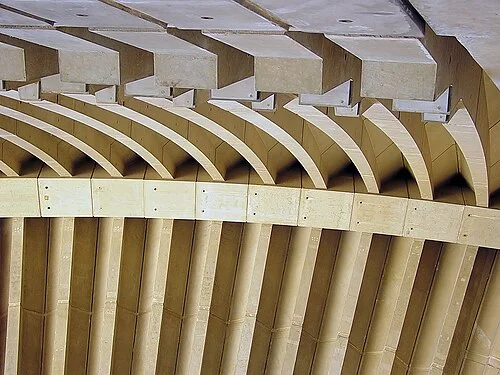
The on-site factory at Bennelong Point produced 2,400 precast ribs and 4,000 roof panels. Each precast rib segment was approximately 4.5 metres long and 0.5–2 metres wide, with a dense concrete mix at 24 kN/m³ (155 pcf). Individual segments weighed up to 15 tonnes. Shells contained up to 17 ribs each; the shortest ribs used 4 segments, the longest 13. Steel-framed plywood formwork was designed for approximately 40 reuses — an economic necessity given the volume required. 3
The assembly process was sophisticated. Once arch segments were positioned, epoxy resin was used to join them — the first large-scale application of epoxy jointing of matched concrete segments anywhere in the world. The segments were then post-tensioned using steel cables threaded through ducts cast into the segments. Total cable in the structure: 350 kilometres. The stressing and de-stressing operations required were estimated at 14–15 times the complexity of a major bridge. The complete roof structure weighs approximately 22,000 tonnes of precast concrete. 8
To erect each shell, Hornibrook engineer Joe Bertony developed a purpose-built adjustable steel-trussed erection arch — a temporary support structure that held the rib segments in their correct spherical position during assembly. Eight erection arches were used (four north, four south), each adjustable to advance rib by rib as the shell grew. The engineering history of the erection arch was itself significant: Bertony's calculations for this support system alone required 30,000 individual calculations. The device was so specific to this project that, as EPFL professor Paolo Tombesi noted in 2024 research that won the NSW Heritage Award, "The firm developed innovative new tools like a telescoping arch that would be in a museum today if it hadn't been destroyed." 9
Tombesi's research deserves emphasis: his team discovered previously overlooked construction shop drawings in the Australian National Archives, revealing that Hornibrook's contribution — including the erection arch — had been almost entirely unrecorded in the roughly 20 books previously written about the Opera House. The architectural and engineering narrative had crowded out the contractor. Tombesi's conclusion: "Our discovery is important because it lets us piece together the Opera House's history using a rigorous approach based on shop drawings that long sat forgotten in the archives." 9
The computer's role in all this was unprecedented for its era. The Sydney Opera House was the first building of significant scale to be designed with computer-aided structural analysis. The most complex structural framework analyzed had 136 joints and took the computer nearly four hours to analyze just five load cases; preparing the input data took almost three weeks. Ove Arup estimated the computer had saved nearly ten years of human calculation work. During shell erection, the computer was used daily: surveyors measured arch pin positions at the end of each day, fed the data overnight, and received the next arch's correct position by morning — a feedback loop Tristram Carfrae, in his 2024 lecture, specifically cited as something "60 years later, performing exactly the same process that was invented on the Sydney Opera House." He was referring to his own current work on the Sagrada Família. 7
The roof was tested before construction began. Scale models were placed in wind tunnels at the University of Southampton and the National Physical Laboratory in the UK to establish wind-pressure distributions — critical for designing both the structural connections and the ceramic tile fixing system. 1
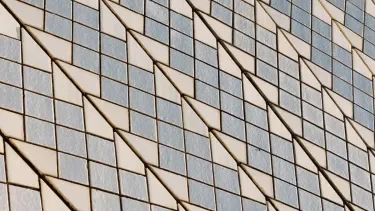
The spherical geometry also solved the cladding problem. Because all tiles sat on spherical surfaces, it became possible to prefabricate the 1,056,006 ceramic tiles into chevron-shaped panels on the ground, rather than fixing them individually at height on a complex curved surface. The tiles themselves — 120 mm square, glazed white and matte cream — were manufactured by Höganäs of Sweden after three years of development to achieve Utzon's required optical effect. The finish wasn't pure white: it included a matte cream variant arranged in the chevron pattern so the shells shift tone as the light angle changes. 1
The political implosion
In May 1965, the New South Wales Liberal-Country coalition under Robert Askin won the state election. The new Minister for Public Works was Davis Hughes, who had been a vocal critic of the project before taking office. 1
By late 1965, Stage III — the interiors — required A$60,000 to build plywood beam prototypes for Utzon's planned ceiling and glass wall system. Utzon's interior concept used repeating plywood components: a modular system based on the same geometric discipline as the shells, with plywood mullions forming the glass curtain walls and acoustic treatments developed by German acoustic engineer Lothar Cremer. Arup's engineers, more accustomed to steel, were skeptical of the plywood scheme. Hughes cited an adverse Arup report and refused to release the funds.
By February 1966, Utzon was owed more than A$100,000 in outstanding fees. On 28 February 1966, he met Hughes at his Bridge Street office and requested A$51,626 in unpaid fees and the prototype funding. Hughes refused. The meeting lasted fifteen minutes. When Utzon threatened to resign, Hughes replied: "You are always threatening to quit." Hours later, Utzon's resignation letter arrived by hand. He left Australia on 28 April 1966. He never returned. 10
Three thousand people signed a petition demanding his reinstatement. A thousand marched on State Parliament. It made no difference.
Peter Hall was appointed design architect. Hall redesigned both major halls: the main hall became a purely dedicated Concert Hall (abandoning the original dual opera/concert function), and the minor hall became the Opera Theatre (now the Joan Sutherland Theatre). Utzon's plywood mullion system was replaced with a different glass wall arrangement. His acoustic treatment — designed by Cremer for a 2,000-seat hall — was scrapped. The replacement Concert Hall seats 2,679, and the acoustic consequences of a larger space under very high vaulted shells were not fully addressed before opening. The roof creates a significant lack of early on-stage reflections; Perspex "acoustic cloud" rings were added above the stage just before opening and were widely described as unsuccessful. 1
The already-installed stage machinery in the major hall was demolished and thrown away. Utzon, who had designed one of the world's most sophisticated stage systems, declined the invitation to the 1973 opening. He wrote to Premier Askin that he could not "see anything positive" in the interior work and could not avoid making very negative statements. 2
The political implosion had a precise engineering cost: A$56.5 million of the total A$102 million was spent on Stage III interiors, by far the most expensive stage, largely because Hall was rebuilding from decisions rather than completing a coherent design. Stage II (the structurally complex shells) cost A$12.5 million. Stage I (the podium) cost A$5.5 million. The cost ratio tells the story: the engineering achievement was cheaper than the political aftermath. 1
Technical specifications
正在加载统计卡片…
| Stage | Contractor | Dates | Cost (A$M) | Key work |
|---|---|---|---|---|
| I — Podium | Civil & Civic | 1959–1963 | 5.5 | 588 piers to 25 m depth; podium rebuilt |
| II — Shells | M.R. Hornibrook | 1963–1967 | 12.5 | 2,194 precast segments; 350 km cable; erection arch |
| III — Interiors | M.R. Hornibrook | 1967–1973 | 56.5 | Hall reconfiguration; glass walls; acoustics |
| Equipment & organ | — | — | 9.0 | Stage machinery; Grand Organ |
| Fees & other costs | — | — | 16.5 | Design, project management |
| Total | 102 | 1 |
The six venues and their seating capacities: Concert Hall 2,679; Joan Sutherland Theatre (Opera Theatre) 1,507; Drama Theatre 544; Playhouse 398; Studio 280–400; Utzon Room 210. 1
The glass curtain walls — the largest laminated glass installation in the world at the time of construction — used a system where each of hundreds of glass panels was cut to a unique size and shape to fit the curved steel framing. The design work for the glass system led Arup engineer John Hooper to develop fundamental research into laminated glass structural behaviour: he determined that under long-term loads, the two glass panes in a laminated assembly act independently (the PVB interlayer creeps over time); under short-term wind loads, they act compositely. Those findings, as Carfrae noted in 2024, remain the basis of international laminated glass design codes today. 7
The air conditioning system used Sydney Harbour seawater in a water-cooled heat pump — the largest seawater heat pump of its kind at the time, supplying over 600,000 cubic feet per minute. It still operates today. The building has a 250–300 year design life and has been carbon neutral since 2018, with a 6-Star Green Star performance rating since 2023. 11
Nine engineering firsts: the 2024 reappraisal
In October 2024, Arup Fellow Tristram Carfrae — currently leading the structural design of the Sagrada Família towers in Barcelona, where he uses techniques developed at Sydney — gave a 1-hour 24-minute lecture at Arup's Charlotte Street offices in London. The lecture, co-presented with Peter Murray OBE (author of The Saga of the Sydney Opera House), was the most systematic technical reappraisal of the project since the building opened. 7
Carfrae enumerated nine engineering firsts. They are worth listing in full, because each one either founded a technique that is now standard or solved a problem nobody had previously tackled at scale:
- Integrated architect-engineer-contractor design — Utzon, Arup, and Hornibrook worked simultaneously, not in the traditional sequential handoff. Hornibrook developed the erection arch before the main construction contract was even signed.
- Digital computers for structural analysis — Peter Rice (then a young Arup engineer, later one of the most influential structural engineers of the 20th century) wrote programs for the Pegasus computer, splitting the analysis across two programs because the machine's memory was insufficient to run a single unified analysis.
- Modern methods of construction (precast segmental) — factory manufacture of complex-geometry precast components, assembled from common moulds using positional data computed overnight.
- Early contractor involvement — Hornibrook's team proposed the erection arch before contract award. This is now standard practice on complex infrastructure projects.
- Glued segmental post-tensioned concrete — epoxy jointing of matched precast concrete segments had never been used at any scale. It is now ubiquitous in long-span bridge construction globally.
- Large-scale prefabricated ceramic tile cladding — the chevron panel system, enabled by the spherical geometry.
- Laminated glass curtain walls at unprecedented scale — and the design code research that followed.
- New materials at construction scale — PVB interlayers, epoxy resins, and structural adhesives used in a building for the first time in the early 1960s.
- Building for longevity through quality — the 250–300 year design life was not accidental; it was an explicit specification driven by Utzon's insistence on material quality throughout.
The institutional legacy of the computer work is direct and traceable. Oasys — the software subsidiary of Arup — was founded in 1976, three years after the Opera House opened. It was created specifically to commercialize the structural analysis programs Arup had developed for the project. Its flagship product GSA (General Structural Analysis) descends directly from Peter Rice's Pegasus programs. In 2023, GSA was integrated with Grasshopper 3D for parametric design workflows. As Peter Debney wrote in the August 2024 IStructE case study: "It's still going strong, producing engineering programs that started with the SOH over sixty years ago." 4
Murray's contribution at the 2024 lecture added a piece of institutional history that the engineering record had missed entirely: Arup's complete archive on the Sydney Opera House was locked away for thirty years, from 1973 until approximately 2003. It was stored behind the desk of engineer Turlo O'Brien. The archive came to light only because Jack Zunz — Arup's project director — became angry at what he saw as a one-sided account in the 2000 film Edge of the Possible, which treated the shell geometry breakthrough as primarily Utzon's personal eureka. Zunz contacted Murray at the opening of the British Museum Great Court (also designed with structural systems descended from the Opera House work), and Murray subsequently recovered and used the archive to write the authoritative construction history. 7
正在加载内容卡片…
Legacy: still running at 60, with one unresolved problem
The structural legacy of the Sydney Opera House is measurable and ongoing.
Carfrae's current work on the Sagrada Família uses an identical technical workflow to the one Rice developed for the Opera House: stone blocks cut by computer, post-tensioned with stainless steel rods, bonded with mortar, and lifted into position as complete units. His phrasing at the 2024 lecture: "60 years later, performing exactly the same process that was invented on the Sydney Opera House." The Sagrada Família's entire construction cost is funded by visitor ticket revenue — Carfrae drew the explicit parallel to the Opera House, which he described as completing "its first public performance" during its own construction, with Sydney Harbour residents watching the shell erection progress daily from the bridge. 7
A 2019 finite element study published in Buildings (MDPI), using Strand7 software, analyzed the long-term structural behaviour of the post-tensioned concrete ribs. The headline finding was reassuring: by 2050, the shells are predicted to experience 0.090% element strain from creep and shrinkage, with prestress losses of 32.59 kN per strand — only marginally more than the 0.088% strain and 32.12 kN losses already accumulated in the 50 years since construction. The majority of the structural settling has already happened. The paper recommended shifting conservation focus from major structural interventions toward "inspection and maintenance of minor issues of surface cracking and water ingress." 12
That maintenance is substantial in volume. The Sydney Opera House Trust's 2024–25 annual report recorded 95,185 maintenance work orders in the financial year — up from 84,100 the prior year and 67,671 the year before. Of these, 64,320 were planned preventive maintenance tasks. For the first time in the building's history, the traditional Good Friday full-shutdown maintenance day was replaced by targeted preventive maintenance that allowed the building to remain operational. A new round of 10-year contracts for building structure, HVAC, electrical services, plumbing, and vertical transportation was going to tender in FY26. 11
WJE (Wiss, Janney, Elstner Associates) conducted a detailed concrete shell inspection and maintenance program, extracting small-diameter cores from the roof shells, treating them with 100% solid silane sealant, and subjecting samples to accelerated weathering and saltwater immersion to measure chloride penetration. The conclusion: the silane sealant penetrated sufficiently in both weathered and unweathered concrete states and was recommended for application to all exposed precast ribs. 13
The acoustic problem, however, was never fixed. The Concert Hall's 2,679-seat configuration — imposed by Peter Hall's 1966 redesign — operates under a roof whose very high vault reduces early on-stage reflections. Musicians performing on stage hear too little of their own ensemble sound; audience members in the upper tiers hear a different acoustic experience from those in the stalls. The Perspex clouds added before opening remain. Utzon's original acoustic brief, designed for 2,000 seats, was correct for the hall's geometry. Hall's expansion to 2,679 was not. The building that is celebrated as an architectural masterpiece has, at its core, a performing arts space that has never fully worked acoustically.
Jørn Utzon received the Pritzker Prize in 2003 — architecture's highest award — with a citation that named the Opera House "his masterpiece." He died in 2008, having never returned to Australia and having never seen the completed building from the outside. Reconciliation with the Sydney Opera House Trust began in 1999; he designed the Utzon Room (opened 2004), the only interior space rebuilt to his vision. 1
In 2022, the building received the Engineering Heritage International Marker from Engineers Australia and the American Society of Civil Engineers, formally recognizing the engineering innovations it pioneered. UNESCO inscribed it as a World Heritage Site in 2007 under criterion (i): "a masterpiece of human creative genius." 3
Frank Gehry — whose own deconstructivist work would have been impossible without the computational and structural techniques developed at Bennelong Point — put it simply: "A building that changed the image of an entire country." 14
The deeper engineering lesson isn't in the shells. It's in the sequence: an unbuildable sketch required a solution that didn't exist; finding that solution required computing power that didn't yet exist in engineering practice; deploying that computing power created the tools that every structural engineer uses today. The Sydney Opera House cost A$102 million and ten years of political chaos to build. What it produced — as a side effect of its own construction — was the infrastructure of modern structural analysis.
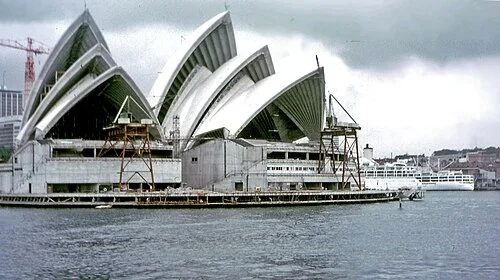
Cover image: Sydney Opera House under construction, c. 1968, showing completed tile cladding on the shells with erection scaffolding visible. Public domain via Wikimedia Commons.
参考来源
- 1Wikipedia: Sydney Opera House
- 2BBC Culture: The tumultuous history of the Sydney Opera House
- 3Engineering Heritage Australia: Sydney Opera House
- 4Oasys: Celebrating 50 years of software development
- 5SOH Official: The spherical solution
- 6Designing Buildings Wiki: Sydney Opera House
- 7Arup: Why was Sydney Opera House so far ahead of its time?
- 8Medium/Civils.ai: The Sydney Opera House and Its Billowing Sails
- 9EPFL: Sydney Opera House is still revealing its secrets
- 10SOH Official: Utzon departs the House
- 11Sydney Opera House Trust: 2024–25 Annual Report
- 12Semantic Scholar: Numerical Analysis of the Creep and Shrinkage Experienced in the Sydney Opera House
- 13WJE: Sydney Opera House — Concrete Roof Shell Inspection, Restoration, and Maintenance
- 14ICE: Sydney Opera House
相似内容
Sydney Opera House: How a Mathematical Breakthrough Turned an 'Impossible' Roof into an Icon
Built to Last视频
Guggenheim Bilbao: How Frank Gehry Used Aerospace Software to Build a Titanium Museum That Saved a City
Built to Last视频
Burj Al Arab: How Dubai Drove 9,000 Piles Into the Seabed to Build a Sail-Shaped Hotel on a Man-Made Island
Built to Last视频
围绕这条内容继续补充观点或上下文。